Eyeglass-brick project: a narrative inquiry.
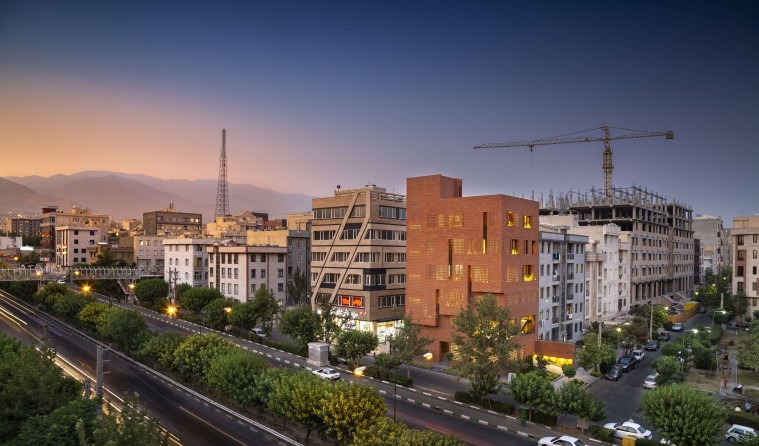
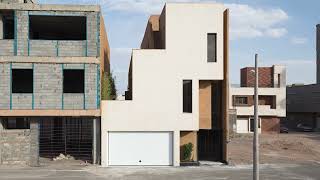
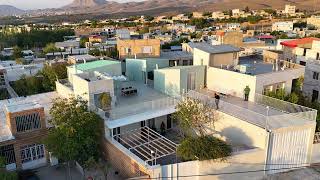
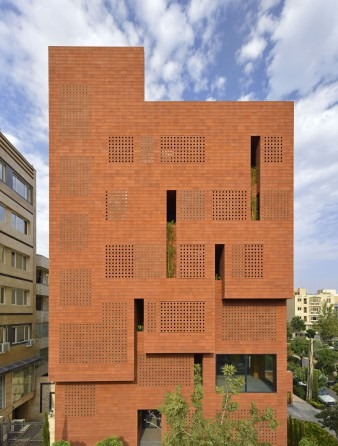
Can the grain of a building bring about a strategic shift in the urban appearance? The site of this single grain stands in a position where both the urban scale and the neighbourhood scale exist simultaneously. The intent here was to create a neutral structure at the urban scale and a legible expression at the local scale, with a pattern capable of working simultaneously at the relative distance and scale of both neighbourhood and city.
The project's story began with the design of the central office of a brick factory on the basis of an existing skeleton. Arriving at a method for redefining the resolution of the city through the tools available to the brick factory became the design objective.
Redefining the building's dualities starts from the city: complex and simple, changeable or fixed, extroverted or introverted, looking outward and looking inward, closed or open — all of these dualities can be defined simultaneously rather than being pinned to a definitive zero-or-one decision. The project therefore tried not to settle the decision between the dualities at any one fixed point, and instead to shift continuously between two opposite concepts along a spectrum.
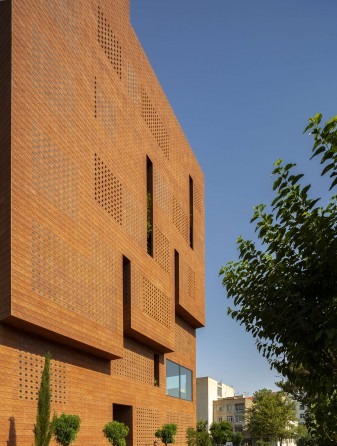
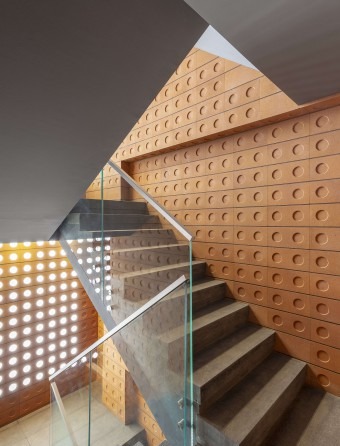
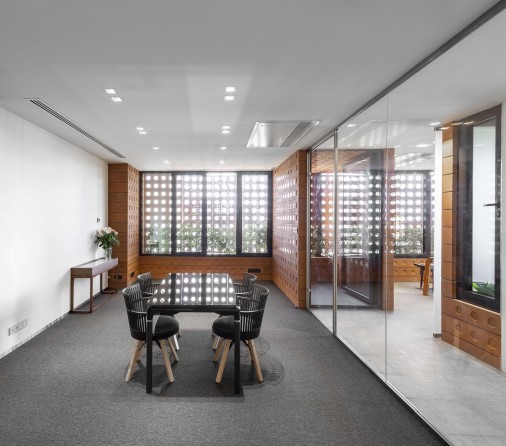
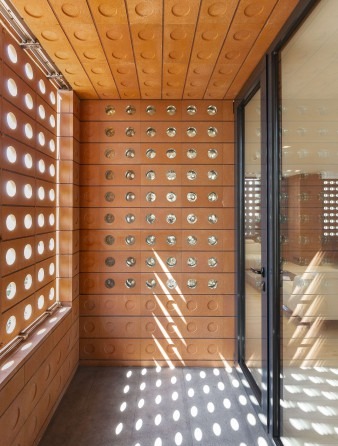
In answer to the questions posed in the project, a cellular being was made that differed structurally from its previous generation. The name of this being was the eyeglass brick. It carried a transparent element within itself, and at the same time delivered structure, finish and insulation. It was no longer rigid; it could see the city from within itself — yet even that role was not enough for it.
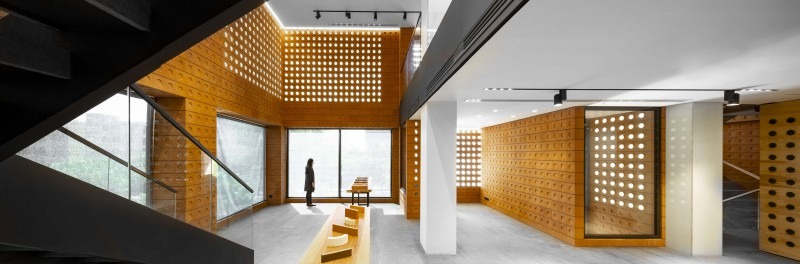
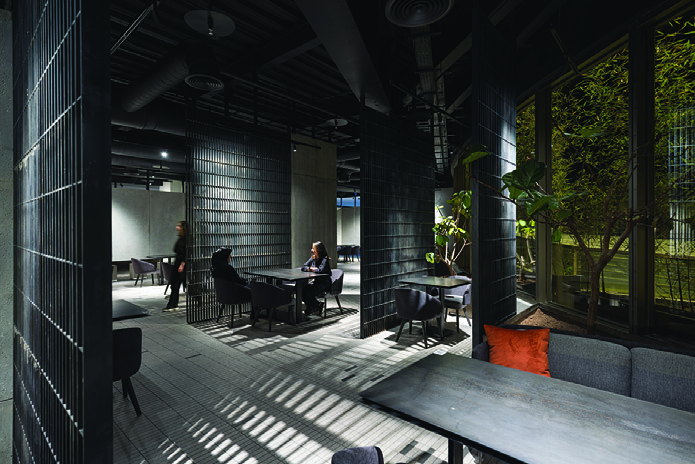
It was no longer merely a wall, it was a window. It was no longer merely a skin: it also organised the interior from the outside in. It did not always behave the same way within the building — it could open and close. It brought natural light into the space in a mysterious manner that held the reading of the space in a suspended state. At times it also provided artificial light to the space. It made the building introverted at one moment and extroverted at another. Very strictly, it allows no one but itself into the building, and although it remains firmly bound to its own geometry, it has caused the interior walls to take their meaning from the outside, and the outer and inner faces to keep swapping their positions.
Permeability is the eyeglass brick's favourite word, for by penetrating from outside to inside, defining the internal divisions of the spaces, and placing greenery in the parts where it has penetrated, it has redefined the boundary between inside and outside. Through its semi-transparent nature and the word (permeability) it constantly seeks to reconcile the relationship between inside and outside.
The eyeglass brick has caused the project, instead of choosing white or black between its various dualities, to form a broader grey spectrum in which the meaning of elements shifts. Dualities such as single-skin into double-skin, the conversion of the outer face into the inner face, the shift of an introverted quality by day to an extroverted quality by night, rigid and semi-transparent faces — the intertwining of dualities has produced a suspension in choice, on which the eyeglass brick itself strongly insists.