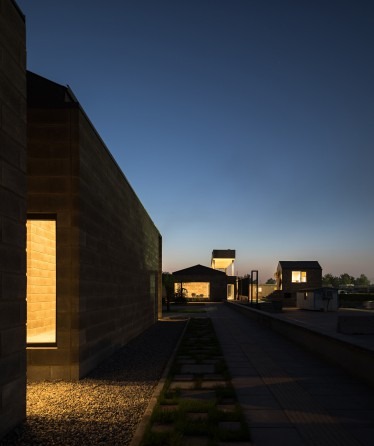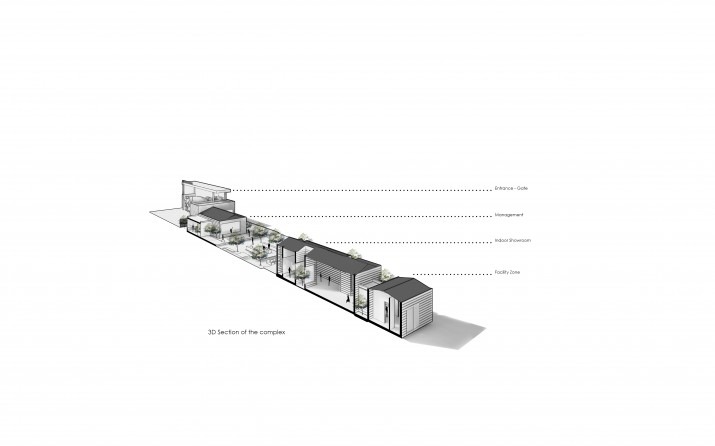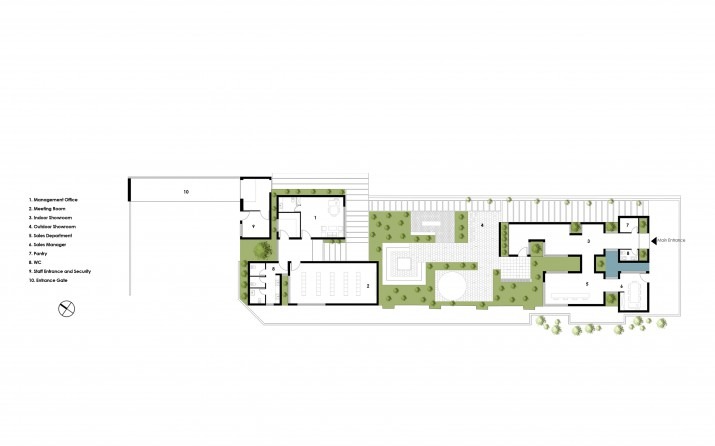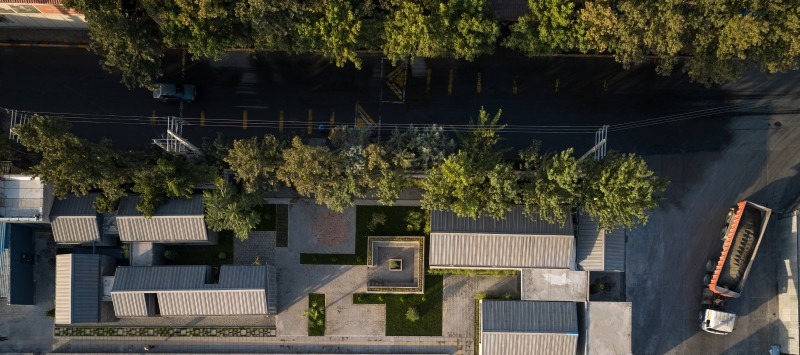
The brief began as an open-air and interior exhibition together with office buildings, on an industrial site producing concrete and concrete block. The project sits within the Aptus factory, on the periphery of Karaj.
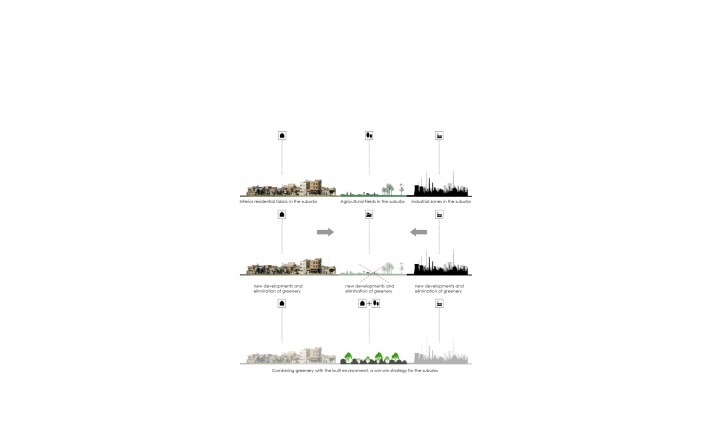
The conceptual question of the project starts where development at the urban edge — industrial zones, agricultural land and low-quality residential fabric — is locked in a tight, contested race, each trying to overtake the other, and where the race usually ends in favour of the low-quality residential fabric.
Under these conditions, the green pockets caught within the dense, low-quality construction are usually wiped out. Most of the time the losers on this field are the green spaces and the farmland.
The question we set ourselves grew out of this: how can a pattern be devised that creates a win-win flow for both sides — green space and built space?
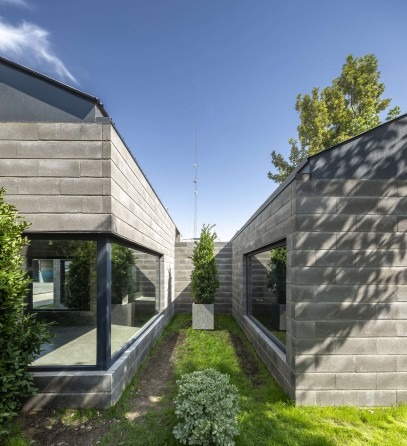
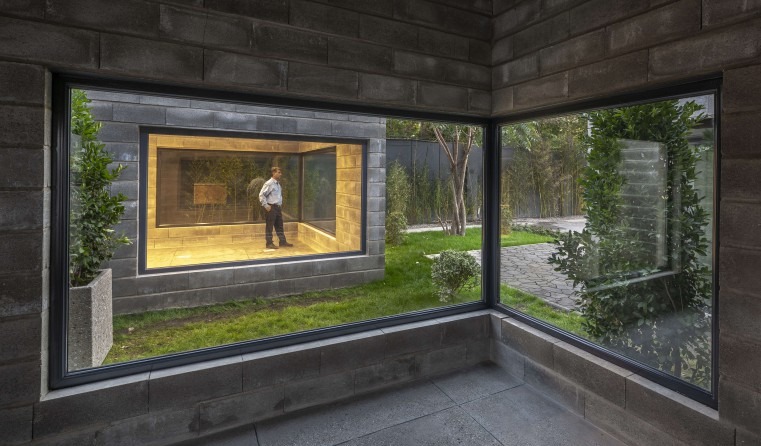
The next issue with peripheral construction is finding a low-cost model that keeps pace with contemporary quality of build. This problem, together with the need to introduce the factory's own products, produced the project's material idea — an attempt to eliminate interior and exterior finishes altogether. The factory's cement blocks have been used to build the entire interior and exterior system of the project.
The use of a single material within the patterns of peripheral fabric is another strategy that can act effectively on the quality of this kind of construction.
The massing strategy, set on top of the initial question, looks for a way to shape exterior, interior and landscape at once. In this strategy, rather than function being placed on the land as one large box with green or outdoor space formed apart from it, each space is given an independent character. Each spatial box, sized to its functional definition, is read as a separate volume; the empty space between these spatial boxes generates the green space that ties back to the interior. A layered connection between the spaces was the theme developed in the project. The simultaneous experience of inside and outside arises through intersections of transparent layers. Reducing the materials to a single substance heightens the possibility of grasping and connecting with the exterior; and the shifting daylight gives this quality its own variations, readable across the different layers of each space.
Projects of this kind become a pretext for thinking through a pattern for peripheral, low-cost fabric.
The neighbourhood of this factory with a handful of traditional cement-block workshops, alongside the new exhibition, all became a reason for setting out a pattern for this segment of the peripheral population — so that, perhaps, an alternative pattern can grow: one of green space and living space together, with the leanest materials and a low-cost build through the elimination of finish work in such regions.