The project responds to the growing role of communications in today's world, and the part the media play in carrying that responsibility. The theoretical basis of the thesis sets out the vocabulary of communication and its consequences — the encounter between cultures and the dialogue of civilisations — and, within the broader field of media, singles out radio because of its distinct qualities.
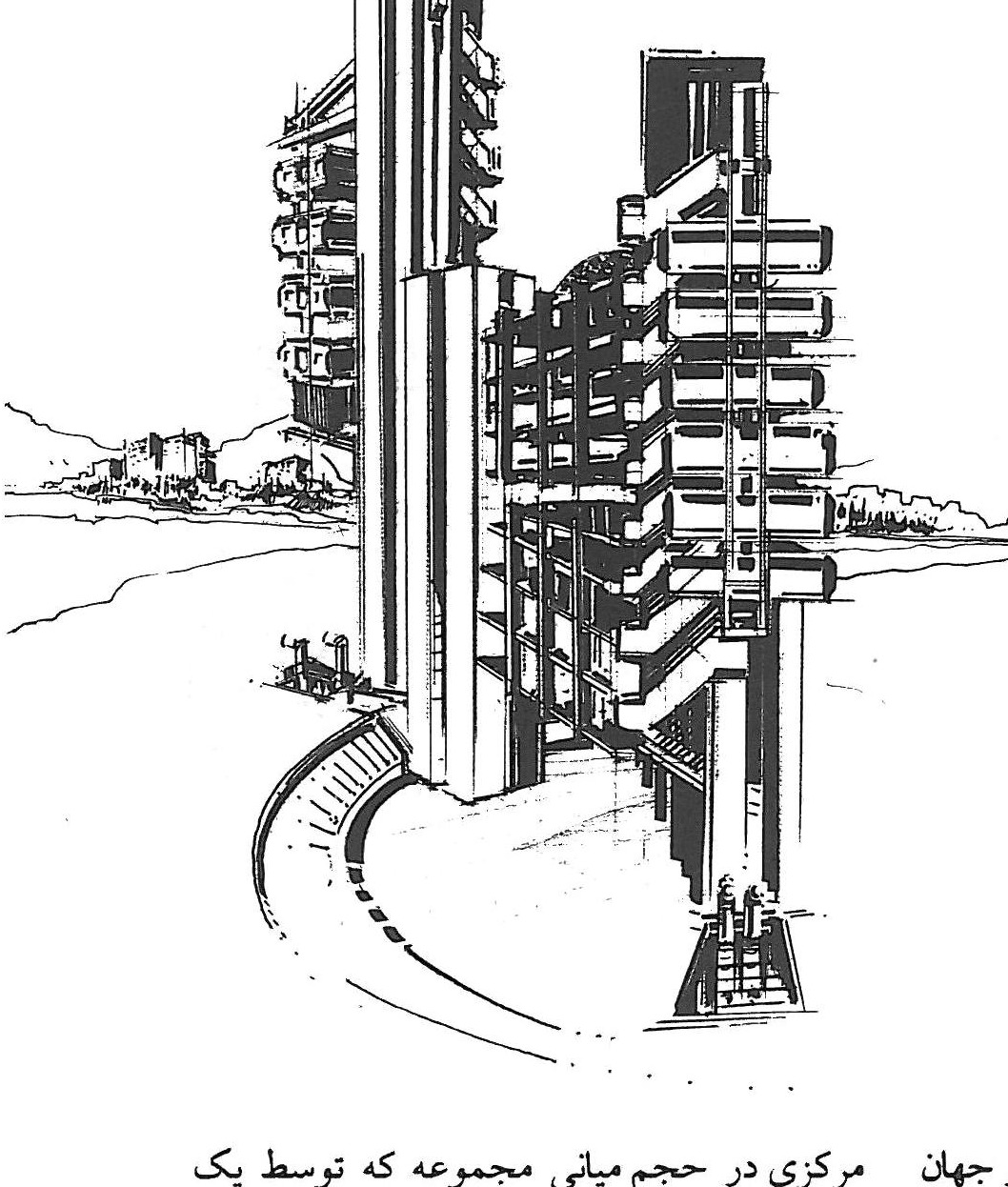
Radio Broadcasting Production Station — master's thesis by Reza Aliabadi (University of Tehran, 1999) — perspective view
The spatial organisation was developed through a series of structural experiments that shared a single conceptual standpoint but differed in the number and distribution of their structural cores. Common to all of them are specialised vertical structures, repeatedly intersected by secondary horizontal elements. The absence of a visible beginning or end to these rhythms evokes the sense of motion, growth and release from time and place that characterises communication itself. The final pattern was chosen according to the technical, functional and industrial requirements of the brief. It consists of three concrete vertical structures that carry two steel-framed capsules between them and support a series of prefabricated capsules suspended behind them. In addition to making the complex's many connections possible and providing its primary stability, these three verticals act as shafts for the distribution of electrical and mechanical services. A central void within the middle volume, roofed by a geodesic half-dome, secures the unity of the building.
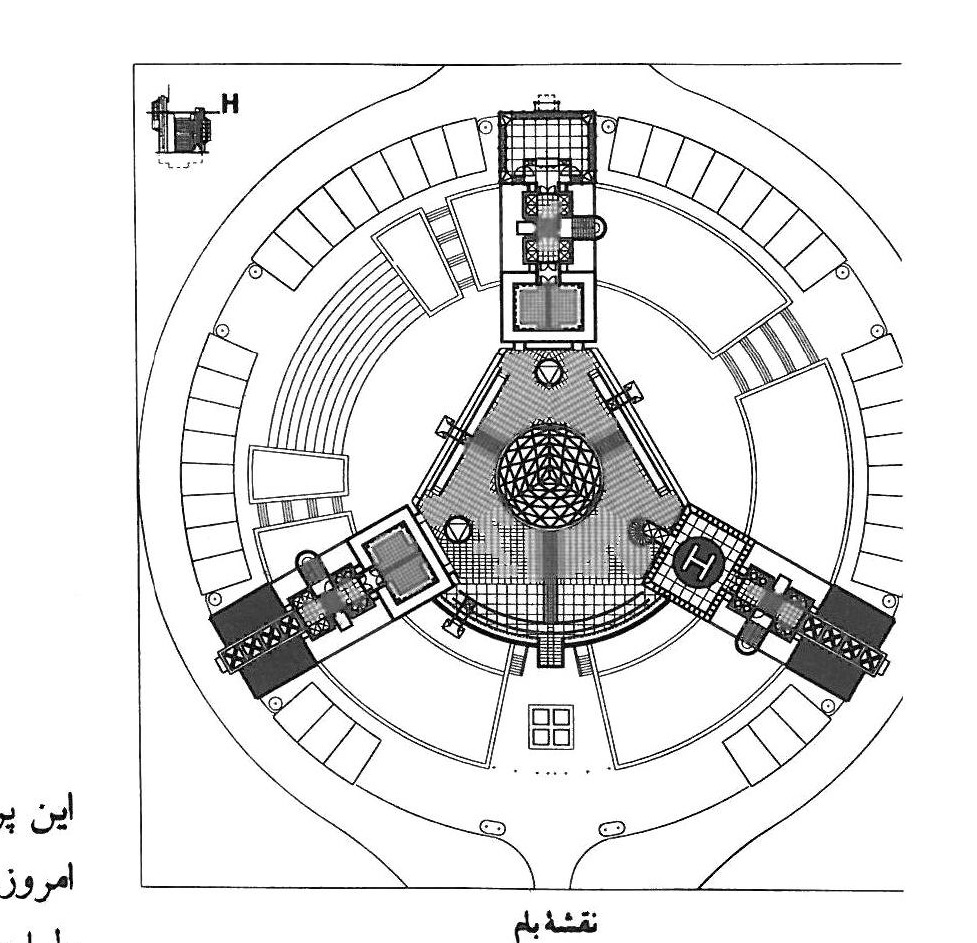
Radio Broadcasting Production Station — master's thesis by Reza Aliabadi (University of Tehran, 1999) — typical floor plan
Public functions begin on the lower floors and rise towards the private functions on the top floor. A mid-height urban terrace separates the two principal functional groups. The project's specific spaces — production studios, the director's offices, and rest areas for staff working outside normal hours — are accommodated in the capsules. The building meets the ground through its three vertical structures rising from an inverted spherical base, leaving the pilotis space beneath available for use. Shelters, service and mechanical spaces, and studios for use during emergencies are placed in the basement.
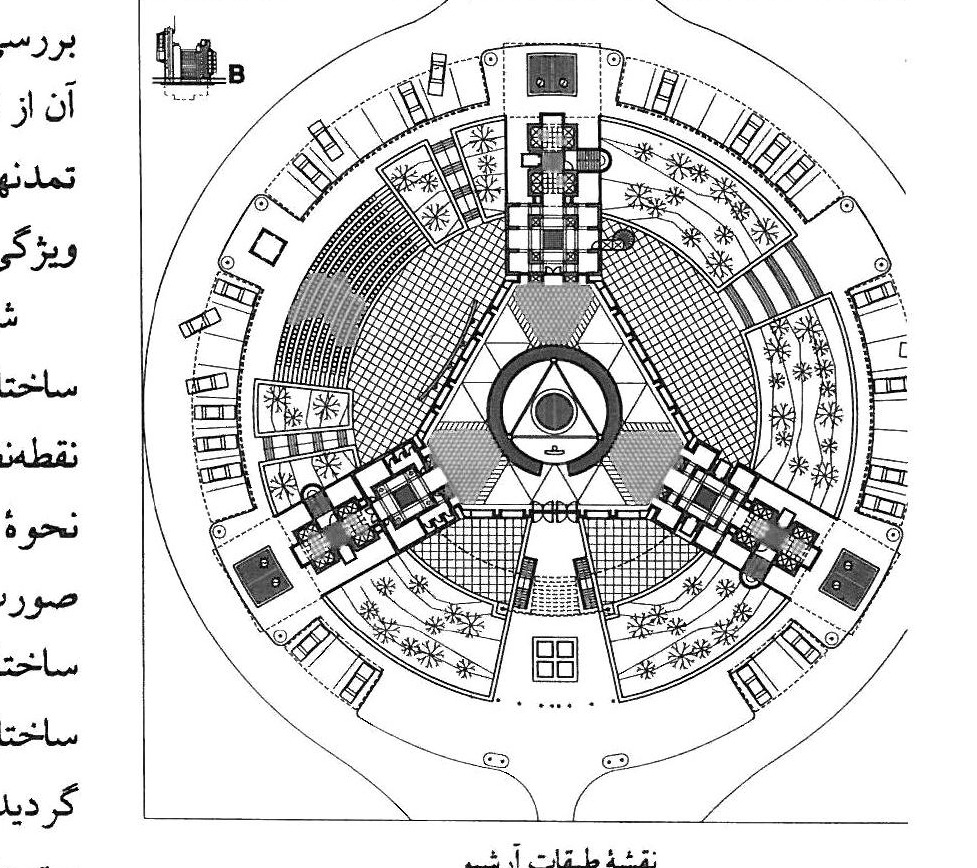
Radio Broadcasting Production Station — master's thesis by Reza Aliabadi (University of Tehran, 1999) — archive floor plan
The site chosen for the project is the area where the Milad (memorial) telecommunications tower is currently under construction, bounded by Chamran Expressway to the east, Hemmat to the north, Sheikh Fazlollah to the west, and Resalat to the south. It is the best-located site in Tehran for the visual and audio coverage of broadcast waves.
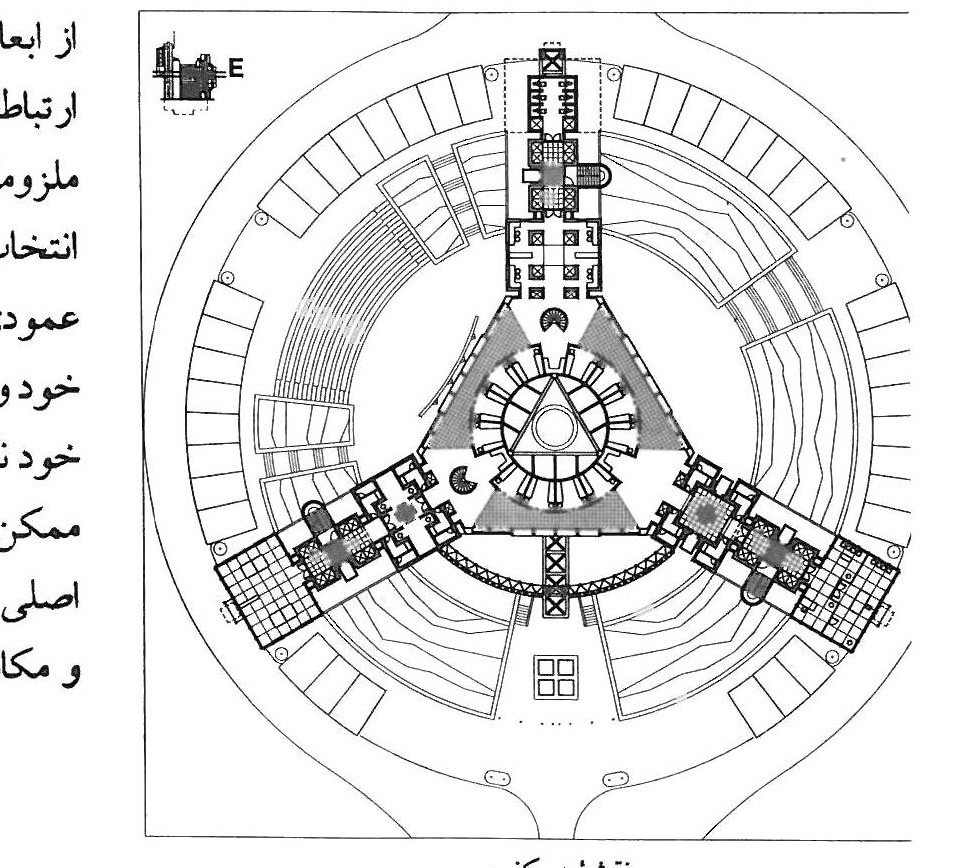
Radio Broadcasting Production Station — master's thesis by Reza Aliabadi (University of Tehran, 1999) — ground floor plan
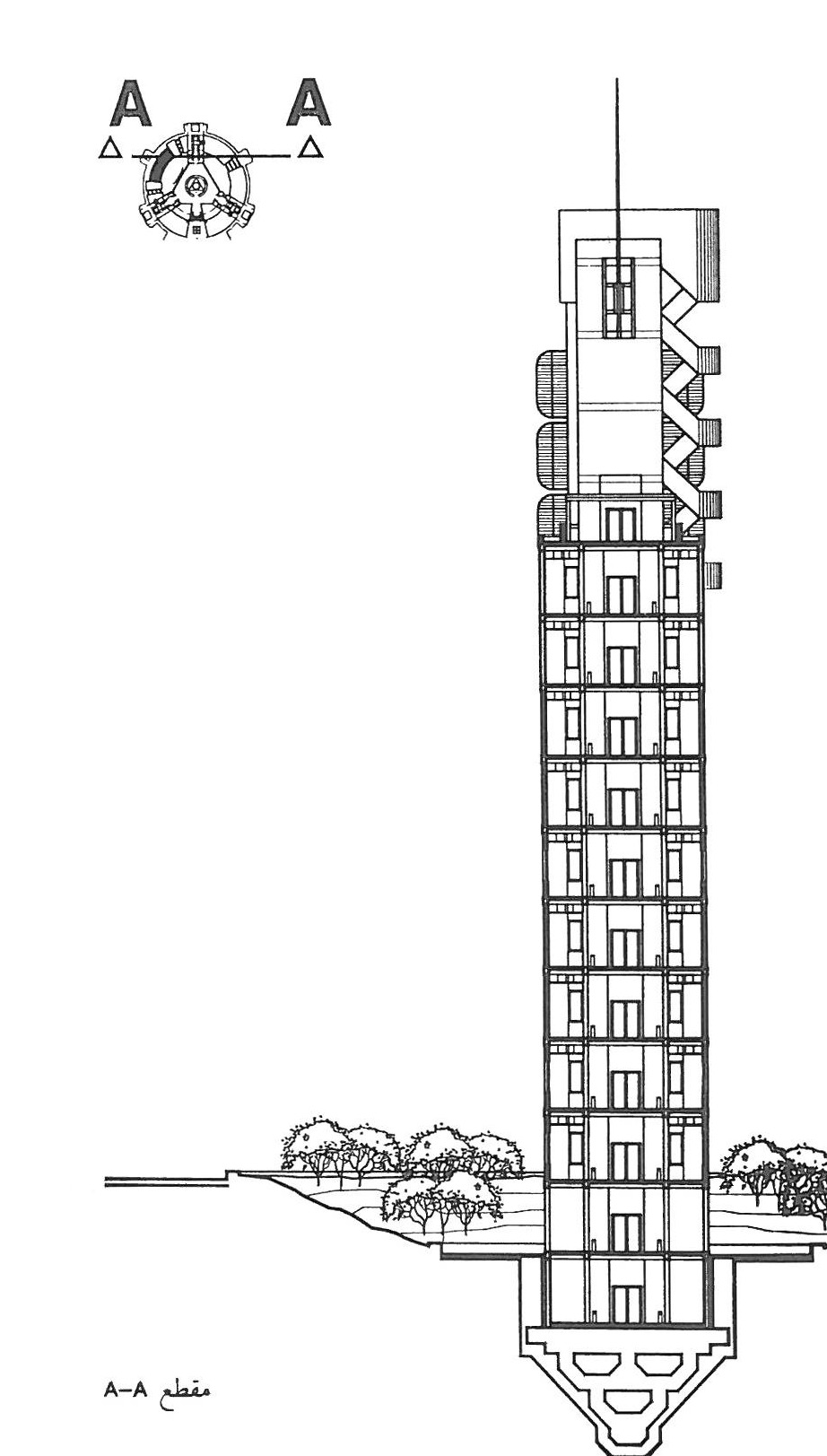
Radio Broadcasting Production Station — master's thesis by Reza Aliabadi (University of Tehran, 1999) — section A-A
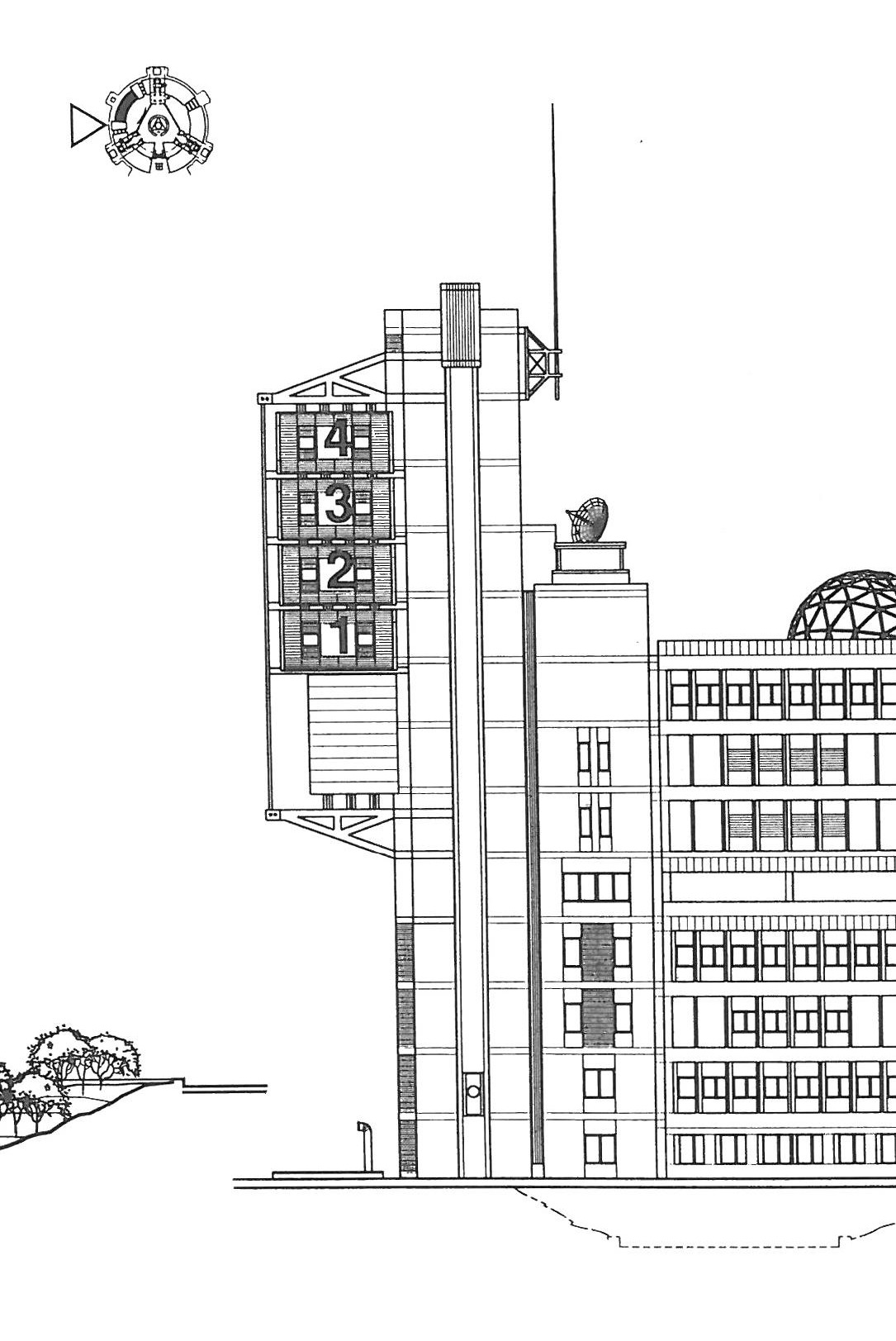
Radio Broadcasting Production Station — master's thesis by Reza Aliabadi (University of Tehran, 1999) — west elevation