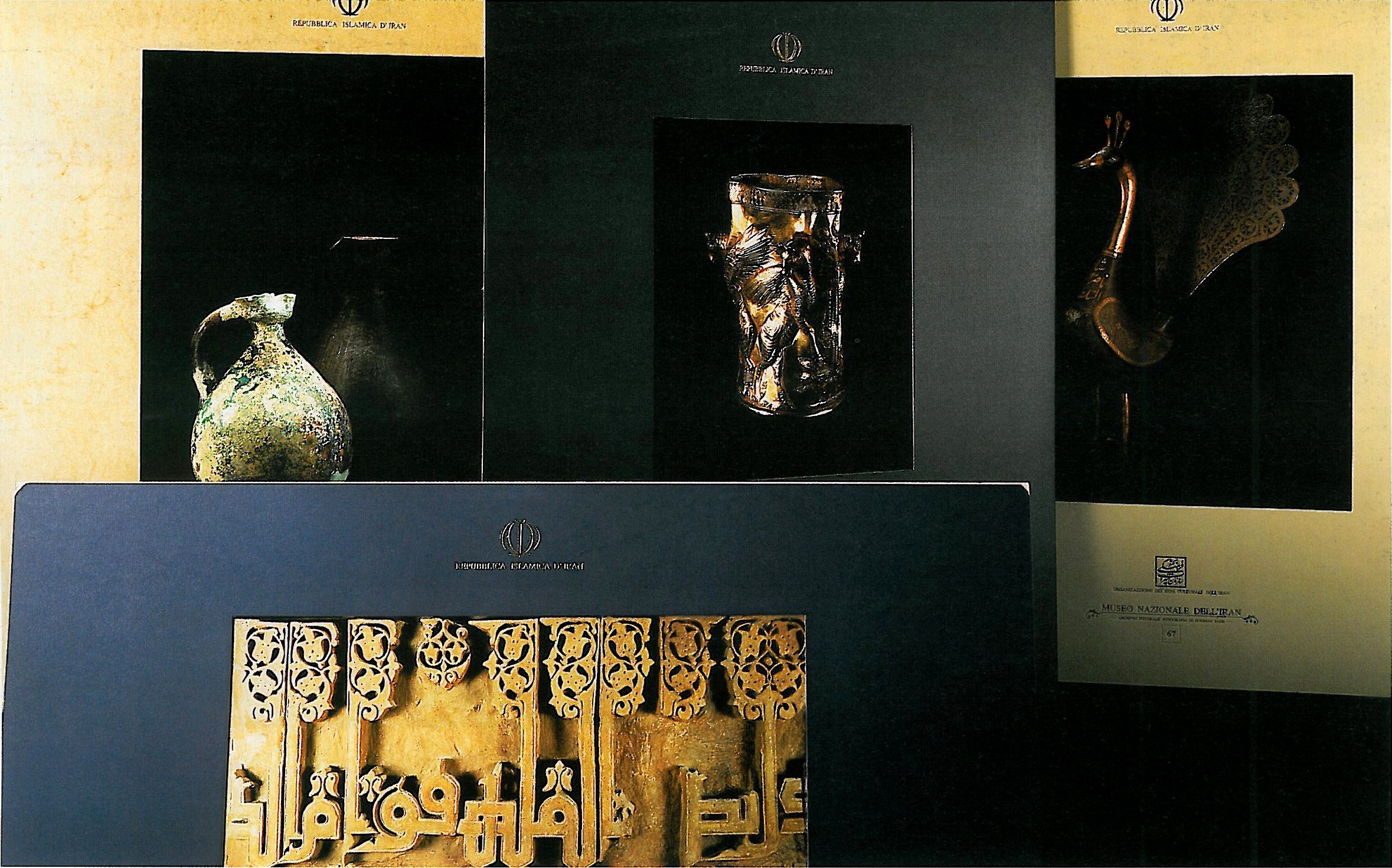
Photo Exhibition Artifacts of Iran's National Museum in Italy
Following the signing of a cultural and scientific cooperation agreement between the Islamic Republic of Iran and Italy, at the proposal of the Institute of Eastern Studies at the University of Naples and the IsMEO institute, in cooperation with Iran's Cultural Heritage Organization, in March of this year coinciding with the beginning of the new year, an exhibition of photographs of historical artifacts held in Iran's National Museum, titled "Iran's National Museum in Pictures," will be held for one month in the Historical Museum of Rome and another month in one of the museums of the city of Naples.
A large number of international archaeologists and directors of prestigious museums from around the world have been invited to visit this exhibition. During the first two days of the exhibition, a seminar will be held to introduce the exhibited objects, in which three Iranian and three Italian archaeologists will present lectures.
The photographs for this exhibition were taken by Hooman Sadr. In preparing this photographic archive, the historical significance of the objects, their uniqueness, their importance from an international archaeological perspective, their artistic value, the craftsmanship of their making, and their aesthetic values were taken into consideration. In selecting the photographs, the fact that the objects had not previously been publicly exhibited was also considered.
This exhibition collection comprises one hundred photographs selected from nine hundred archival images with the help and consultation of expert archaeologists from the Cultural Heritage Organization. In this selection, effort was made to ensure the photographs have value both artistically and visually as well as in documentary terms. In many cases, photographs of the regions where the objects were found have also been included so that viewers can develop a deeper connection with Iranian culture.
All photographs were taken using large-format studio cameras, and the photographer studied all information related to each object and considered the relationships between objects from different periods in terms of form and shape, and the creation of a space in which objects could be viewed as a collection. The lighting was also designed to create strong contrast so that the volume, texture, patterns, or inscriptions could be better distinguished.
This project took seventeen months and the photographer says of his work: "This is the fruit of the effort of eyes, mind, and hands that lovingly gaze upon their land and history."
Iranian Architecture
Introduction
Extensive studies have been conducted on classical Roman and Greek architecture, demonstrating that temples, palaces, and other buildings of that period were designed according to complex and very complete rules governing both the overall form and the smallest construction details. Regarding Persepolis and other Achaemenid-period buildings — which have long attracted the attention of researchers and archaeologists — very little has been written from this perspective. The most important studies, primarily from a metrological standpoint, have been presented by Michael Roaf. He has identified the existence of more or less precise measurement units at Persepolis and the existence of marks carved on stones for determining the axes of columns and midpoints of walls (which were apparently used for laying out the plan with string).
Some time ago, while researching the origins of Apadanas from a typological perspective, and given my background in studying proportions and geometry in Islamic architecture and their relationship to religious and mythological concepts, out of curiosity I examined the proportions of the famous gate and discovered that the length matched the plan of the palace. To my surprise, all other lines of the gate also aligned remarkably with the plan's lines. I also discovered other interesting numerical and geometric relationships.
In those years, beyond the typological discussion, I had also become interested in iconography and the interpretation of Persepolis motifs and their relationship to pre-historical myths and religious concepts of Iran. Simultaneously with the discovery of certain specific numerical relationships and coefficients in various measurements of the building, I searched for possible relationships between numerical coefficients used in
Hall of Hundred Columns at Persepolis





