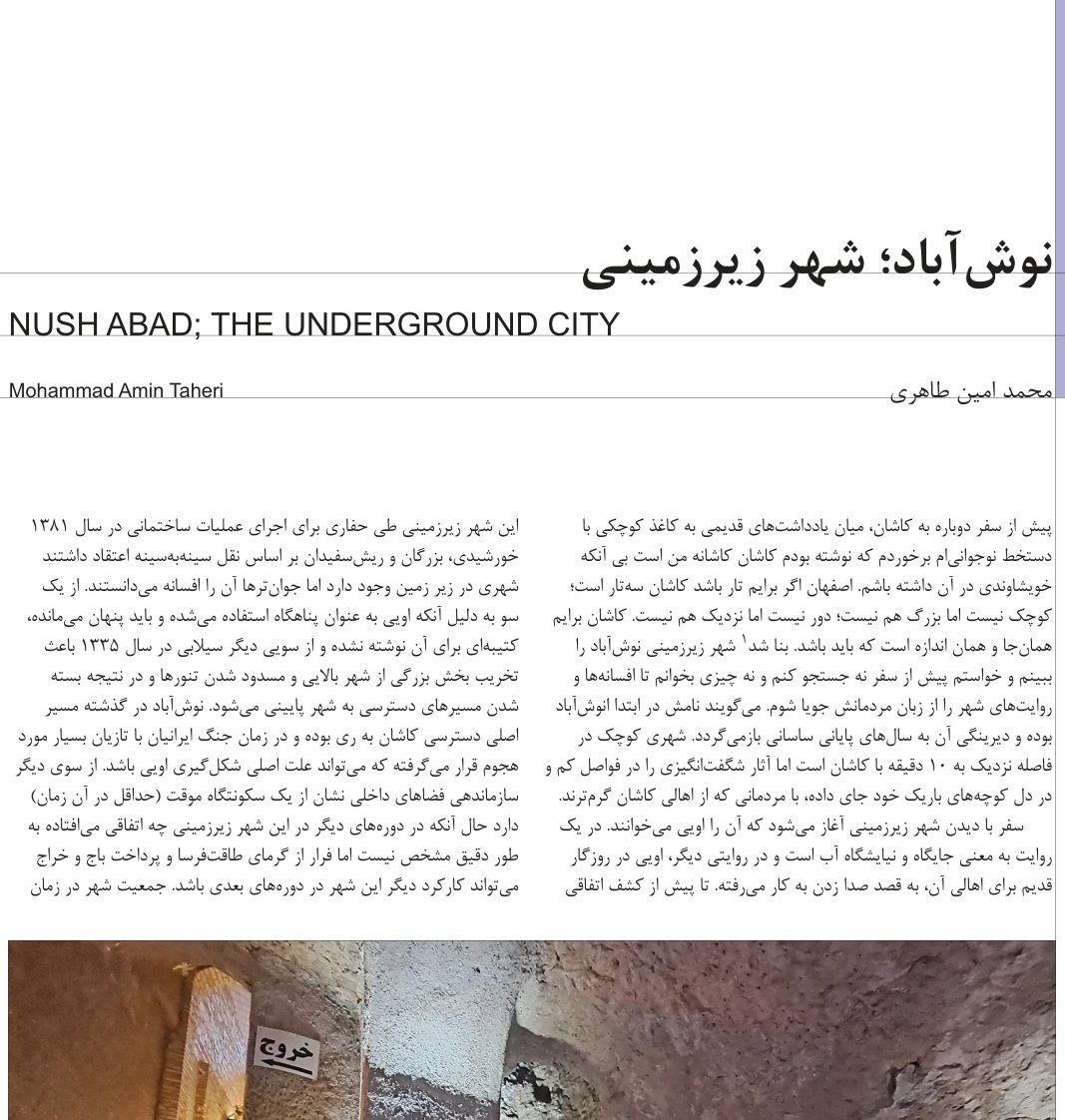
Noushabad: The Underground City
Before my second journey to Kashan, I came across a small piece of paper in my old notes, written in my teenage hand: "Kashan is my Kashan, even though I have no kinship there." If Isfahan is for me a single-stringed instrument, Kashan is three-stringed — not small but not large, not near but not far. Kashan is exactly where it should be and exactly the size it should be. I decided to visit the underground city of Noushabad, and I wanted to neither search online nor read anything in advance, so that I might hear the city's legends and tales from the lips of its own people. They say its name was originally Anoushabad, and its antiquity stretches back to the final years of the Sasanian period. It is a small town barely ten minutes from Kashan, yet it conceals astonishing monuments within its narrow alleyways, peopled by residents even warmer than those of Kashan itself. The journey begins with a visit to the underground city, which they call Ouyi. In one account this means a place of worship and sanctuary for water, and in another it was used in ancient times to call out to the town's inhabitants. Before the chance discovery of this underground city during construction excavations in the Iranian solar year 1381, the elders and village patriarchs — relying on oral tradition passed from chest to chest — believed that a city existed beneath the ground, while younger generations dismissed it as legend. On one hand, because Ouyi was used as a refuge and had to remain hidden, no inscription was written for it; on the other, a flood in 1335 caused the destruction of a large portion of the upper town, blocking the tanoors and thus sealing off the access routes to the lower city. Noushabad in the past lay along the main route from Kashan to Ray, and during the wars between the Iranians and the Arabs it was frequently attacked — which may well be the primary reason for the formation of Ouyi. The organization of its interior spaces moreover points to a temporary dwelling (at least in that era), though what occurred in the underground city during other periods is not precisely known; escape from unbearable heat and the paying of tribute and taxes may have been its function in later times. The population at the time Ouyi was formed is estimated at close to two thousand, who were skilled in the digging of wells and qanats. This city, built across three levels (illustrated with a hand-drawn cross-section), extends some four kilometers in total and was hewn entirely by hand; the primary reason for its durability is the silica-rich and resistant soil of this region. Access was mostly gained through the tanoor rooms of houses, though today it is possible to enter via cellar stairs through two separate entrances leading to two of the levels. The interior spaces include family rooms (both small and large), latrines, a guardroom, lamp niches, storerooms, an ambush chamber, a trap, a tanoor, and ventilation shafts that connect to tanoor-houses in stables or kitchens at ground level. During the period of active use, lighting was provided by oil lamps set into the niches, but as can be seen in the photographs, the current lighting scheme seems poorly conceived — merely an unsuccessful attempt to create visual interest — whereas focused spotlights would have been a far better choice. On the second lower level there is a large room attributed to a council chamber, believed to have been the place of decision-making during times of crisis. The width and height of the corridors and access routes were deliberately kept low to slow any attacker, and access to the various levels was guarded, beyond its complex mechanical system, by sentinel platforms. Ventilation is provided through cylindrical shafts by means of reverse pressure, which makes breathing possible without difficulty even at a depth of twenty-three meters (the deepest point of the city); at this lowest level, however, no rooms or dwellings are found, for it is believed that this floor served solely as a passageway and ventilation channel. The interpretation linking Ouyi to the meaning "guardian of water" draws me toward the discovery of Noushabad's mysterious well — a well that, according to local belief, was a place of worship dedicated to the goddess Anahita, and into which, it is said, a girl once disappeared. Several wells, or water shrines as they may be called, stand in Noushabad at a short distance from the Shazde Eshaq shrine, and they may well be remnants of the Mithraic tradition and the veneration of water and Anahita in Iran. The Shazde Eshaq shrine is another sanctuary near this well.
And at barely twenty meters from it stand the ancient mosque of Noushabad, the Seljuk minaret, the sabat, the reservoir hall, the maktab, and the cistern (illustrated with a hand-drawn sketch). The ancient mosque of Noushabad is a two-iwan mosque said to have been built upon the foundation of a Sasanian fire temple — which, given the city's historical background and other evidence, does not seem far-fetched. This mosque has undergone change and transformation through various periods, but much of its present state dates to the Seljuk and Safavid eras. In the southern iwan, a mihrab from the Qajar period remains, and a single minaret stands behind the northern iwan, whose masterly brickwork and geometric interlace reveal the artistry of the Seljuk age. The prayer hall facing the southeast is the main venue for religious ceremony, since the destruction of the summer hall and the smallness of the courtyard and iwans has doubled the importance of this space. The convergence of the cistern, the mosque, the Shazde Eshaq shrine, and the maktab along a pleasant shaded passage beneath a sabat in the older fabric of the town is a delight, though the remains of the Sizan (Farzin) fortress — despite its proximity to this fabric and its great value — have been met with indifference and neglect. The small excavations of recent years suggest that this fortress too belongs to the Seljuk period. I had set out for Kashan to see the underground city of Noushabad, but I found Noushabad more mysterious than I had imagined — with its towers and walls and fortress speaking to the importance of this town; a mosque whose every excavation reaches back to a more ancient time than thought; a minaret with spellbinding brickwork standing beside cisterns, each of which opens a passage to the underground world. I heard stories from people who love their small town deeply — of a well that was a place of veneration for the goddess Anahita, and of a Shazde Eshaq who, they say, grants wishes. Perhaps it is the interlocking knots of this minaret and the mysterious legends of the city of Ouyi that have bound these people so firmly to their history and their town.
Footnote: 1 — The editor, noting the notes I sent and our conversations, suggests that given my interest in Kashan I focus on this city, which will result in a text on Sialk in issue 147 of Memar; another dossier is to follow, but the fascination of Noushabad itself prompted me to arrange a separate journey for this visit.
Courtyard and southern iwan
Photographs: Malihe Mohammadi



