This past summer, scattered examinations were held to select master's students in various specializations. The text attached to this letter is in fact a critique of the process and manner of holding these examinations. My aim in this critique is not to insult or offend any particular person or body; rather, I am making a despairing effort to play a small part in reforming this process. If possible, please publish this text so that, through the shared thinking and cooperation of those interested in the subject, the selections might be made more judiciously.
It was 12 June (22 Khordad), and a few days later the presidential election would be held. Tehran had become crowded. A few bombs had gone off here and there, and I was wandering the alleys around Enghelab looking for a bookbinder. A group had gathered opposite the University of Tehran to protest the violation of women's rights in the constitution, while I, indifferent, was searching for a binder to bind my résumé.
The morning of the twenty-third arrived. It was the day of the landscape sketch exam at the University of Tehran. When I arrived, I was surprised by the silence there. That silence showed just how much the officials valued students! It was something I had realized long ago, but for some reason I did not want to accept it.
I had realized it back at the written (multiple-choice) exam in Esfand, as I was answering the questions, and at that very moment I truly wanted to cry out like that crowd opposite the University of Tehran; but what was I supposed to protest against?! Against the university, which I had entered of my own free will four years earlier and remained in?! Or against myself, who had come to the exam by my own choice? Or against the professors? Or against the Assessment Organization, which after all these years still did not understand the field of architecture?
The multiple-choice exam was in Esfand — questions that were meant to gauge the knowledge of an architecture student over four years. Judge for yourselves: take a book as monumental as Space, Time and Architecture, and imagine asking a bachelor's student of architecture, “What was the name of Le Corbusier's painting style?”!!! To which court, really, can one bring a complaint that such a question is an insult to the intelligence of a bachelor's student?
Of course, if I were to dwell on the multiple-choice exam, I would have to object to each and every question; but my aim in this critique is the exam as a whole. The exam lacked any scholarly weight; it lacked unity and coherence of meaning. The exam tested rote memorization, not concepts. Really — in what year did Brunelleschi go to the stonemason's shop to make purchases for the church of Santa Maria del Fiore?!!!
All these objections faded away under the weight of coursework and project deadlines. My feeling of anger and protest at the multiple-choice exam also dimmed under the pressure of faculty assignments, and so I sat waiting for the results.
Soon it turned out we were permitted to choose fields. But they had again sent us the field-selection form, and we had to sit sketch exams for all the fields. When the sketch-exam schedule was announced, the dates clashed at several universities. Apparently it was not the mute duty of the Assessment Organization to attend to this overlap, and naturally it felt no responsibility whatsoever to help the students who should not have to be present at two universities at the same time. The officials of one university even delivered the crowning line: “The students made a mistake choosing several universities together.”
So the likes of me, who had committed this “extra mistake,” had to travel all around Iran doing sketch exams: Tehran, Qazvin, Shiraz, Tabriz, Yazd, and so on. Believe me, had they announced it beforehand, we would not have made such mistakes...
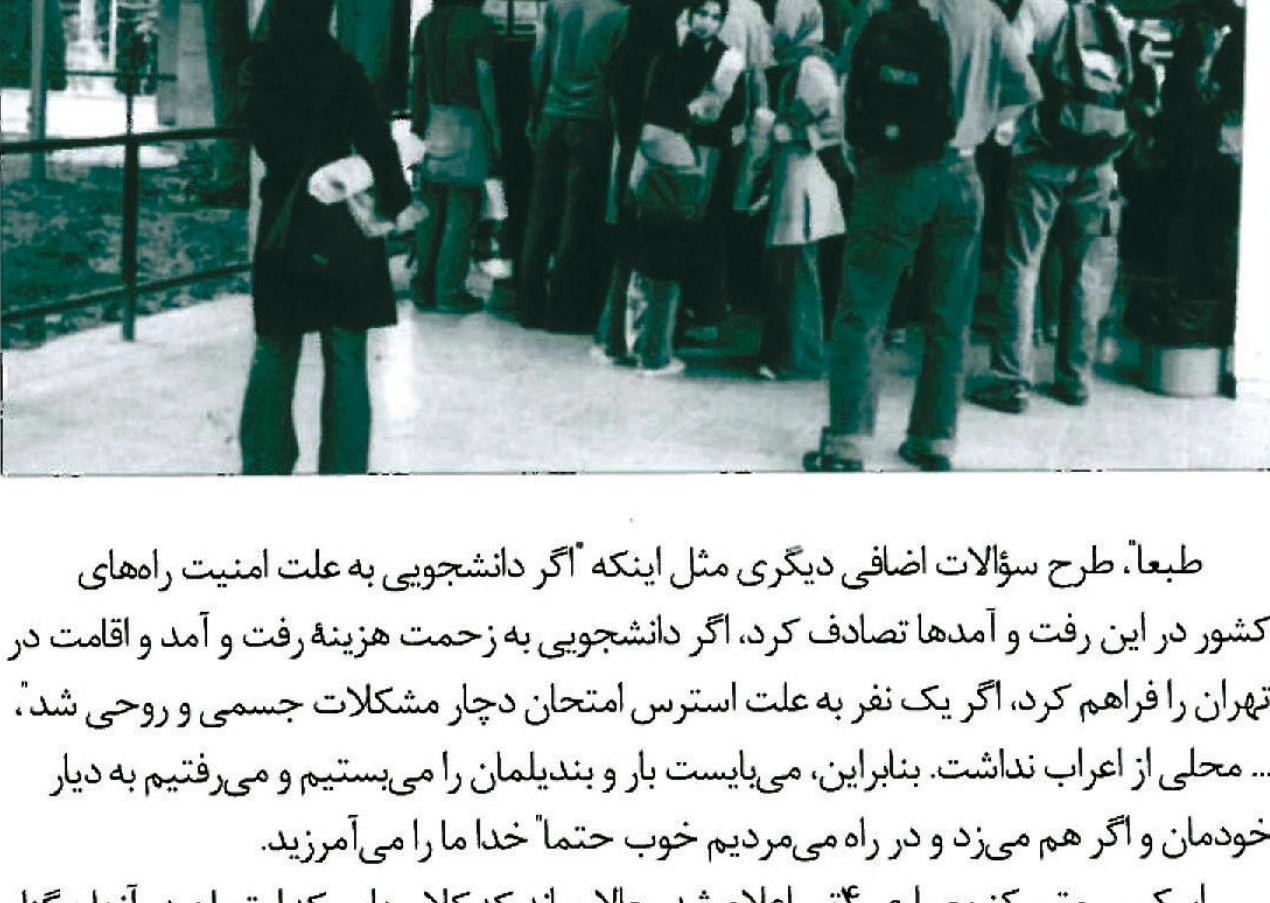
It was Khordad and very hot, and the heat of the exams and the coursework deadlines only made things worse. We rescheduled exams, put off submitting work. With bad luck we managed to get tickets and set off for Tehran. In any case, we got ourselves to Tehran by 13 June (23 Khordad). But at the sketch-exam venue only some twenty or thirty students were to be seen. The silence there was astonishing. No notice, no official was in sight.
God bless that doorman who said, “There is no sketch exam today.” After a little inquiry, we realized that the University of Tehran had only just, after eleven days, understood that the Assessment Organization had assigned all 384 eligible architecture applicants to the University of Tehran's sketch exam! And only one day earlier had they told the universities that the sketch exam would not be held. Never mind that in many provincial towns the students, to reach Tehran, had to set out two days early. Even so, no objection was accepted.
When I asked the officials why they had not announced this sooner, they said: “It's a bad thing; we announced all the sketch exams centrally so that you would not be left wandering from city to city!” They did not wait for us to ask:
— “Couldn't you have thought of it three or four days earlier?” — “Why didn't you hold it centrally as you did last year?” — “Why did you only reach this decision after two weeks had passed?” — “Why didn't you announce it on television?” — “Why didn't you publish it anywhere?”
Naturally, raising further questions — such as “What if a student, because of the insecurity of the country's roads, had an accident on these journeys? What if a student had gone to great trouble to cover the cost of travel and lodging in Tehran? What if someone, because of exam stress, suffered physical and mental problems?” — had no standing at all. So we had to pack up our bags and head back to our home towns, and if we happened to crash and die on the way, well, surely God would forgive us.
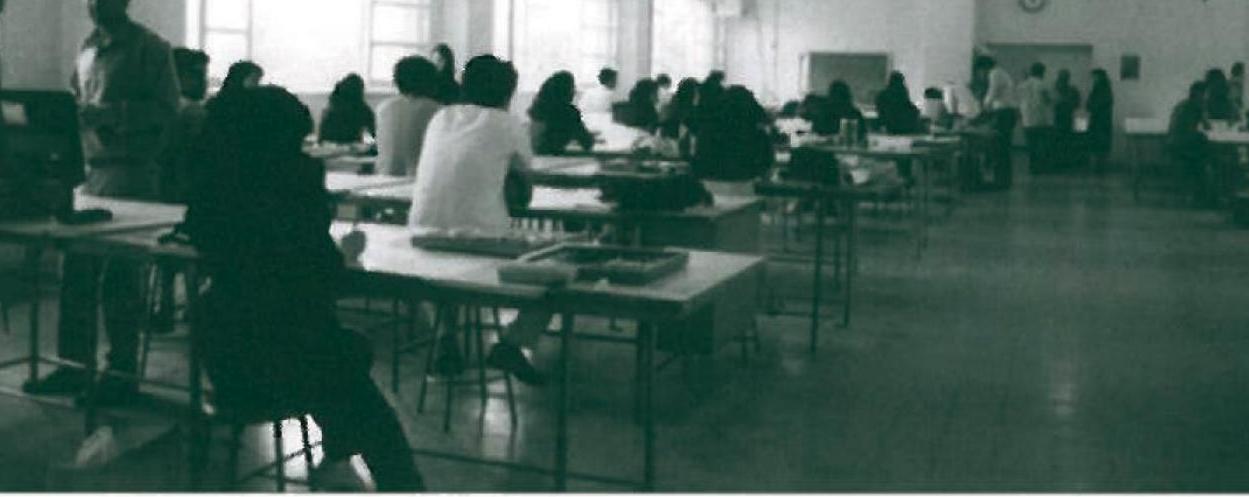
The centralized architecture sketch exam was announced for 25 June (4 Tir). Never mind that the rooms in which the exam was held had no air conditioning and they gave us no cold water. The sketch topic, too, had been practised in advance at some faculties, and some instructors gave their students corrections during the sketch exam. Never mind that many people had also brought ready-made work... But we went blind and deaf and poured our whole world onto a single 70×50 white sheet, and after the exam we soothed our throats with a hot fruit drink in an even hotter summer and forgot everything we had seen and heard — until, right there, they announced that the landscape exam would not be held centrally: the University of Tehran separately, on 28 June (7 Tir), and Shahid Beheshti separately, on 3 July (12 Tir).
Once again no voice or protest was raised, not even from the one whose village-project submission had been delayed and who had to go back to the provinces. Like the others, I downed my fruit drink and went out. I bought a ticket and went to pursue my village project, and for the third time was obliged to be in Tehran on 3 July (12 Tir) — why?!
In any case, I sat that exam too and went back home, and my nightly task became the Assessment Organization's website — waiting for whenever the esteemed officials pleased to announce the results. For a while there was no news, until on Monday Peyk-e Sanjesh was published. It reached the provinces on Tuesday, and the interviews began that same week, on Thursday, 12 August (21 Mordad).
Don't you think all this scatter in the planning is one of the wonders of the age? 13/5, Art University Tehran architecture; 14/5, Art University Tehran interior architecture; 15/5, Science and Technology; 16/5, Shahid Beheshti; 17/5, Tehran; 19/5, Tarbiat Modares; 23/5, Shiraz; 24/5, Yazd; and so on.
They did not even announce at what time we should turn up or what equipment to bring! At eight in the morning of 4 August (13 Mordad) I was at the Art University. Apart from students and doormen, there was no sign of anyone. It grew hotter and hotter, and enduring the heat of the scorching summer courtyard grew harder; yet they would not open the door of the art faculty. After two or three hours, we wrote our names on sheets of paper so the professors would realize how many of us there were! Presumably they had not had time to glance at the Assessment list. At 5:10 they opened the door, a little of the cool air from inside reached me, and the interview began.
At five in the afternoon, having taken two acetaminophen-codeine tablets, I entered the room for the interview. The professors were no less tired than we were. At six they announced that our interviews would not be finished, and read out the names of a few lucky ones to be interviewed the next day in Karaj. They said the interior sketch exam would also be held there. Once again a murmur rose and eyebrows furrowed?! We were all so tired that we did not even have the strength to frown. Exhausted as I was, the next day I got myself to Karaj. One hundred and seventy people took the interior-architecture sketch exam, of whom five were to be admitted.
I had set off and reached there at seven. The doorman would not even let us into the grounds; no one had told them that that day was interview day! The students' voices could be heard from all sides:
— “God, let there be no more sketch exams.” — “Is it a sketch exam or an interview?” — “I can't do another sketch!” — “We have to bring cardboard too...”
We had to fill in a form again. They had asked for our design grades and even our high-school average; only the conduct grade was missing. The interviews moved quickly, and we managed to save a little energy for the next day's interview.
The next day we went to Shahid Beheshti University. The students were tired. For an hour we wandered, bewildered, through the faculty corridors, until a few people arrived with papers in hand. We thought we would again have to speak of our passion, our goal, and our reason for coming; but no — again questions, again an entrance exam, each of us re-examined for fifteen minutes... In whatever complicated and frightening fashion, the interview exam was got through. In this way, we had passed four or five of the seven labours; even Rostam would have fallen short!
I do not know on what basis they arranged the names and called us in. First we waited in a room, drenched in sweat from the heat; then they called us and we entered a large room with a big white table in the middle and three white-haired professors seated behind it. God have mercy on courtroom benches by comparison! I will pass over the other interviews. Never mind, too, the state in which the students went from Tehran to Shiraz and from Shiraz to Yazd, and each time had to explain their reason for continuing their studies.
I, who had gradually fallen into doubt, kept asking myself whether it was worth it or not. Had Le Corbusier and Wright gone to school? Did Shamlou not speak mockingly of the literature faculty? Had Pirnia not left the university of his own accord?
But let all these arguments be; let them be for those who sit behind the desk and decide — those who decide that a student holding a bachelor's degree in electrical engineering, admitted to architecture at Shahid Beheshti, must pass 32 prerequisite credits to become an architect, and need only pay the fee for all the prerequisites as an evening student. I will not forget how, in class, he said he could not afford this cost, and the professors fell silent before him. All the while, I was listening to him speak of his love for architecture.*
I realized that all these courses and schools are a pretext — a pretext to make us forget what we are after, to forget that one can make progress through love, too.
Where has fairness gone — see, they have made a school / of a place where a tavern's foundation might have been laid.
* This student, unable to pay the tuition for the prerequisites and unable to complete all the architectural-design courses, transferred out of this university.