ECAT Office Building, Rasht
Location: Golsar, Tohid Boulevard. Client: Mr. Daneshnia, Mr. Varghani. Design team: Amir Niknafs, Hamideh Raoufzadeh, Sahand Mohaddeth, Hamed Bakhtiari, Mehrdad Karchani, Venous Entezami, Aida Ehsani, Sama Khaki, Parisa Pouyafard, Parisa Soltani, Ehsan Danandeh. Design assistant: Amir Niknafs. Construction: Seyed Abdollah Sharifi. Structure: Arash Tadayon. Electrical and mechanical systems design and construction: Amin Ghorbani. Photography: Did Studio. Built area: 2,300 sqm. Site area: 400 sqm.
[Alidoust and Associates Office] Shahab Alidoust, Sona Eftekhar Azam
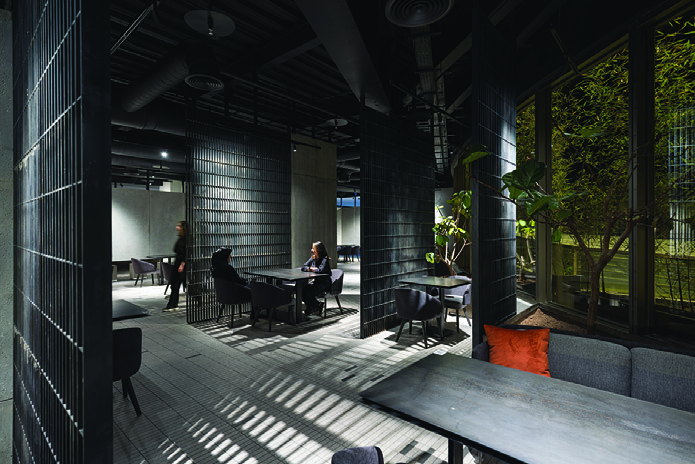
The project is located in the Golsar area along Gilan Boulevard in the city of Rasht, which, with its predominantly residential and commercial land use, is considered one of the city's valuable zones. The building comprises a ground floor and mezzanine with combined lobby and commercial use, first and second commercial floors, one underground parking level, and four office floors. Given the building's function, height, and scale, and its placement within a section of Rasht filled with fine-grained volumes of residential or commercial use, the primary challenge of the design process and its strategies took shape around the necessity of harmonizing the project's volume with this urban fabric. To achieve harmony with the urban fabric, the design team's strategy was to subdivide the relatively large-scale volume into smaller components that better matched the height and scale of the surrounding buildings. In other words, while maintaining overall unity and identity, the building was transformed into a collection of smaller volumes. Furthermore, by adding double-pitched roofs to these smaller components and multiplying them throughout the project, formal harmony with the familiar building typology of Rasht and, more broadly, the cities along the northern strip of the country was achieved.
To advance the primary design strategy and given the site coverage limitations, by sliding the smaller volumes over one another, open-air terraces were created in addition to the allowable density, which on one hand increase the usable area of each floor and enhance its spatial quality, and on the other hand are reminiscent of the familiar typology of courtyard houses in Rasht. In the detailed design of the building, by utilizing dry facade technology and large-format ceramic panels, efforts were made to avoid the problems of facade construction in humid regions. Additionally, the white color of the project was chosen to match the dominant color in Rasht's urban landscape. Given the project's favorable location and the ideal urban scenery around it, large translucent surfaces were incorporated into the facade, which do not create privacy issues for the combined office-commercial use while offering maximum views to the occupants. Achieving harmony with the urban fabric in terms of both scale and dominant form and color has been the main objective of the designers of the ECAT office-commercial project. Moreover, the design process employed strategies that, in addition to achieving this goal, also elevate the spatial quality of the interior.
Digital City Commercial-Office Building, Isfahan
Location: Ahmadabad Street, Khajeh Nezam-ol-Molk Intersection. Client: Nikan Investment Group. Design team: Mohammad Hossein Naghieh, Partow Khayambashi, Vahid Kouhi, Banafsheh Bahadori. Construction: Daem Bana Company. Supervision: Mohammad Hossein Naghieh, Yosef Masjedi. Structure: Mohammad Karbasi. Electrical systems: Riahi Nasab. Mechanical systems: Amin Rejali. Graphics: Shahab Shamaizadeh, Mohammad Mehdi Arab. Photography: Ali Fazileh, Mohammad Soroush Joushesh. Built area: 3,770 sqm. Site area: 662 sqm.
Saden Espadan Consulting Engineers, Mohammad Hossein Naghieh
Since the project is situated on a stretch of Ahmadabad Street in Isfahan that lacks significant commercial activity, with a scattered and heterogeneous commercial fabric of different uses in its vicinity, and considering the site's commercial potential adjacent to the street, the presence of a large public parking facility near the project, and leveraging the commercial potential formed a few kilometers from the site (Ahmadabad Square), the aim was to create a unified, same-category commercial complex to boost the economic vitality and attractiveness of the ensemble. Given the limited land area and building height restrictions (a maximum of three floors above ground), to realize this idea, the commercial floors were expanded around a void adjacent to the main passage on both lower and upper levels. The main design concept, given the site's shallow depth and its elongation along the length, was to create an urban space and allow pedestrian circulation to penetrate the project by establishing an open, level urban space alongside the sidewalk of the main passage on the ground floor, which, for greater invitingness, extends upward through the floors, and by creating and extending a void adjacent to the street, reinforces visual continuity to the lower levels. For better connectivity and access, in addition to vertical circulation (elevators
and stairs), this urban space connects to upper and lower floors through arcades and linear escalators in the open space, so that the circulation path covers all parts of the project. The extension of this open space across floors, in conjunction with the greenery extending around the site, promotes vitality, life, and appropriate sight corridors from inside to outside, as well as visual extension from outside the project into the interior and commercial uses, enhancing the overall complex — which, while creating a sense of introversion on the lower levels, reinforces the extroverted qualities and sight corridors to the arcades and all commercial spaces within the project structure. The circulation paths of each floor are visible on the building's facade. The building facade is a combination of the feedback between interior space and exterior skin, such that interior and facade are fully integrated. Since transparency dominates the interior due to the need for continuity of the commercial display fronts, the facade alternates between glass and solid brick sections. The outer skin, considering the surrounding environment and the dominant materials of the contextual fabric, has been conceived as a combination of glass and brick — solid and transparent — which in the construction details innovatively and modernly draws on traditional brick-laying patterns while employing dry facade techniques and technology.
Saman Satellite Office Building, Tehran
Location: Bumehen, Pardis Technology Park. Client: Saman Satellite Communications Group. Design team: Parima Jahangard, Neda Dehghani, Babak Tousipour, Mona Razavi. 3D visualization: Mona Razavi. Supervision: Danial Shamlou. Structure: Shaloudeh Sazan. Electrical systems: Eng. Nikkhoo. Mechanical systems: Eng. Minaei. Phase 2 manager: Neda Dehghani. Phase 2 design team: Neda Dehghani, Babak Nasirabadi, Dariush Ghorbani. Presentation: Matin Rostami, Sara Maleki, Marjan Naraghi. Photography: Did Studio. Built area: 6,500 sqm. Site area: 5,000 sqm.
Hoba Tarh Architecture Group, Hooman Balazadeh, and Kalanshahr Experimental Architecture Branch, Arash Mozaffari
One of the most challenging tasks in architecture is designing from the midpoint of a half-finished project. The Saman Satellite project was defined as an office building with an incomplete skeleton at Pardis Technology Park, articulating new functional requirements. The existing skeleton had deviated from the original architectural plan and undergone changes in its overall structure that required correction and revision; additionally, new sections needed to be added to the existing skeleton as an annexe building. The overarching goal of the project was to foster a culture of collaboration and advance a joint plan in the form of two design offices. The project took steps to conceptually evolve the previous structure so that, with a fresh perspective, new potentials could be created — yielding a matured result from two lines of thought. In projects like these, where the original designer has completed part of the work, it is common for the continuation not to follow the original idea, and for the redesign to produce something new that not only has no connection to the original concept but sometimes even contradicts it. In the design, the approach was to preserve the overall character and create a complementary potential, while also striving to create a landscape that interacts not only with the project itself but with the entire park. As a first step, the section added to the original plan was reconsidered as a portico for public use by the entire complex, to further emphasize the design's strengths and diminish the unwanted changes to the original plan. Certain sections needed to be added as a new annexe building to the existing skeleton. The design strategy determined that the annexe spaces should be organized underground rather than above ground. Through this approach, instead of adding new formal elements, the effort was to reduce them, so that the achievement of the new sections would be the creation of a courtyard for both the project and the entire park, serving as a public open space. One of the important achievements of this strategy was creating an intermediate
void for the project, through which the boundary between the existing skeleton and the annexe sections was defined by an in-between space that also provides connectivity with the project's broader site. This intermediate space creates a sunken garden along the entire length of the project and the new section, establishing light, ventilation, and connectivity between the different parts. The creation of public space for people inside and outside the site through the annexe sections, which play a complementary role, was achieved in such a way that, in addition to the sloped roof serving as a connective element between the existing condition and the desired program, it provides a seating area within the complex as part of the grounds. Additionally, natural lighting for the various spaces is achieved through peripheral sunken gardens and skylights in portions of the roof. In keeping with the original project plan, the material concept was extended through the use of neutral materials (washed cement); likewise, the exterior color penetrates into the interior spaces, and by using transparent interior surfaces and minimizing color and material variety, the emphasis is on internal connections and the ambient exterior colors. The layering of transparent interior surfaces throughout the project provides visual connectivity between circulation space and work space on both sides of the facade simultaneously along longitudinal and transverse axes. It must be acknowledged that many projects in the country are defined with good initial potential, but for various reasons slip out of the original architect's hands, and in the second phase, the idea or fundamental nature of the design is destroyed — resulting in work lacking identity in terms of intellectual continuity and causing loss of the country's energy and capital. The experience of such projects, which ultimately culminate in a shared intellectual process, carries a value beyond the achieved result — one that will foster the growth of architectural collaboration culture in the country and its development.
Main ramp for underground access
Honeh Cultural Complex, Kohgiluyeh and Boyer-Ahmad
Location: Gachsaran, Sadat neighborhood, corner of Seh-Goush Square. Client: Moshk va Maler Collection. Construction: Atabak Tajgardoun. Photography: Mehdi Bonyadinejad, Arash Sedighi. Built area: 165 sqm. Site area: 155 sqm.
The Sadat Neighborhood Cultural Complex was built to create a cultural environment in one of the most deprived areas of Gachsaran. The design and construction of the cultural complex was shaped through community-based socio-cultural participation, from construction to operation. This complex was designed to revitalize the neighborhood and serve as a symbol of change — by the neighborhood residents and local benefactors of Gachsaran — such that the operation, management, and maintenance of the complex would be carried out by the residents themselves. The overall building volume was designed to match the form and volume of the previous building, which had been one of the neighborhood's older structures. The physical program was developed so that a library, cafe, educational classrooms, and a screening room for children would be freely available to the neighborhood residents under local management, enabling them to operate independently. For this reason, separate access to these spaces was needed, with courtyards serving as intermediate spaces between them. Considering the neighborhood's deteriorating fabric, the presence of movement in the complex and its visibility in the neighborhood, and the use of affordable materials as a model, the main idea of the project was to help regenerate the worn fabric
and renovate the neighborhood's houses. Given Gachsaran's hot and dry climate, the courtyards — as collective spaces and access routes — and the building's south-facing orientation were designed to both moderate the temperature and have an external presence. The main wall of the building facing the urban square was designed as porous. By creating a continuous arcade alongside the square, while establishing a connecting path between the four spaces, air circulation and temperature moderation were achieved. Tall, dried trees were planted in the neighborhood courtyard and covered with climbing plants and bougainvillea that had traditionally been found throughout the city — becoming a symbol of hope and the renewal of life. This complex was shaped by the idea of social participation, whereby the artists, educators, and professors of the city could, in a distinctive setting, engage socially while offering free classes for children, adolescents, and unsupported women, thereby raising the neighborhood's social and cultural level and, through education, securing a brighter future for these individuals.
Ground floor plan, Scale 1:100
First floor plan, Scale 1:100
Longitudinal section, Scale 1:100. Cross section, Scale 1:100
Pordaroom Eco-Lodge Complex, Mazandaran
Location: Tonekabon, Garmaposhte village. Client: Pordaroom Eco-Lodge. Design team: Neda Mirani. Construction: Milad Abedini. Graphics: Armin Saraei. Photography: Did Studio, Benyamin Jahanshahi. Built area: 9 sqm.
The Pordaroom Lodge sits atop a hill of the same name. The complex overlooks the village rice paddies, and to reach the lodge, one must pass alongside the paddies and, with prior arrangement, be transported there by horse or mule. The hotel owner requested a temporary, informal space among the rice paddies where the initial guest reception procedures could take place before they proceed to the accommodation (First Use). During the initial survey, we realized this could also be suitable for the oldest users of the space — the rice farmers — providing a space for breakfast, rest, and work for the women (Second Use). After reviewing the site and surveying the village, we saw that this space could also serve as an educational and play area for the village children (Third Use). Interestingly, the registered Tonekabon trail running course
called Pordaroom starts precisely from this point, and typically, at each race, ceremonies are held at the start and finish at this location, which meant we also had to consider that the project could serve as a stage for them (Fourth Use). All of this became the wishes of ourselves, the village, and the client for the project, and after construction, we found it was not enough — with the building of this space, different people responded to different needs, including a clothing business that enthusiastically embraced the space. A yoga instructor has also chosen this location for weekly meditation. Village youth come here for gatherings... (Other Uses). After construction and use, we realized that architecture, it seems, is meant to be like water — finding its own path.
SinaGen Pharmaceutical Company Office and Production Site, Alborz
Location: Shahriar, Simin Dasht Industrial Town. Client: SinaGen Pharmaceutical Company. Design team: Farzaneh Norouzi, Neda Shahjoui, Mahyar Javidan, Partow Hedayati, Niloufar Moradi, Araz Esmaeili, Kamyar Salavati. Structure: Davoud Zarei. Mechanical systems: Alireza Farsad. Electrical systems: Mohsen Nemati. Construction: Arash Lahouti. Photography: Aydin Shahi. Built area: 20,000 sqm.
Modam Architects, Sanaz Ghaem Maghami, Mojtaba Mohammad Zaheri
Designing a biopharmaceutical factory encompassing interwoven production, mechanical, storage, support, laboratory, management, and office spaces — and designing open, closed, and semi-open volumes — presented a full-fledged design challenge. A straightforward solution was to separate the masses by different functions and connect them with transparent bridges. As a result, three main masses were produced: a mass for mechanical functions; a mass for production, support, and storage functions;
and a mass for laboratories and office/management spaces. In the next phase, the masses were refined. The mechanical and production masses became large white cubes with semi-transparent skins. The office mass was designed atop a large glass cube that formed the complex's tall lobby. A delicate brick volume was placed on the glass cube, and within its voids, it created green courtyards for employees to enjoy fresh air and trees — a hanging garden amid brick buildings.
Office. Production. Laboratory. Mechanical.
Office. Production. Laboratory. Mechanical.
Office. Production. Laboratory. Mechanical.
Office. Production. Laboratory. Mechanical.