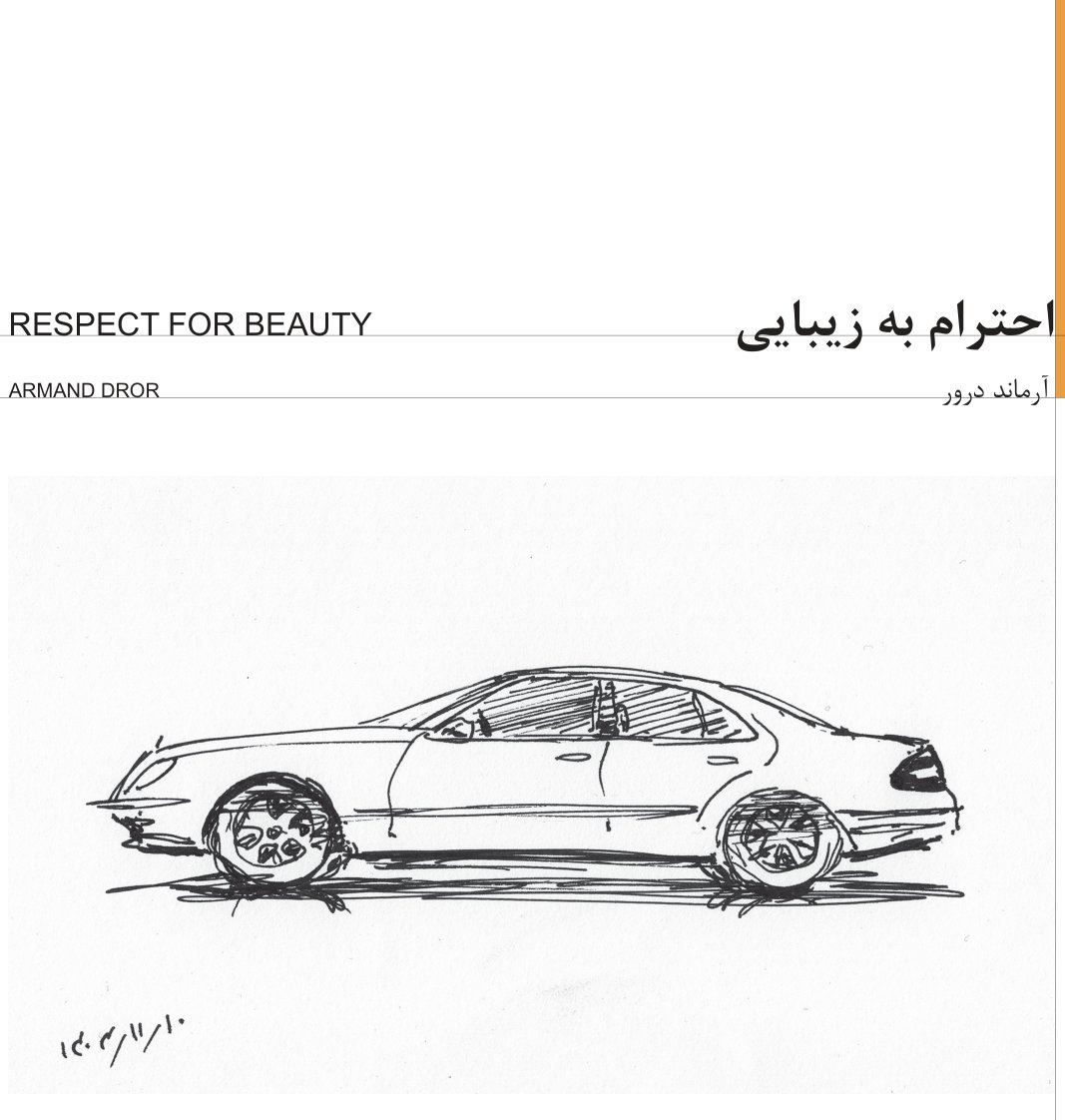
In 2003, Mercedes-Benz introduced a new model in the mid-range sedan segment — the W211. Over the forty-eight months of this car's design process, its drawings, digital models, and clay models were revised repeatedly, until the designers' work finally reached production in the form of a beautiful, fully sculpted and refined body. This body was designed with a soft volume and curved lines that allow the observer's eye to glide smoothly over its pleasing contours — just as the airflow moves easily and buoyantly over its aerodynamic bodywork. This car's design reached its resolution at a time when the expectations of Mercedes buyers regarding visual quality and appearance were exceptionally high. I am deeply convinced that the element of beauty holds an undeniable place in the field of design, and that beauty is itself a subject worthy of discussion and critique. The enduring quality of beauty in this design is precisely the value that one can attribute to the work of its designers. The W211 may not be, qualitatively speaking, the finest car Mercedes has ever produced — but it is without doubt one of the most enduring automotive designs of the past several decades, remaining singular, eye-catching, and visually gratifying amid the large number of car designs shaped by uniform and often shallow trends and styles.
This issue of Memar magazine is dedicated to one of the important and influential architects of contemporary Iranian architecture, Engineer Faramarz Sharifi, and these notes have been written in tribute to beauty. A few years earlier, in a text published in the issue devoted to the late Iraj Kalantari, we wrote about taste — a quality that surfaced as significant during our shared conversations. Taste is a value added upon the other requirements of good architecture: it renders the outcome of the work more personally the architect's own, in aesthetic terms. Taste is a curious component. It cannot be defined in architectural criticism, and yet it is not measurable either, and its description using objective indicators is impossible. That said, one can be certain that it is born from sensibility — and is, of course, a product of the architect's lived experiences and individual acquisitions. In Faramarz Sharifi's architecture, this quality — the element of taste — is clearly in evidence. Among today's architects, Faramarz Sharifi belongs to the generation of senior pioneering architects. He was a student in the Fine Arts Faculty of Tehran University in the 1950s — years when the weight of Hoshang Seyhoun's influence on the atmosphere of architectural education at the faculty was very considerable. He learned architecture under that same discipline and, like many of Seyhoun's other students, acquired skills that today's generation of architects might well envy. Sharifi has said: "At the Fine Arts Faculty in Seyhoun's time, they did not teach us architecture. What we learned there was how architecture should be learned."
Note — Note
Writing about the architectural quality of Faramarz Sharifi's buildings is an easy task — and yet writing about the architect himself, the creator of these works, is a very difficult one. He is not accustomed to speaking of himself; his words are simple and yet rich in implication; and in an era when the quality of architecture buckles under the weight of architectural discourse that architects offer up generously in every essay and lecture, Sharifi insists that what he has built speaks of its own architecture and needs no story. In most of Faramarz Sharifi's buildings, fidelity to modern architecture is apparent — and it was even more pronounced in the early years of his career. In the architectural form of his early work, from the late 1950s and 1960s, one can see traces of the architecture of Richard Neutra, and later Louis Kahn — which gradually becomes more complete and more personal in the houses he designed. In the Keykobadi House, built in 1344 SH, this tendency reaches its fullest expression. Over time, however, this
modernism combines with elements drawn from his keen attention to the environment and takes on a new form. The emphasis on the durability of built architecture, through a focus on efficient details, matures in the buildings of the 1970s and after. The use of materials such as brick, and its repetition in the works of this period, is entirely evident and continues in subsequent years. His approach to durability is not confined to structure and materials; it concerns the creation of spaces that are functional and in harmony with their surroundings. For Sharifi, durability is the foundation of his buildings' permanence, and this permanence is completed by the durable relationship between the owner-inhabitant and the building. Faramarz Sharifi's architecture — and everything he has produced over more than six decades — bears strong resemblance to the W211: clean, precisely cut, and polished. An ability and a skill brought to maturity, such that his works generally abound in detail, and these details, in their manifestation, do not exceed the duty they bear in
1340 SH — the architect and his car; 1391 SH — the architect and his car
the development of the overall design. His attention to detail is evident in every aspect of his designs: from intricate brickwork to the considered placement of windows and doors; from the adjacency of different materials to the small elements that channel rainwater from surfaces and facades. He believes that it is these details that contribute to the overall quality and longevity of a building. At the same time, Faramarz Sharifi's ability to resist the temptation to become absorbed in the importance of details, and to avoid exaggerating their display, is very masterful and valuable — and this balance has been greatly effective in bringing the overall quality of his architecture to fruition. Functionality is without question one of the primary components of Faramarz Sharifi's architectural design. For him, architecture has always been shaped from the inside outward, and this emphasis on the principle of inside-out design has been maintained unchanged throughout his entire career. His architecture focuses on creating spaces that are functional according to his and the inhabitants' expectations, while also possessing visual appeal — and this balance between function and beauty is a distinguishing characteristic of his work.
Another important point in Faramarz Sharifi's architecture is his use of natural light and the creation of open spaces within the building. He believes these elements contribute to the quality of residents' lives and create a sense of connection to the environment. For this reason, in the houses he designed in the early decade of his career — such as the house for the Yildirim family, a modernist building with clean lines, flat roofs, and large windows that exemplifies the classic architectural language of the mid-twentieth century — we encounter large windows and openings, and abundant transparent surfaces. These gradually become somewhat more restrained in subsequent years and in later works, arriving at a desirable balance. With this same approach, designing the courtyards and shared open spaces of his buildings has always been of equal importance to him as designing the buildings themselves, and his works have generally involved the integration of buildings with their surrounding environment — whether that environment is urban or a natural landscape. This approach ensures that his buildings are not merely self-contained structures but form part of a larger fabric.
In the early years following the Revolution, the halt in investment and the construction downturn led Sharifi to concentrate most of his activity within the consulting engineers firm Artiman. A period during which the prevailing working methods were not well suited to his preferred and expected approach to architecture; and after the last executed project within the engineering consultancy structure — the Jam housing project for the National Gas Company — he left the firm and continued his personal architectural practice. The foundation of Sharifi's architecture reflects his respect for tradition and simultaneous embrace of modernity, and through his architectural process he creates spaces that are both contextual and timeless. His works are testimony to the idea that architecture can bridge past and present, creating environments that are both innovative and culturally significant.
Faramarz Sharifi and Abolqasem Roshandel, at the workshop for the Khabiri project in Imameh



