Client: Mohammadreza Rezaieyan · Structure: Poor Akbar Sharifi · Design team: Saba Masoudinejad, Nooshin Hosseini, Arman Asgharloo · Supervision: Ali Rahimian, Ali Soltani · Graphic: Saba Masoudinejad, Mehdi Amini · Photo: Farshid Nasrabadi
Total built area: 122 m² · Site area: 160 m²
Ayeneh Office (Ali Soltani, Atefeh Karbasi, Ali Dehghani) — A Single Vault Over the Whole House
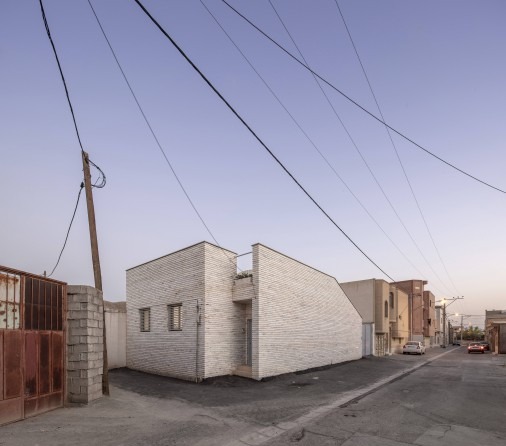
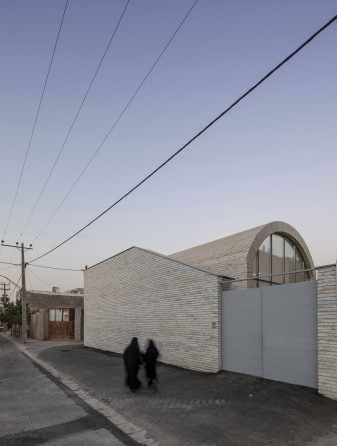
Twilight street view. The white-stone-clad cubic mass sits within the everyday urban fabric of Najafabad; the arched vault appears as a quiet wave above it.
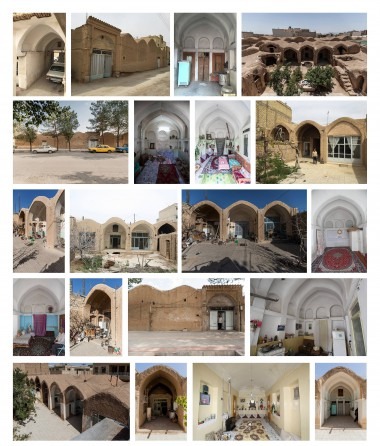
The Single-Vault House draws on the pattern known as the cheshmeh vault in the historic houses of Najafabad. Inside the historic houses of this city, each vault has taken on varied functions — from sitting room to kitchen to reception, sometimes a combination of several — and the wave of vaults has built a visual identity for the urban skyline. The small dimensions of the plot and the client's wish to build cheaply on a single storey was a challenge that the historic cheshmeh vault pattern helped to solve. Through an agreement between client and municipality, about eighty per cent of the land was allocated to construction.
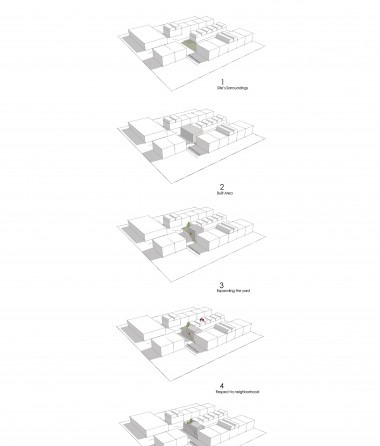
Design concept diagrams. Five axonometric steps trace the design moves — reading the dense urban surroundings, placing the built mass, expanding the historic cheshmeh vault, respecting the neighborhood scale and arriving at the final form.Historic references. A collage of vaulted spaces in Najafabad's old fabric — the cheshmeh vault tradition from which this house's single arch is reread.
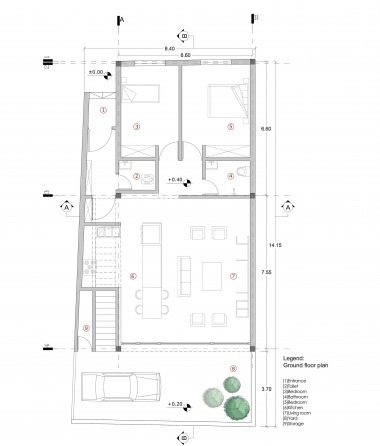
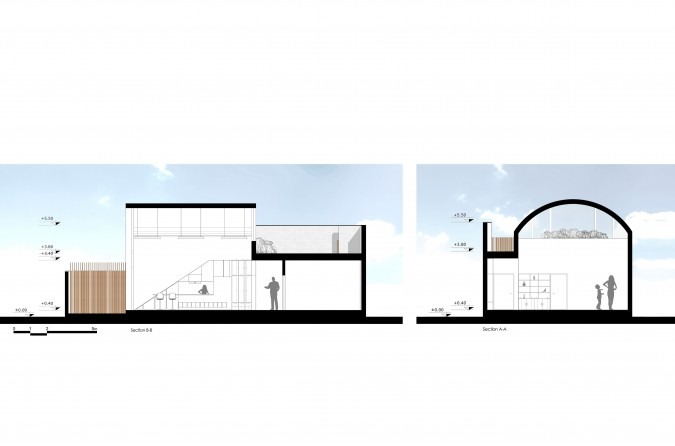
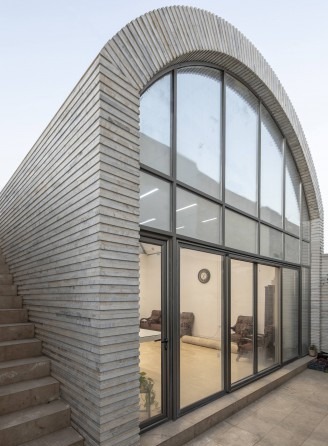
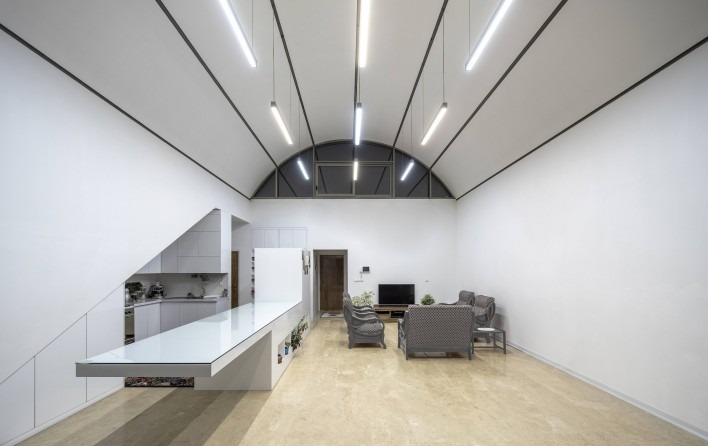
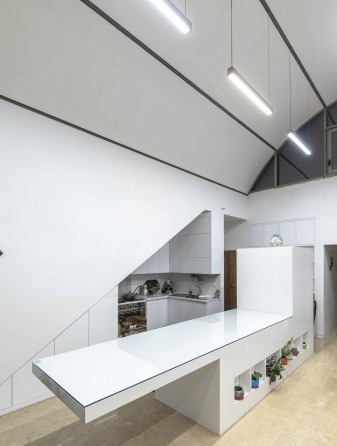
The living and reception room sit on the south side, with a narrow strip kitchen on the west — all under a single vault — while two rooms on the north side, under a lower roof, allow a small courtyard to form above them. To unify body and roof, the entire building was clad in thin strips of the region's local stone, which was also economically reasonable. In this way, all the public spaces of the house took shape under one wide vault, offering the dweller a sense of openness and sky-gazing — despite the small courtyard — together with the memory of historic houses: houses that are still visible adjacent to this one, in the surrounding alleys.
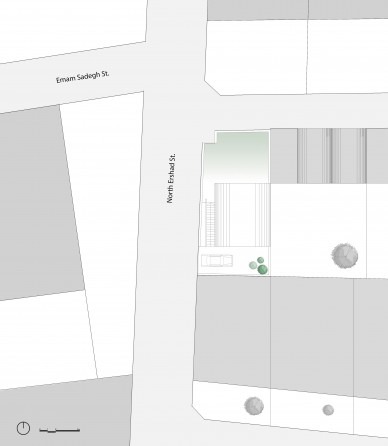
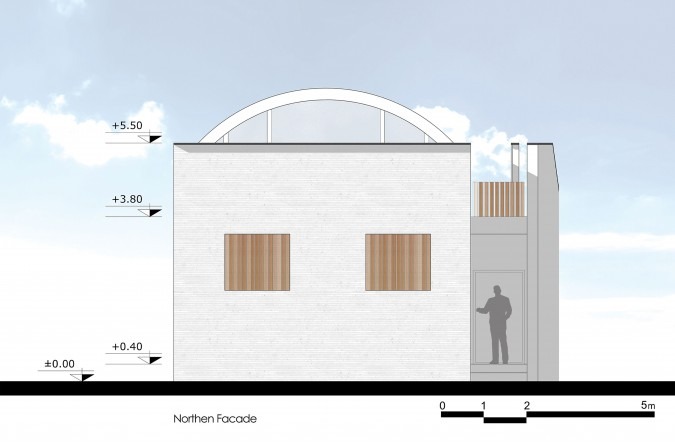
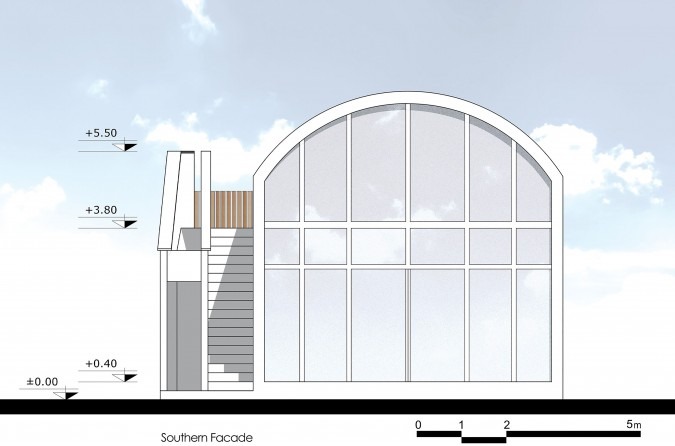
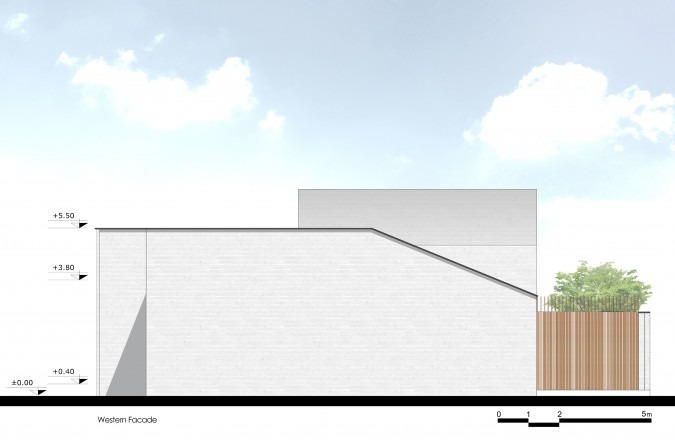
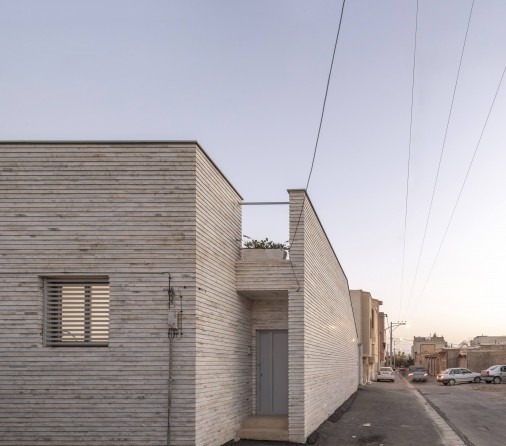
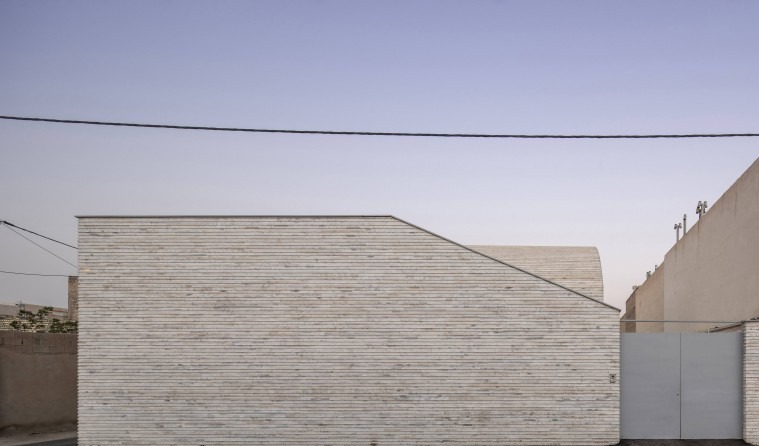
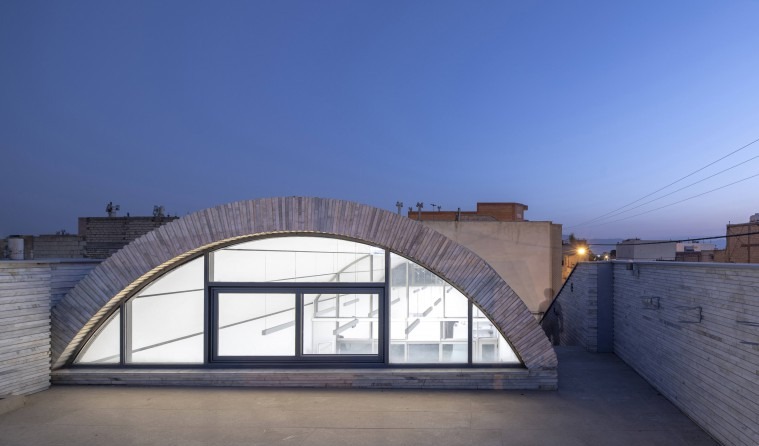
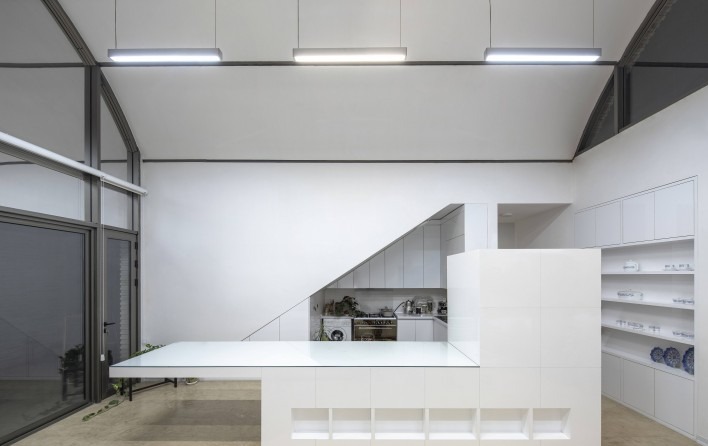
Urban site plan. The small irregular plot sits at the corner of Emam Sadegh Street and North Ershad Street within the dense Najafabad fabric.Ground floor plan. The living and reception space sits under the single vault on the south; a narrow kitchen runs along the west; two bedrooms occupy the north under a lower roof, with a small courtyard on their roof.Sections. Section B-B (left) shows the entrance stair and the split-level relationship; Section A-A (right) reveals the single large vault that gathers the public spaces.Northern facade. The vault rises behind the flat-roofed bedroom mass; two timber-screened openings sit in the white-stone wall.Southern facade. The vault opens to the south through a large arched glass wall divided into a regular grid.Western facade. The stepped form follows the descending section; the planted parapet of the roof courtyard tops the lower mass.Side view from the alley. The stepped facade reveals the roof courtyard above the entrance door.Side facade. The flat stone-strip wall faces the alley; the descending parapet line marks the section change.Twilight street view. Two passers-by walk past the corner; the vault rises quietly above the side wall.From the courtyard. The arched glass-fronted vault reveals the interior; a stair to the roof rises beside it.Roof courtyard at dusk. The back face of the vault opens as a glazed wall onto the small rooftop courtyard above the bedrooms.Interior from the kitchen. Linear lights track the curve of the vault; the rear skylight pours daylight onto the kitchen.The single vault, in full. All public functions live under one continuous curve — kitchen counter, dining, living seating — with the rear skylight opening the apex to the sky.Kitchen island. The white counter steps forward under the steeply rising vault wall.