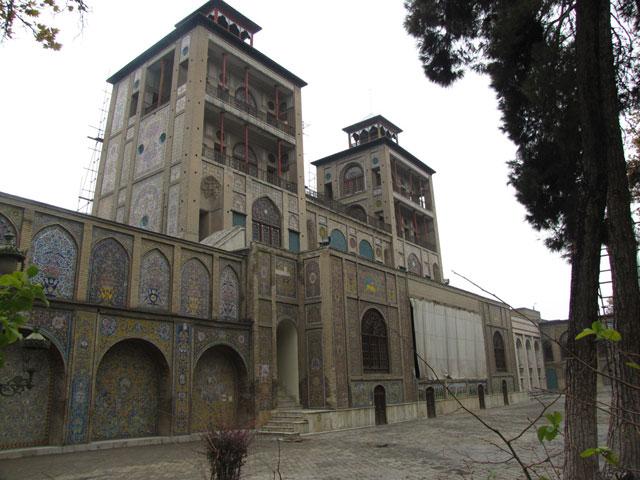
Inscribed in the UNESCO World Heritage List in 2013,The lavish Golestan Palace is a masterpiece of the Qajar era, embodying the successful integration of earlier Persian crafts and architecture with Western influences. The walled Palace, one of the oldest groups of buildings in Teheran, became the seat of government of the Qajar family, which came into power in 1779 and made Teheran the capital of the country. Built around a garden featuring pools as well as planted areas, the Palace’s most characteristic features and rich ornaments date from the 19th century. It became a centre of Qajari arts and architecture of which it is an outstanding example and has remained a source of inspiration for Iranian artists and architects to this day. It represents a new style incorporating traditional Persian arts and crafts and elements of 18th century architecture and technology. (UNESCO, “The List>Golestan Palace.”)The Gulistan Palace complex in Tehran dates back to the Safavid period. In its present form, it comprises several different buildings and halls, including the following: the Imarat-i Takht-i Marmar, (also called the Marble Throne Building, Iwan-i Takht-i Marmar, or Iwan-i Marmar, 1759), the Khalvat-i Karim Khani (Karim Khani Palace, 1759), the Talar-i Almas (Diamond Hall, 1801), the Imarat-i Badgir (Wind-catcher Building, 1813), the Talar-i Aaj (Hall of Ivory, 1863), the Shams al-Imarat (Shams-ol Emareh, or Sun Building, 1866), the Talar-i Salam (Reception Hall, 1874), the Mouze-i Makhsous (Special Museum, 1874), the Talar-i Ayeneh (Hall of Mirrors, 1874), the Imarat-i Brelian (Talar-i Brelian, or Hall of Brilliant Diamonds, 1874), the Kakh-i Ab'yaz (White Palace, 1890), and the Chador Khaneh (Tent House).The Gulistan Palace complex is bordered on the north by the Ministries of Finance and Justice, on the east by Naser Khosrow St, on the west by Davar Street, and along its southern edge, it is one block from Panzdah-e Khordad Ave. The Gulistan complex is located at the heart of old Tehran, which itself is framed by Shahr Park on its northwest, Pamenar Street on its east side, and the Tehran bazaar to the southwest. The complex, in its current condition, consists of two connected gardens, a smaller one on the west and a larger one on the east, and the buildings that surround them. The smaller garden on the west, referred to here as the Takht-i Marmar garden, is oriented along a north-south axis, with a small degree of rotation along the northeast-southwest axis. A water channel runs down the garden's central axis. The larger garden, here called the Gulistan garden, is roughly square in plan (it is slightly longer along its east-west axis) and with a small degree of rotation to northwest-southeast. It features a water channel that runs north-south along its western side, near its border with the Takht-i Marmar garden.The main access to the complex is from Panzdah Khordad Square on the southwest corner. Here, one enters the Takht-i Marmar garden on its south side, and immediately views an elongated pool running on the main axis of the small garden to the north, terminating in a pool in front of the Imarat-i Takht-i Marmar. This building is located along the north side of the small garden and spans the garden from northwest to northeast. On its west side, the Takht-i Marmar garden is separated from Davar Street by a wall. Along its east side, this garden is open to the Gulistan garden and on its southeast corner the Kakh-i Ab'yaz is situated. Moving to the Gulistan garden, facing northwest and then turning clockwise (from west to east), one sees the Khalvat-i Karim Khani where the two gardens meet. This palace shares its west wall with the Imarat-i Takht-i Marmar. Facing north and moving east from the Khalvat-i Karim Khani is a series of buildings: the Talar-i Salam, the Mouze-i Makhsous, the Talar-i Ayeneh, the Talar-i Aaj, and the Imarat-i Brelian. An elongated pool runs north-south in front of the Talar-i Ayeneh. Looking east, one sees a wall with arched niches decorated with polychrome tiles. This wall leads to the Shams al-Imarat, located on the southern part of the east wall of the Gulistan garden. Facing south, one sees the Imarat-i Badgir at the southeast corner of the Gulistan garden. The Chador Khaneh and the Talar-i Almas are located west of the Imarat-i Badgir on the south side of the Gulistan garden. The garden wall makes up the remainder of the southern side. Turning further clockwise to face west and southwest, one sees the east elevation of the Kakh-i Ab'yaz, which is oriented along a north-south axis.The construction and development of the Gulistan Palace complex dates back five centuries, concurrent with the growth and expansion of Tehran as Iran's capital. The building complex has been built and modified during four different dynasties: Safavid, Zand, Qajar and Pahlavi. The small city of Tehran became, for the first time, one of the residences of the Safavid rulers in the mid-sixteenth century. The first defensive city wall around Tehran was constructed under Shah Tahmasb (r. 1524-1576) in the 1550s. Known as the "Hisar-i Tahmasebi," this wall encircled the royal citadel (Arg) situated on its north side. The Arg (measuring 500 by 800 meters) consisted of a small palace and audience chamber. These structures, which are no longer extant, formed the foundation of today's Gulistan palace. The earliest extant structures in the complex are from the Zand dynasty (1750-1794). Karim Khan-i Zand (r. 1750-1779) intended to make Tehran his capital. To this end, in 1760 he commissioned the architect Ustad Ghulam Reza Tabrizi to renovate the Hisar-i Tahmasebi and add new buildings: an audience chamber known as the Divan Khana (today's Imarat-i Takht-i Marmar), and the Khalvat-i Karim Khani.The Qajar dynasty came into power, in 1779, with Aqa Mohammad Khan (reg. 1794-1797), who chose Tehran as his capital in 1785. He selected the Gulistan complex as his palace and administrative center. Aqa Mohammad Khan took over some parts of the estate in the Arg, enlarging the Gulistan garden, and built a palace on the east-west axis of today's Gulistan garden. Called Qasr-i Gulistan, this palace is no longer in existence. Following his assassination in 1797, most of Aga Mohammed Khan's construction projects remained incomplete. After the death of Aqa Mohammad Khan, Fath Ali Shah (reg. 1797-1834) took power, becoming the first king to implement many major development projects in Tehran. At the Gulistan Palace, he initiated new building projects in addition to completing some of Aqa Mohammad Khan's projects; the Qasr-i Gulistan was finished in 1801. At the same time, two other buildings were constructed on the north-south axis of the current Gulistan garden: the Imarat-i Bolour on the north side of the garden and the Talar-i Almas on the south. Of the two, only the Talar-i Almas remains. The Imarat-i Badgir was Fath Ali Shah's last addition to the Gulistan complex in 1813. Naser al-Din Shah (reg. 1848-1896), Fath Ali Shah's grandson, was crowned in the Imarat-i Takht-i Marmar in 1848. During the fifty years of his reign, the Gulistan Palace, his winter residence and center of government, underwent major changes. Naser al-Din Shah's projects for the palace can be grouped into five phases: (a) 1853-1885, (b) 1858-1868, (c) 1868- 1878, (d) 1878-1882, (e) 1882- 1895.Within the first phase, Naser al-Din Shah's prime minister, Amir Kabir, bought the land on the east side of the garden, adding it to the Gulistan complex. The first addition to the Gulistan was a museum for royal weapons, located on the eastern side of the Qasr-i Gulistan. At the time, the elongated east-west complex of Qasr-i Gulistan, the new museum, and some other buildings to its west were collectively known as the Imarat-i Khorouji. During the same period, major reconstructions were performed on the Imarat-i Badgir (1853). In the second phase, Tehran was expanded and reconstructed by Naser al-Din Shah. He made a new defensive wall with twelve entrance gates around the city, Hisar-i Naseri, increasing the size of the city fourfold (1867). Inside the borders of this new wall, the Arg was located within the central area. The major construction work of this phase in the Gulistan Palace was the construction of the Shams al-Imarat on the southeast corner of the Gulistan garden. This five-story building with two flanking turrets was completed in 1867. Shortly after, the andarun (women's quarters) was built on the north side of the Imarat-i Takht-i Marmar, and the Talar-i Aaj was constructed on the west side of the Imarat-i Bolour. (c) 1868- 1878. The Tekie-i Dowlat, a theatrical building for religious shows and ceremonies, was constructed south of Talar-i Almas between 1868 and 1873. It was the largest building built by Naser al-Din Shah in the Gulistan complex. Some necessary modifications were performed on the east and south buildings of the Gulistan garden in order to connect them to the Tekie-i Dowlat.After traveling twice to Europe between 1873 and 1882, Naser al-Din Shah was greatly influenced by 19th century neoclassicism. In 1873, he initiated the construction of a series of buildings with a continuous two-story façade on the north site of the Gulistan garden and the west side of the Talar-i Aaj. These constructions resulted in the demolition of a significant portion of the Khalvat-i Karim Khani. This new complex included a main audience hall, or Talar-i Ayeneh, a museum building, and other adjoining smaller halls. The Talar-i Mouze, later was renamed the Talar-i Salam, was the first building to be in Iran to be designed as a museum. It held Naser al-Dim Shah's collection of antiquities, as well as gifts made to the sovereign. (d) 1878-1882: In 1878, the Imarat-i Khorouji, including Fath Ali Shah's Qasr-i Gulistan, was demolished and replaced by pools, grass plots, flowers, and trees. (e) 1882- 1895: The Imarat-i Khabgah was erected in 1885 on the north of t...



