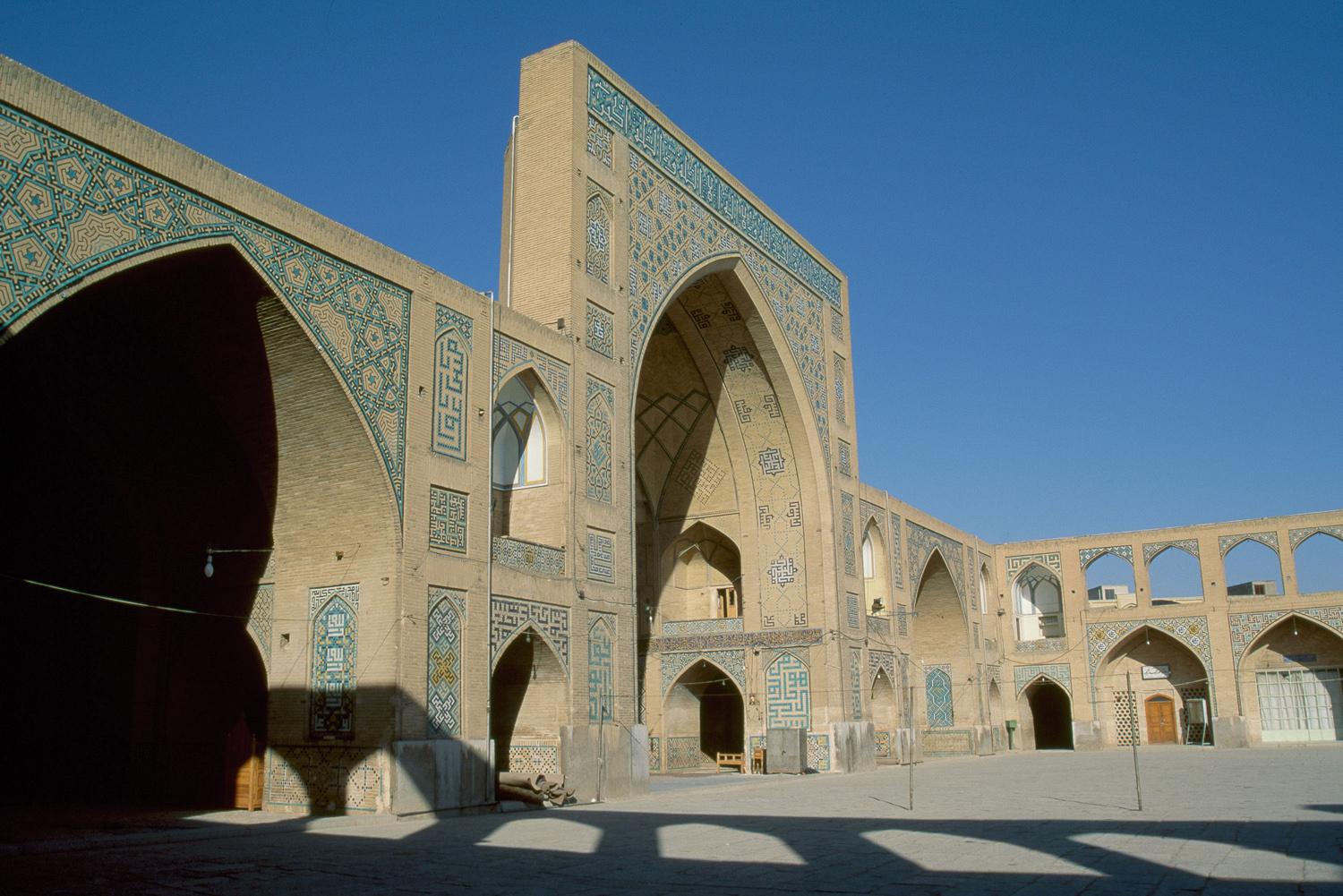
Mosque Al-Hakim, located near the bazaar, was built in 1654 during the reign of Shah Abbas II (1648-66) by Doctor (Hakim) Daud, who fled from Isfahan to India. After making his fortune there under the grand Moghuls. Hakim Daud financed this mosque in Isfahan in his name.A mosque is not only a house of worship, but also a public building serving a multiplicity of uses. It is a gathering place for prayers five times a day, an Islamic college, a community center for functions with present day Western associations, and an emergency shelter for travelers. A mosque contains amenities, such as wash rooms and toilets, for public use. It is the first civic symbol one encounters after coming out of a secluded house at the end of an obscure valley. As much as it is a container of space, it is also contained within the city fabric. The Mosque Al-Hakim has no monumental entry, but five different minor entries. Frequently, a mosque is also used as a short-cut for another destination beyond the mosque. Although the penetration of the mosque walls may take many forms, the primary destination is always the same. It is a courtyard which can be called a monumental space.Sources:Herdeg, Klaus. "Mosque Al-Hakim." In Formal Structure in Islamic Architecture of Iran and Turkistan, 21. New York: Rizzoli, 1990. (Available on Archnet at http://archnet.org/publications/2780)
Gallery
Location
Loading map…
Isfahan, Iran(32.663, 51.675)



