مهر آذر سهيل دريغ از ميراث معمارى مدرن تهران تاريخ، شهر را مى سازد. طى قرون، نسل هاى مختلف جامعه ليه ها و مقوله هايى نو به اين شعر سمفونيك، شهر امروزين، افزوده اند. دفاع از ميراث فرهنگى و هويت جارى درمحيط هاى ساخته شده و طبيعى ملت ها، سرلوحة پيدايش يونسكو بوده است. معمارى و شهرسازى اى كه از اوايل قرن بيستم شكل گرفت، مبتنى بر نظم اجتماعى، تكنولوژى، و اشكال زندگى نو، در يك چارچوب بين المللى و جهانى بوده. اين تحول به شكل گيرى جنبشي بين المللى انجاميد كه تأكيد آن بر كارآيى عملكردى و مفاهيم نو فضايى، مبتنى بر نوآورى هاى فنى و تحول يابنده اي است كه امكان آزمايش و ابداع در فرم هاى نو را فراهم مي كند. در عين حال، در بهترين حالت، معمارى مدرن مي تواند با تأكيد بر ويژگى مكان، آمال و نيازهاى اجتماعى را برآورده كند. معمارى مدرن بخشى اساسى از ميراث مشترك ماست و از طرف سازمان هاى بين المللى همچون يونسكو و اتحادية اروپا، و همچنين سازمان هاى تخصصى مانند ايكوموس)شوراى بين المللى يادمان ها و محوطه هاي تاريخي( به رسميت شناخته شده است. كارگروه بين المللى مستندسازى و حفاظت بناها، محوطه ها و محله هاى ، شناسايى و تهية فهرست اين نوع معمارى در كشور هاى 1جنبش مدرن مختلف را آغاز كرده و تعداد زيادي از نمونه هاى شاخص معمارى و مجموعه هاى شهرى مدرن آفريقا، آمريكا، آسيا و اروپا را به فهرست ميراث جهانى يونسكو افزوده است. مردم تهران مى توانند به كارهاى باارزش سازنده هاى شهر خود، نه تنها در گذشته، بلكه در قرن بيستم كه با نزديك شدن به افكار جنبش بين المللى، توانستند اين داده ها را با در نظر گرفتن نيازها و چارچوب فرهنگ محلى به ميلدى بخشى 1970 تا1950 كار گيرند به خود ببالند. بناهاى سال هاى مهم از معمارى تهران را تشكيل مى دهند، اما با تأثر عميق، شاهد از دست رفتن و تخريب اين ميراث كه به بخشى ماهوى از تاريخ شهرتبديل شده، هستيم. مهم است كه اين ميراث تنها از نظر فرم معمارى تعريف نشود، بلكه چارچوب وسيع اكولوژيك، اجتماعى، انسان شناختى، اقتصادى و فرهنگى كه تماميت آن را تشكيل مى دهد نيز در نظر گرفته شود. با وجود اينكه ميراث مدرنيسم از جوانب گوناگون نسبت به دوره هاى قبل متفاوت است، بخشى از تداوم، و مرحله اى ماهوى از تاريخ كلى شهر است. مسئولن موظف به اجراي قوانين موجود كشور در راستاى حفاظت از ميراث، بناها و محوطه هاى مرتبط با مدرنيسم هستند. حفاظت از اين ميراث به تمركز بر ايجاد آگاهى در جامعه نيز نياز دارد. اولين قدم، توقف تخريب است! پانوشت: 1- DoCoMoMo .ICCROM * مهرآذر سهيل فارغ التحصيل معمارى از دانشگاه تهران، و حفاظت معمارى در . عضو كميتة علمى آموزش، تئورى و La Sapienza تخصص و دكتراى حفاظت از دانشگاه رم ، انجمن نجات بناها.ARCo فلسفة ايكوموس و شوراى علمى Mehr Azar Soheil ARCHITECTURAL HERITAGE OF TEHRAN CONCERNS FOR THE MODERN History builds the town. Over the centuries, the different genera- tions of the society have continued to add new layers and themes to this fantastic symphonic poem that forms the city today. Different generations have had their specific cultural, social, and economic references that characterise the significance and identity of the city. It has been one of the founding ideas of UNESCO to defend the cultural heritage and identity of each people, embedded in their built and natural environment. The architecture and urban planning, which has developed from the early 20th century, has been based on the new social or- der, new technology, and new forms of life in society in an increas- ingly international and global framework. This has contributed to the development of an international movement which has empha- sised functional efficiency and new spatial concepts benefiting from the evolving technical innovations allowing new formal experimen- tations. At the same time, modern architecture at its best can ex- press the specificity of each place, and respond to the aspirations and needs of the community. Modern architecture is a fundamental part of our common heritage, which has been fully recognised by international organi- zations, such as UNESCO and the Council of Europe, as well as professional organizations such as ICOMOS (International Council on Monuments and Sites). The International Working Party for Documentation and Conservation of Buildings, Sites and Neigh- bourhoods of the Modern Movement, DoCoMoMo, has started to identify and list significant expressions of this architecture in the dif- ferent countries of the world. The World Heritage List of UNESCO has inscribed an increasing number of outstanding examples of modern architecture and urban ensembles representing Africa, America, Asia and Europe. The people of Tehran can be proud of the significant contribu- tion of the builders of their city not only in the past centuries but also in the 20th century, who have shared the ideas of the inter- national movement, and who have been able to implement these inputs taking into account the local requirements and cultural framework. The buildings from the 1950s-1970s are indeed a sig- nificant part of this architecture of Tehran. It is with great sadness that we hear the news of the loss and demolition of this heritage, which has become part of the history of the city. It is important that this heritage should not be defined only with reference to its architectural forms, but taking into account the broad ecological, social, anthropological, economic and cultural framework which forms its whole. Even though the modern heritage differs in many aspects from the previous periods, it nevertheless forms part of the continuity, and becomes an essential phase in the overall history of the city. It is the responsibility of the authorities in making use of legislation already in force in the country to protect modern herit- age, buildings and areas. Safeguarding this heritage also needs focusing on awareness raising within the community. The first step is to STOP DEMOLITION, please! * Mehr-Azar Soheil, Based in Rome. Graduated in architecture from Tehran University. Attended the Architectural Conservation Course, ICCROM. Specialisation and doctoral degree in conservation from the University of Rome La Sapienza. Has written and lectured extensively on conservation. Participant in UNESCO World Heritage sites projects in different countries. Member of ICOMOS Scientific Committees on Training, and Theory and Philosophy. Member of the scientific council of ARCo, Associazione per il Recupero del Costruito.
\\nروبه روى باغ مسعوديه- اكباتان كاركرد فرمي متقابل EKBATAN STREET - Off BAHARESTAN SQUARE, Opposite the Qajar MASSOUDIEH garden and mansions. Reciprocity
\\nنيلز كريستين فريتش سقف هاى صاف مدرنيسم در ميان سقف هاى صاف تهران معمارى كه از اروپاي مركزي به تهران مى رود، مسلماً از پيش شهري را كه در دامنة البرز ساخته شده مي شناسد. او انتظار طيفى چشمگير از فرم هاي معماري را خواهد داشت، يك مخلوط كامل ژئو پوليتيك از موتيف هاي آسيايي، آفريقايي شمالى، و غربي. اما پس از ورود به تهران، به نظر مي رسد اين شهر يك بافت شهري معاصر و ساده را منعكس مي كند، يك قرباني ديگر ترافيك و الزامات تجاري. كمى بعد، بايد در پيش فرض هاى خود تجديد نظر كند: چراكه تهران يك شهر مدرنيستي ناب است. كوچه ها و خيابان ها پر هستند از ساختمان هايي به سبك باوهاس. كمي دست نگه داريم: سقف هاي صاف طبيعتاً براى يك اقليم نيمه خشك مناسب اند، پس چندان دور از انتظار نيستند. اما در مورد فراواني چشمگير جزئيات نامحسوس معماري مدرن بايد چه فكر كرد؟ در تهران، نه تنها انواع پنجره ها با قاب هاي كشيده و تقسيم بندي هاي دكوراتيو، طرح هاي جالب در و دستگيره، نماهاي زيبا با تقسيم بندي ها و شيارها و جزئيات فكر شده، و بالكن هاي سه بعدي و برجسته كه با حجم هاي اساساً مكعب Niels-Christian Fritsche THE FLAT ROOFS OF MODERNISM AMONG THE FLAT ROOFS OF TEHRAN The visiting architect, coming to Tehran from central Europe, knows about the city built along the Alborz Mountain slope. As- suming some research prior to departure, the visitor expects an extraordinary array of architectural forms, the thorough geo- political mix of Asian, North African and Western motifs. Upon arrival in Tehran the city seems to display a rather unassuming contemporary urban fabric. Another city victimized to car traffic and commercial necessities. Soon the visiting architect has to revise: Tehran is a quintessential modernist city. The streets are brim with Bauhaus-style buildings. We are inclined to modify: Flat roofs are a natural fit in a semi-arid climate, so what? But how to conceive the striking abundance of discreet details of modern architecture? Not only is there a multiplicity of slender window frames and decorative mullions, playful door designs and door knobs, beautiful façades includ- ing joints and articulations, plus plastic balconies that seem to work perfectly with the fundamentally rectangular building نبش شمالي تقاطع وليعصر و فاطمي Valiasr [W] + Fatemi [N]
\\nمستطيلي ساختمان ها به بهترين وجه كار مي كنند وجود دارد، بلكه به نحوي شگفت انگيز، يا شايد هم كاملً طبيعي، اين مشخصه ها با عناصر محلي عجين شده اند. آيا پيچ و تاب خط فارسي كه در تابلوهاي مستطيل شكل مغازه ها و علئم ترافيكي ديده مي شود، به شكل گيري معماري مدرن تهران به عنوان تركيبى خاص از منحني ها و خطوط راست كمك كرده است؟ اين شهر ناگهان يادآور و رقيب آزمايش هاي شاخص مدرنيستي مثل مجموعة مسكوني بابا در را به ياد مي آورد، مشابهتي 2 مي شود، مدرنيسم ارگانيك هنس شرون1پراگ با جنبش متابوليسم ژاپن در آن به چشم مي خورد: معماري صاف اما سه بعدي و مجسمه گونه اي كه به تواني نادر در شهرسازي دست يافته، معماري بدون هياهو كه در هر كوچه و خيابان جا مي افتد، در حالي كه جزئيات منحصر به فردي دارد. اين يگانه بودن در كنار شبيه سازى هاي سبك بين المللى، كه سادگي و حذف تزئين را نويد مى داد، برجسته تر مي شود. نكتة اصلي اين است آيا اين موجوديت را مي توان از جوانب ديگر جدا ديد؟ باز مي گردد كه حاكمان 1920 موضوع شهرِ به يكباره ساخته شده، به دهة كه به هيچ - مي خواستند شهر را دوباره اختراع كنند. به نظر مي رسد امروز معماري مدرن از مد افتاده باشد، حداقل - وجه مختص تهران هم نيست چون طي اين سال ها به خوبي نگهداري نشده. فرسودگي در همة موارد از ستايش معماري مي كاهد، چراكه كيفيت معمارانه نمي تواند وضعيت نامطلوب ساختمانى را جبران كند. اما افزون بر اين، معماري مدرن تهران از اين رو كه نمايندة گذشته اى است كه به آن بى اعتنايى مى شود، بيشتر در خطر است. سال، عمر بسياري از 80 تا50 تهديدي سه جانبه وجود دارد: پس از ساختمان ها به پايان مي رسد. معماري مدرن، با سطوح افقي و آب بندي هاي پرمخاطره، معمولً با يك سري آسيب هاى جدي سازه اي همراه است. بخش سوم اين است: معماري مدرن متعلق به دورة خوش بيني قرن بيستم، پيش از كلوپ رم در مورد »مرزهاي رشد« و بحران نفتي سال 1972 قطع نامة سال است. 1973 ، ساختمان هايي كه در جنگ1920 در آلمان، بقاياي معماري مدرن دهة جهاني دوم از بين نرفتند، نقش نشانه اي پيدا كرده اند. به آنها به عنوان بخشي ماهوي از ميراث فرهنگي متنوع قرن بيستم نگاه مي شود. اميدوارم كه در تهران و ديگر شهرهاي ايران هم ارزيابى مناسبى در اين رابطه صورت گيرد. پانوشت ها: – ك.م.1993 ثبت حفاظتي در سال-1932 -1 2- Hans Scharoun در2000 تا1995 * نيلز كريستين فريتش فارغ التحصيل دانشگاه تكنولوژى درسدن آلمان از شيكاگو كاركرده. او هم اينك معمار، تصويرگر و استاد روش هاى ارائه در دانشگاه DTA دفتر تكنولوژى درسدن است. schemes, they surprisingly, or rather naturally, merge with vernacular motifs. Did the curvy Persian language, offered in rectangular displays like shop windows and traffic signs, help to shape modern Tehran architecture as a particular combination of curviness and straightness? Suddenly the city commemorates and exemplifies quintes- sential modernist experiments like the Baba Housing Estate in Prague (1932). Hans Scharoun’s organic modernism comes to the mind. Parallels to the metabolism movement in Japan pop up: Flat, yet sculptured architecture that achieve the rare balance between compatible urbanism, architecture that fits the street without making noise while the structures are uniquely detailed. Such individualism stands out in front of the clones of the “international style”, that called for simplification and the ban of ornaments. The crux: Can that substance be appreciated without the connotation it comes with? The built-from-scratch city matter originates from the 1920s when the rulers wanted to reinvent the city. In these days, and that is by no means a Tehran singu- larity, modern architecture seems to be outdated if only because it wasn’t maintained all that well over the years. While dilapida- tion always decreases the appreciation of architecture, as if the architectural quality would stand for the state of construc- tion, modern architecture in Tehran is additionally endangered because it stands for an unwelcome past, the period prior to the “Islamic Revolution”. There comes a three-part threat: After 50-80 years the lifespan of many buildings is reached. Modern architecture, with its horizontal canopies, adventurous caulking and its peculiar extension joints, usually comes with a set of serious structural damages. The third part is related to moral exhaustion: Modern architecture belongs to the twentieth century optimism, prior to the Club of Rome’s 1972 publication on the “Limits to Growth” and the 1973 oil crisis. In Germany, the remains of the 1920s modern architecture, the buildings that have survived WW II, have become land- marks. They are conceived as an integral part of the mixed cultural heritage of the twentieth century. I hope that such criti- cal appreciation will be established in Tehran and other Iranian cities as well. * Niels-Christian Fritsche - Architectural studies, Dresden University of Technol- ogy, Germany, 1985-90, PhD 1995. Architect with DTA in Chicago, 1995-2000. Since, architect, curator, illustrator, publicist in Dresden, Professor, Chair of Presentation Methods, Dresden University of Technology: “Applied representation, the visualization of information for communication purposes, is introduced as a switchyard where aesthetic creativity and creative problem solving are constantly rearranged. In order to be successful, the original design impetus has to be transformed into a working habit that mediates between intent, knowledge and aesthetic fundamentals.” He visited Tehran in May 2008. ضلع- وليعصر جنوب - غربي - تخت طاووس خيابان اتحاديه Valiasr [W] + Ettehadieh
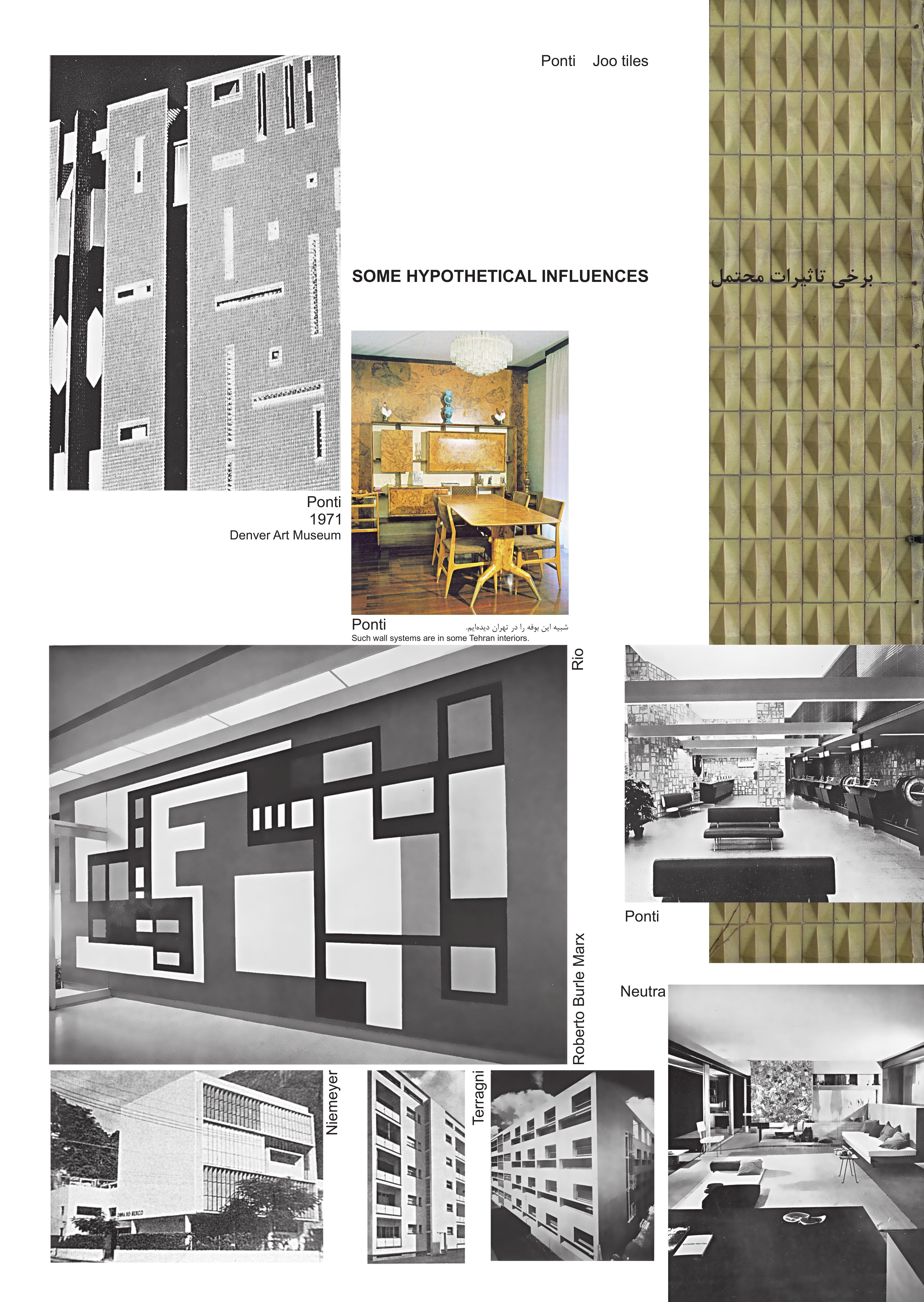
\\nبرخى تاثيرات محتمل Ponti Joo tiles Ponti Rio Roberto Burle Marx Terragni Niemeyer Ponti Neutra Ponti 1971 Denver Art Museum Such wall systems are in some Tehran interiors. SOME HYPOTHETICAL INFLUENCES .شبيه اين بوفه را در تهران ديده ايم
\n