Foreword
Even the best examples of architectural design don't have a good construction quality in Iran. That is, our knowledge and skill of construction is far behind that of design category. Many do believe in this interpretation. But in the following interview, Heshmatollah Monsef — one of the most adept and highly experienced Iranian mechanical engineers — and Ali Asghar Taheri, who is also among the most well-known structural engineers, believe that this way of dealing with the problem stems from a naive understanding of architectural design. In their point of view, this is a mistake (and a big one) to consider structural and mechanical considerations belonging to the constructional discipline and counting architecture only related to the field of design. All disciplines, from the beginning stage of the design process to the end of it, co-operate with one another and what is called "architecture" is a combination of all.
Architecture, in the end, is the making of fitting space for human life
Heshmatollah Monsef: In my view, architecture is in the end the making of fitting space for the life of man. Matters of providing the conditions of comfort in a building, too, are not only industry, only execution; setting the various disciplines apart in the work of architecture is not right. At present, in the world, this is the dominant manner of dealing with building and with architecture. If we attend to the publications of Arup — one of the largest architectural consultancies in England — we see that, in the introduction of every building, a section is given to its function, a section to architectural matters, and another to engineering. The mechanical services and the structural work are presented under the name of engineering. These sections cannot be set apart from one another. From the very beginning to the end, all are simultaneously engaged, and matters even at the level of detail are matters of design. To restrict these to the field of execution and the construction industry, therefore, does not seem right. Building services are, before everything and beyond everything, an issue of architectural design — not a separate matter that is imposed on architecture.
We accept your view. In any case, everything is built with a thought and on the basis of a design. So the point is not that special weight should be put on building and execution and that we should give these disciplines more or less weight in design. We accept the principle that, in our country, in many cases, design is carried out without regard to whether it can really be built — confined only to the display of form. The realisation of a building's execution is often not regarded as the architect's task. But if we can present good examples of execution and building that themselves rest on a design, we can to some extent bring architecture out of its abstract state.
Two disciplines: Architecture and Architectural Engineering
Monsef: In America there are two fields: Architecture and Architectural Engineering. Most of those who enter university study the first, and a number study the second. Structure, services, electrical work — even matters such as the waterproofing and fire-proofing of materials and the building itself — are also considered part of engineering. In Germany there is even a field called Fire Engineering. In America this system works very well. They come together under one roof: the engineering team is always with the design team — at the early stages as consultant, at later stages as collaborator. In Iran, students of architecture have classes in structure and services, but at the margin, and not much attention is paid to the importance of these disciplines in design and architecture. The result, as you described, is design without regard to the requirements of execution and the realisation of the building. In advanced countries the situation is more or less the reverse; there, the structural engineer does not give views only on the building's skeleton. Today a great part of structural discussion concerns non-structural elements such as walls, partitions, and façades, which have their own structural questions. All this shows that, in principle, engineering and design cannot be as separate as we see them in Iran.
Until that separation is reduced and the recognition that the understanding of engineering questions is part of architectural work is established, we cannot have much real innovation. In fact, the structural engineer cannot do lightening of weight on his own; if the architect does not fundamentally grasp what advantages lightening has, he cannot design in such a way that lightening attains real standing. That is why we today design buildings that have, in appearance, a European or American look, but whose engineering content is in no way European or American — heavy volumes that are also very over-justified, and for which we even fashion a set of rationalisations. For not only do architects fail to attend to this knowledge: there is also no connecting link to bring architects and engineers together. In my view, what you have called "industry" should rather be called engineering, or safety engineering. The fields have become so specialised that there is even a heading called Facade Engineering.
Beauty and craft, in tradition and today
Ali Asghar Taheri Behbahani: In our historical and traditional architecture, which is also very beautiful, structural and service questions have been correctly resolved. The architects of that period were so masterful in these aspects that they may be called engineer-architects. But today, when work has become specialised and a part of the architect's tasks has been delegated to others, those delegated tasks cannot be carried out abstractly. From the very early stage at which the design idea takes shape, all these aspects must be considered: the architect, at this design stage, must either have command of these aspects, or, with the cooperation of others, settle the related questions. Let me give an example: an experienced architect had presented a design for a large project in which a shell structure had been used — the shell is at once a structural and an architectural matter. In old Iran, the shell has been used as much as you like — for example in domes. But in this design, in fact, a space-frame structure was used, while the architect thought he was using a shell.
A façade drawn for a building, very beautiful on paper and with a pleasing form, must hold up on the body; this calls for knowledge of which the architect must have a general grasp. The architect must know what the response of this façade will be in an earthquake. At a time when earthquake was called a heavenly affliction and there was no understanding of it, our architects built such a work as the Soltaniyeh Dome — a masterpiece in this respect. Today our architect cannot be wholly ignorant of this matter and think that everything can be solved by welding. I remember once we were working on the design of a tall building one of our architects had drawn. An American architect who had come to our office, on seeing the design, said: if anyone gave such a design in our country, his designer's licence would be taken from him — for in this twenty-storey tower not the slightest thought has been given to the matter of fire.
Monsef: In these years we have seen very beautiful designs on paper in whose preparation no question of building comfort has been resolved. Before turning to those, let me mention a built case: the new Ministry of Housing and Urban Development building, in which we have a meeting once a week, has no proper air. On this point, those of us who are there only once a week, and those who must work there all day, are agreed. Even fire-zoning is the architect's task. I have seen, for instance, the introductory documents of the Sydney Olympic buildings; in those calculations the routes of crowd evacuation are not described, but the width of stairs has been determined relative to the importance of the evacuation routes. From the moment the architect starts designing, he must be aware not only of form but of many other aspects, or, if he is unaware, must consult an expert.
Key questions of services that are matters of design
Monsef: Among the important questions of services that chiefly belong to architecture are: the supply of healthy air, suitable lighting, the appropriate use of solar gain in cold regions, and the spaces required for the principal heating and cooling plant. For this reason, the coordination of architecture with services and structure must take place from the very start. From the very beginning, the architect must have in mind the dimensions of a room and the equipment that goes in it, and must think of where to place the door according to these conditions, so that when the equipment is installed, it can be done.
We accept this and would be glad if we could carry this approach forward. But there is also this point: services are an apparatus and a system that is added to space, and it is an answer to needs whose scientific solutions are uniform — that is, unlike form, they have no fresh invention or innovation. In architecture, every job in the end is a new form and a new design; in services it is not so. The second point is that, in present circumstances in the country, there is a great gap between design and execution. Our designers, by and large, do not think executively — whether we consider the architect alone or the multidisciplinary team. The maximum effort is bent on having the design be correct on paper, by the rules. On the other hand, even where a correct design is given to the executive group, correct execution remains difficult. It even seems that, in our country, the capacity for execution lags behind the capacity for design — though execution is, in the full sense, the revealer of design; design cannot show itself except through good execution.
Taheri Behbahani: The notion that invention and innovation belong to architecture and not to the other disciplines is itself our own invention! Perhaps because of customary working practice, the architect generally does his work and hands it over to the other engineers, and so no occasion is left for the development and refinement of the design. A very obvious instance of this approach is the performance of recent competition designs we have witnessed. In most designs, architecture has been thought through, but the place of structural-system invention alongside the architectural system is empty. When we look at the development of structural systems in, for example, tall buildings, we see that architecture has given rise to new invented structural systems. In New York buildings of the 1960s and 70s a very fitting structural system was invented in the façade — bracings span several floors, with one bracing every five floors. Or take the tube system in American office buildings.
Three phases of design, and the absence of quality control in Iran
Monsef: Today in the world, Phases 1, 2 and 3 in the manner used in Iran are no longer customary. After conceptual design comes design development, and after that detail design. They often hand the third phase to the contractor — to experienced contractors, of course. The general conditions of contract of the Plan Organization also place detail design with the contractor, but contractors do not accept it.
Taheri Behbahani: Our great problem in Iran is the absence of quality control. Anywhere in the world, if this is not done, bad work is delivered. This stage is an inseparable part of the process of design and construction, and must be carried out in Phase 4, that is, in operation. Quality control in our country is exercised only over the volume of materials used, not over correct execution of the design. Another problem is the lack of experienced technicians in building work. In Iran we are either engineers or nothing — whereas in America, for instance, the salary of technicians is higher than that of office engineers. The next problem is the lack of executive instructions: in other countries, for every job there are clear instructions — for fixing stone, for fixing windows, for painting walls. We do not have these.
In recent years, in Isfahan and Shiraz, the engineering organisation and the municipalities seem to have managed to work together; the consultants too have controlled work to some degree, and the quality of construction and structure has noticeably improved. In Isfahan, the greater part of building work is in steel; the presence of Esfahan Steel and a public that wants its work done both cheaply and properly has had its effect. The engineering organisations of Shiraz and Isfahan have been chosen from among themselves, and unlike Tehran, have done well — in Isfahan today we can see the most beautiful concrete works. In the sheikhdoms (Persian Gulf states), too, decisive concrete tests are run and all work is done according to international standards: Iraqi, Kuwaiti and Indian engineers work there, but the municipality is Kuwaiti and insists on concrete tests, and in such cases just as the foreigners take bad work from us, they also take good work — because there is a framework of engineering rules.
Two examples from Arup
Continuing the discussion of the multi-disciplinary character of architecture and the need for the simultaneous cooperation of all disciplines, the following are extracts from two works of the well-known firm Arup, in which the role of inter-disciplinary cooperation across the whole design process is evident.
1 — Manchester Aquatics Centre
Pools, by their large volume and hard surfaces, inevitably have a long reverberation time. Here the field of action for acoustic measures was limited, so the sound-absorbing surfaces had to be very effective. The design team decided to use the roof structure for absorption as well. Perforating the middle layer of the roof cladding allows the layer of mineral fibre, used for thermal insulation, also to act in sound absorption.
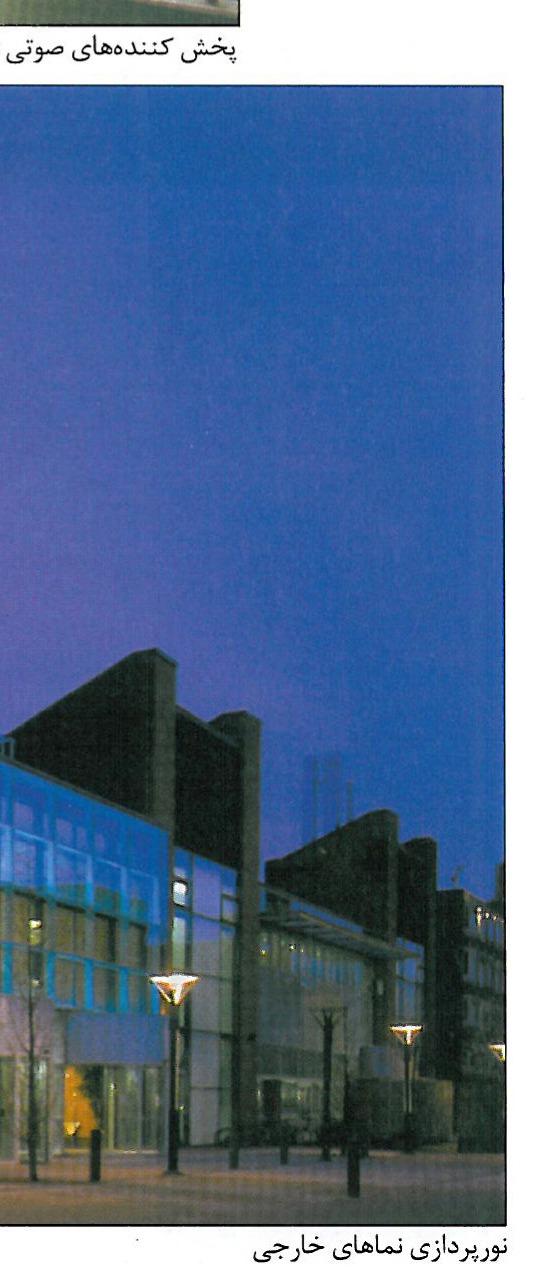
To meet the building-control requirements, the voice-alarm system (VA) is fully integrated into the fire system. The loudspeakers used for voice alarm are also used to communicate with the crowd in the pool. Nine cone speakers (with a high quality of direct projection), mounted on the central catwalk of the roof, provide acoustic coverage of the competition pool. Beside the above speakers, sockets are provided along the wall by the pool for underwater speakers (one per side) which on special occasions are lowered into the water with weights.
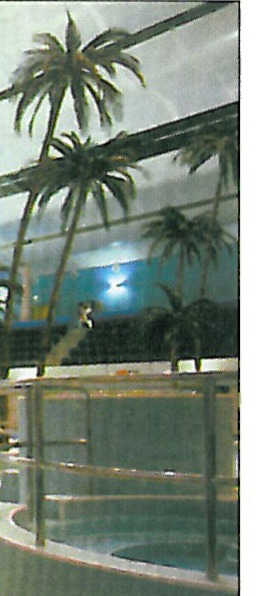
The principal concern of the services engineer in designing the pool was to provide ventilation that could control the steam rising from the pools and protect the building's fabric from its damage, while providing pleasant conditions for wet swimmers. Water at 29°C has a higher rate of evaporation than colder water. To address these issues, Arup applied the same successful and integrated engineering strategy used at Ponds Forge: under-floor ducts for distributing and exhausting air in the main spaces of the indoor pool. Warm, dry air is sent up from the building's enclosure, and return air is taken from the lower level — where pollutants are at their highest — through the pool grilles. To verify that air temperature and the speed of distribution in the pool hall remain at acceptable levels, the CFD method was used.
A small CHP unit (combined heat and power) was installed to reduce running costs. The building's efficiency was modelled with BEANS programs to determine the unit size suitable for 365-days-a-year continuous operation. A 300-kW and 410-kW packaged unit was selected and clad with an acoustic enclosure.
2 — Osaka Maritime Museum
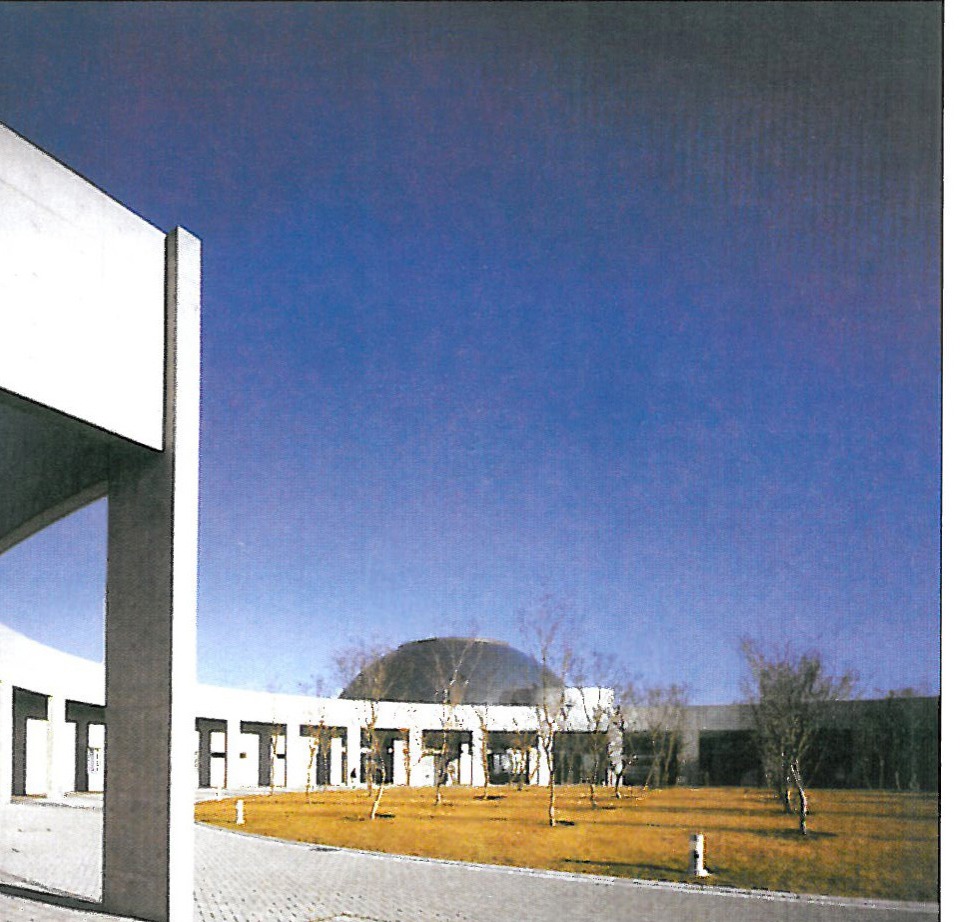
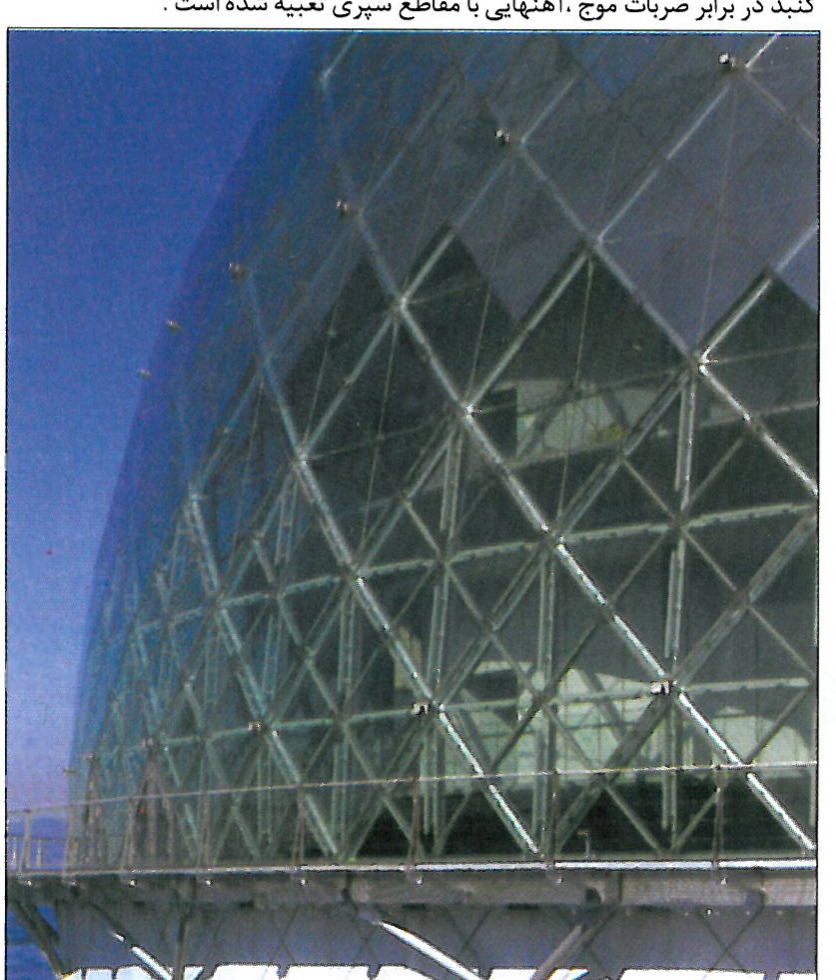
In 1993 the Osaka harbour-office authorities approached Paul Andreu's architecture office in Paris to advise on a maritime-museum project. The office proposed that the building be built in the bay's waters, and presented preliminary designs of a spherical dome floating in Osaka Bay. On this basis the Osaka Maritime Museum was placed on a piece of reclaimed land in the bay's waters. Its all-glass metallic dome, 70 m in diameter, is connected by a 60-metre underwater tunnel to an entrance building on land. The latter also frames a circular shoreside courtyard, also 70 m in diameter. The dome contains three ringed levels surrounding the Higaki Kaisen ship — reconstructed from booths of wooden trade ships of the Edo period between the 17th and 19th centuries. Site area: 33,443 m²; total built area: 20,699 m², 70 % of which lies inside the dome.
Paul Andreu's office, on commission from the Osaka city authorities, invited Arup London to provide structural services in studying the project's feasibility. Subsequently, the scope of work was expanded to fundamental studies in joint cooperation with Arup and Tohata, one of Japan's leading consulting engineers. Preliminary design was carried out in Paris, London, and Osaka, and was completed in spring 1996. In early 1997 the same team was commissioned with the detailed design; the centre of activity moved to Japan, the architect set up an office, and Arup Japan undertook the engineering services. Arup's responsibility covered the structure of the glass dome and the macro-structure within. Tohata's responsibility covered the entrance building, the tunnel, the lower part of the dome, and the pile foundations of all three buildings.
Ventilation of the dome and its spaces is provided by several systems, each covering a separate part. The dome itself houses three large air-handling units (AHUs) at its lower part and three more at the top, on the central parts of each level. These units provide warm and cool air through nozzles set around the foot of the dome and at the top of the principal cores. All floors inside the dome use under-floor air distribution. This combination keeps overall floor depth at 1.2 m and minimises the need for above-ceiling access — both key matters in the architectural design.
Construction and installation of the dome
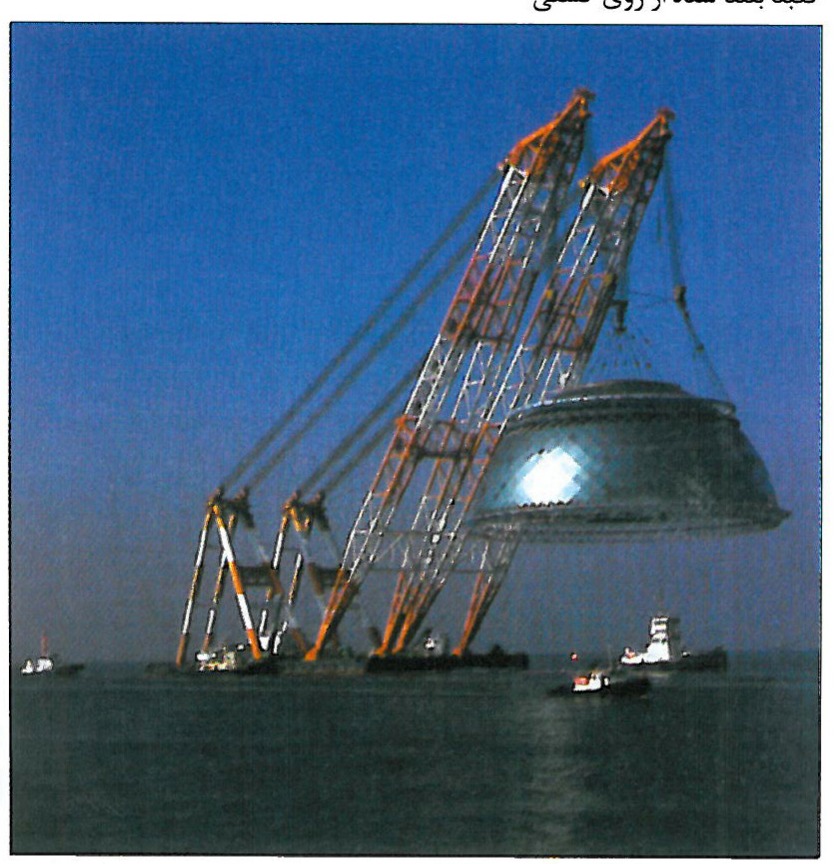
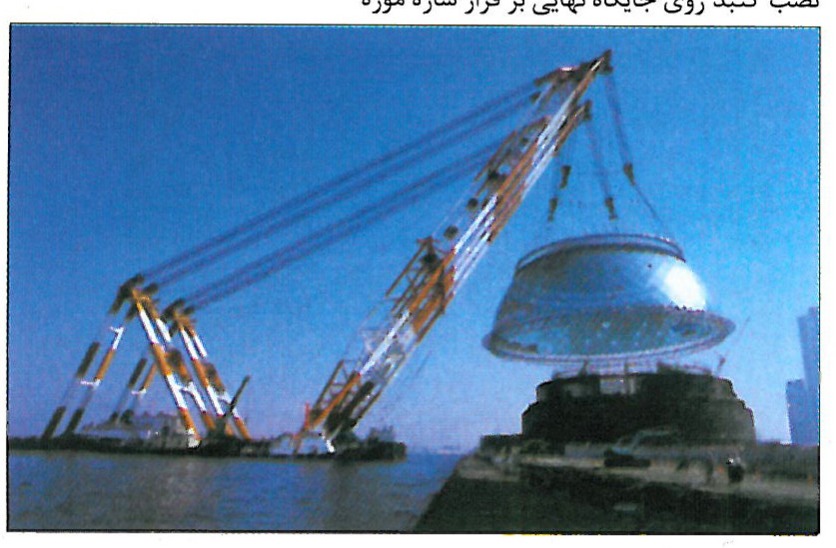
The short 25-month construction programme showed that installing the dome after completing the inner structure (or vice versa) was not possible. Fortunately, the dome's location, only 15 metres from the shore, together with sufficient water depth, made possible a novel mode of execution: build the dome entirely off-site and then install it onto the completed inner building, using a large floating crane. The Kawasaki Heavy Industries factory at Harima was chosen — not only for its capabilities but for its easy access, only 12 km from the site across Osaka Bay. Harima lies near Awaji Island, well known for being the centre of the 1995 Kobe earthquake.
The installation date was set on the basis of weather forecasts, sea-traffic conditions, and the wish to do as much work as possible in the factory; the chosen date was 7 November 1999, with one week's allowance for delay. Construction of the dome began at the end of 1998 after extensive quality-control tests on the cast-steel nodes for the diagonal connections of the structural lattice. The hemisphere of the dome was divided into 12 large units, each assembled on its own jig. The weight of these jigs is roughly equal to the weight of the dome itself.
These extracts are taken from The Arup Journal, issue 1/2001.