tree-like unified elements that branch out beneath the ceiling, joined together. On the main facade, an auxiliary structure supports the glass skin. This composition is a dynamic combination of wood, steel, and a touch of glass. Continuous, firm connections between various compressed and rigid structures with lighter forms are another type of composite connections that can embody the interaction between fixed and variable, load-bearing structure and facade, or frame and content. The primary concept of Norman Foster's Sainsbury Centre for Visual Arts in Norwich (1978) aptly demonstrates this principle of composition: the relationship between a fixed, resistant load-bearing structure (consisting of steel trusses) and a renewable layer with a skin of aluminum panels as cladding. The composite quality of the twin towers of the European Central Bank (ECB) in Frankfurt, by Coop Himmelb(l)au (2004), is similar to the design by the Think architectural group for the World Cultural Center at Ground Zero in New York. Both towers are stabilized against wind and earthquakes by a concrete core and a concrete frame skeleton, further balanced by several aerial walkways, ramps, and platforms. A key element is the existence of a flexible and standardized spatial program for office spaces. Moreover, the multi-layered, glass-covered composite skin serves several functions. After the devastating 1995 Kobe earthquake in Japan, Shigeru Ban employed cardboard, wood, and steel in his composite structures for earthquake-prone regions of Japan, India, and Turkey. Diebedo Francis Kere, in rural schools he built in Burkina Faso, used local materials, technology, and indigenous methods. For example, in the Dano Secondary School (2007), he employed a combination of local stone for the building's base and clay for the walls and undulating roof. The concrete framework atop the walls and the undulating roof, comprising a steel frame and corrugated metal sheet. Dome of the Cathedral of Santa Maria del Fiore, Florence, Filippo Brunelleschi. Renault Distribution Centre, Swindon, 1982, Foster + Partners. Iron bridge, Coalbrookdale, 1775-79, Thomas Farnolls Pritchard. Swimming stadium, Kuala Lumpur, 1998. Padre Pio Pilgrimage Church, 1991-2004, Renzo Piano Building Workshop. Mobile IBM Pavilion, 1983-86, Renzo Piano Building Workshop.
The corrugated roofing sheets are among the construction methods left over from the colonial era. In this way, old traditions are combined with newer, adapted forms through the application of simple technology. A similar example of material combination is the METI Handmade School in Rudrapur, northern Bangladesh, designed by Anna Heringer and Eike Roswag, built in 2005 with the help of local residents. The cob walls of the ground floor create cooler, darker rooms, while the lightweight bamboo structure of the upper floor creates bright, outward-facing, well-ventilated spaces. The joining of dissimilar materials in this building exemplifies a model for redirecting technology, scientific knowledge, and experience. Condition-based composite structures utilizing local materials and technology are found in all cultural spheres and climatic zones. For example, in the northeast region of Nepal, there is only one method of construction. Here, hard stone and wood are abundantly available. These materials, along with corrugated metal roofing and internal connections and plaster, must be transported by humans or caravans of buffalo and mules. Only basic, simple tools are available, yet drawing on rich experience and technical knowledge, the result achieves the highest degree of refinement and precision. The former exhibition hall at La Defense in Paris (1958), covered with a seemingly heavy concrete vaulted roof with a triangular plan 225 meters long and 48 meters high, was converted by Brullmann Crochon into a center for shopping, services, and events, where the interplay of large and small forms creates an extraordinary spatial experience. In many cases, the modification and conversion of existing buildings not only extends their useful life but also preserves the building's historical documents. For example, the reconstruction of the Alte Pinakothek in Munich (1952), carried out by Hans Dollgast after World War II, is a collage of composite construction forms and historical identity — one of the most skillful postwar conversions. Returning to this type of work represents a new stance toward existing architecture. Carlo Scarpa's designs shine as jewels in the field of composite building forms. In any case, nearly all buildings are composite, and in the future, complex computer programs will calculate fully composite systems, and in every situation the most suitable materials will be employed — in natural form or as a composite, hybrid element. * Ulrich Pfammatter teaches at ETH Zurich and the architecture schools of Lucerne and Bern. Footnotes: 1- Christian Schittich. 2- Frei Otto. 3- Metz. 4- Cecil Balmond. 5- Filippo Brunelleschi. 6- Swindon. 7- Jorg Schlaich. 8- Padre Pio. 9- Peter Rice. 10- Sibelius. 11- Hannu Tikka. 12- Kimmo Lintula. 13- Sainsbury. 14- Norwich. 15- Coop Himmelbau. 16- Ground Zero. 17- Kobe. 18- Diebedo Francis Kere. 19- Dano. 20- Anna Heringer. 21- Eike Roswag. 22- La Defense. 23- Brullmann Crochon. 24- Alte Pinakothek. 25- Hans Dollgast. 26- Carlo Scarpa. Reconstruction of Alte Pinakothek, Munich, 1952-55, Hans Dollgast. Sibelius Hall in Lahti, 2000, Hannu Tikka and Kimmo Lintula.
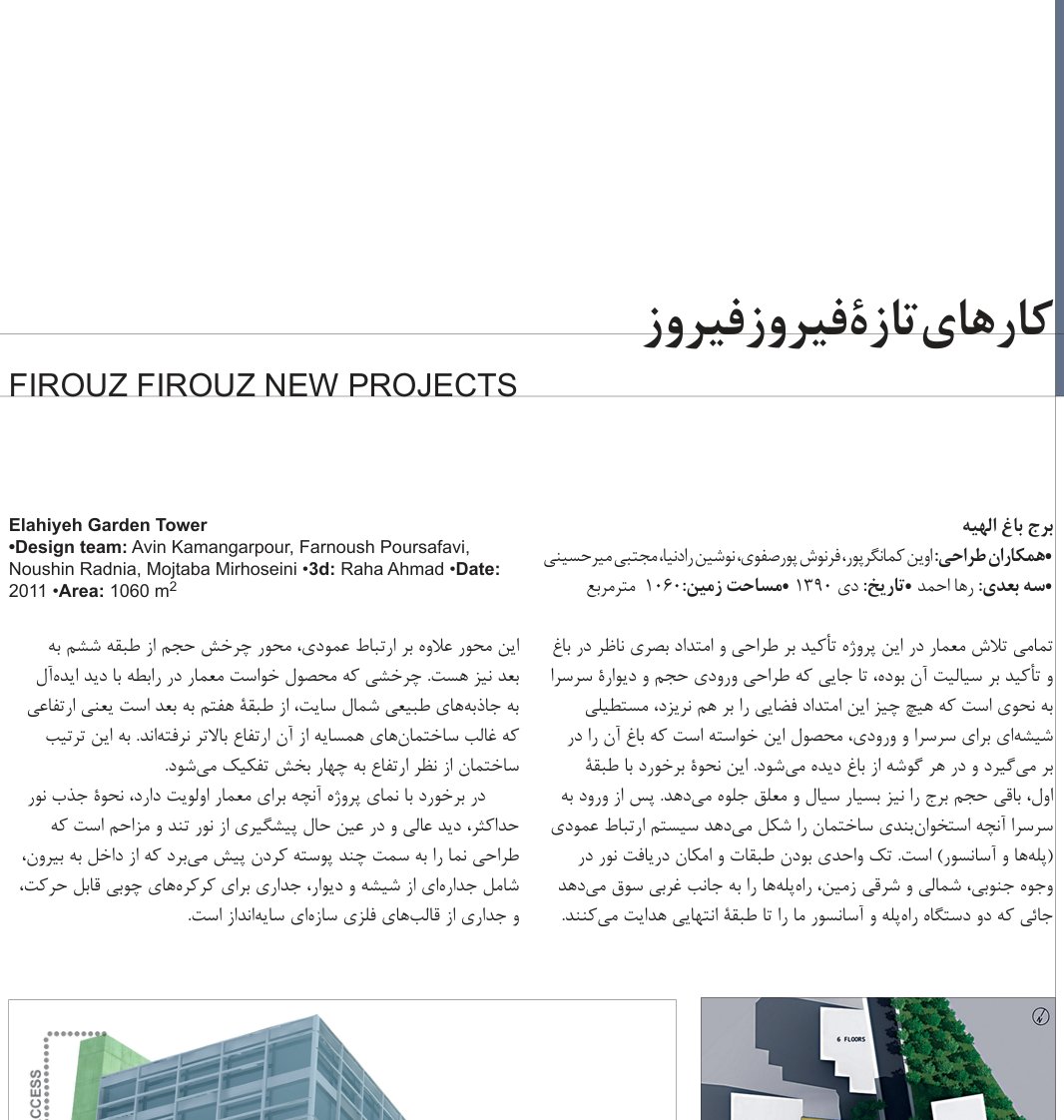
Elahiyeh Garden Tower. Design associates: Avin Kamangarpour, Farnoush Poursafavi, Noushin Radnia, Mojtaba Mirhoseini. 3D: Raha Ahmad. Date: 2011. Area: 1,060 sqm. The architect's entire effort in this project has been to emphasize the design and visual extension of the viewer within the garden, and to emphasize its fluidity — to the point that the design of the volume's entrance and the lobby wall is such that nothing disrupts this spatial continuity. A glass rectangle for the lobby and entrance is the product of this desire, embraced by the garden and visible from every corner of it. This approach to the ground floor also makes the rest of the tower volume appear highly fluid and suspended. Upon entering the lobby, what forms the building's skeleton is the vertical circulation system (stairs and elevator). The single-unit floors and the ability to receive light on the southern, northern, and eastern sides direct the stairways to the western side, where two sets of stairs and elevators guide us to the topmost floor. This axis, in addition to vertical circulation, is also the axis of rotation for the volume from the sixth floor upward — a rotation produced by the architect's desire for an ideal view of the natural attractions to the north of the site, from the seventh floor onward, meaning the height above which most neighboring buildings do not rise. In this way, the building is divided into four sections by height. Regarding the project's facade, what takes priority for the architect is the method of maximizing light absorption, excellent views, and at the same time, preventing harsh and intrusive light — which drives the facade design toward multiple skins: from inside to out, a layer of glass and wall, a layer of movable wooden shutters, and a layer of structural metal sun-shading frames. New Projects by Firouz Firouz.
1st to 6th floor plan. 7th to 10th floor plan.
Niavaran Residential Building. Design associate: Avin Kamangarpour. 3D: Mojtaba Mirhoseini. Date: June 2011. The project site, with an area of 3,181 sqm, is located between Boukan and Marjan streets north of Niavaran Street, with a 14.50-meter elevation difference between them — Marjan Street on the south side is lower, and the project site has access from both sides. The client requested the design of distinctive shared amenities. This change in elevation on both sides of the site was transformed from a limitation into an asset, and the consultant used it to assign separate entrances for the semi-private residential use and the public exhibition space. Given the latter's lesser and more limited need for light, its entrance was placed on the Marjan Street side. The architect's constant preoccupation with weaving his architecture into the urban space and blending the entrance with the street — especially in this project, where the Marjan Street entrance serves as the entry to the project's public space — gave rise to the idea of unifying the courtyard and the sidewalk. In this way, the project courtyard became a public, green space that invites passersby to the exhibition space. After positioning the entrance, the second step in the design was planning the vertical circulation of the building, which has a significant impact on the interior layout, the way one reaches the floors (lobby design), the building's facade, and more. The architect's sensitivities regarding the quality of interior circulation spaces, the effect of light on spaces of pause and movement, the single-unit nature of the floors, the provision of parking, and the preservation of hierarchies directed the placement of circulation spaces toward the edge of the site (eastern side). Thus, the lobby space on the ground floor and the apartment entrance were placed beside it, and the project floors, from the northern entrance, are allocated successively to parking and lobby on the ground floor, five residential floors above, and a pool, gym, and three exhibition floors below — spaces that were each organized according to their orientation relative to light, their position in the hierarchy, and the preservation of privacy.
What is notable about this building is the differentiated treatment of the facade according to the expression of its function. The northern facade, entirely residential, is treated simply — concrete (at the client's request) — with the amount of light required by each space. But the southern facade, which encompasses all building floors and is therefore taller, has been designed differently owing to the viewer's different perspective (entering the shared amenities) and its integration with the street. A silent expression of the two-story wall on the building's lower floors, and consequently the doubled impact of the greenery at the entrance and the portico above, represents an effort to separate the exhibition section. A solid wall bordered by greenery from above and below, and continuing with a facade similar to the northern one, enclosed in a glass frame and resting on a concrete base — with planters that decrease in depth from bottom to top. Spider glass with a frosted (fritting) design creates a light frame for the concrete facade.
Darya Commercial Complex Competition. Client: Mojtamah Omrani Iranshahr. Competition manager: Nader Salehi. Project manager: Firouz Firouz. Design team: Mohsen Marizad, Noushin Atroush, Negar Baghaei Pour, Raha Ashrafi, Helena Ghanbari, Noushin Radnia. 3D: Mohammad Ashkbarsefat, Raha Ahmad. Date: 2012-2013. Site area: 2,895.22 sqm. Total built area: 37,310 sqm. Floors: 16 (8 underground parking levels). Jurors: Iraj Etesam, Ali Akbar Saremi, Darab Diba. The Darya commercial project was designed with a different perspective on commercial complexes — a space that meets the desires of shoppers and offers a solution to the stagnation of shopping centers. Transforming shopping centers into spaces for recreation and leisure, and merging them with urban open spaces, was the architect's first line of thinking in this project. This aspiration, through the rotation of the building toward the park adjacent to the site and the creation of a void within the volume, draws the urban green space ever further inward, and the merging of the two enriches both and creates a powerful entrance. The second design priority was stitching the horizontal urban vistas to the south with the vertical view of the northern mountains and taking advantage of both — resulting in the twisting of the volume. From this twist, a massive cantilever emerges on the south side, providing an ideal surface for large-scale vehicular advertising (cars moving from the Chamran highway toward the boulevard). The eastern and northern facades also attract pedestrians, and in this way, the building's facade itself becomes the promoter and advertiser of its contents. After passing through the eastern green space and ascending the southern steps of the volume, one reaches the interior space — organized linearly with fluid corridors circulating around a void that changes shape on every floor, creating a flexible space. This opening, in moving from the ground floor to the topmost floor, draws ever closer to the facade walls, pulling a vast volume of light inward. The form of this project, resulting from analysis and prioritization, has led to a massive cantilever and has become an inviting form that seems to draw everything into itself. The structural response to this cantilevered and complex form is a trussed skin that covers the entire facade. The components of this truss determine the form of the building's enclosure, and in fact, structure and form become one. The result of such a process is the creation of an iconic building that can serve as a successful urban landmark in western Tehran. Interaction with nature. Interaction with the city.
Damavand Garden. Design manager, consultant, and supervisor: Firouz Firouz. Design and supervision associate: Noushin Radnia. Renovation associate for parts of the garden's buildings: Emarat-e Khorshid Office. Studies and landscape associate: Farnoush Poursafavi. Landscape consultant: Saeed Atazadeh. Construction: Farshid Sadeghi, Emarat-e Khorshid Office. Photography: Sabk Design Office. Area: 8,000 sqm. The primary design approach in this project was the restoration of the garden with minimal alterations, while simultaneously imbuing the summer retreat space with meaning. The existing facilities and buildings were largely preserved and, in accordance with the renovation plan, some received optimized uses. This work was undertaken with the aim of preserving the nostalgic and pleasant character of the space for the owner. The western side of the property, which had previously consisted of a triangle formed by the main building, guest building, and pool, inherently had the potential to create a sense of gathering and memorable perspectives — a space that, through lighting, paving, and the creation of effective axes, could bring family members together at different hours of the day. Since the clear separation from the designed Iranian garden on the other side of the property did not interfere with creating an independent space in this section, the designer began the renovation of this part by emphasizing the old solitary plane tree, a nostalgic element and a mark of the garden's age. Avoiding the planting of new vegetation, designing purposeful windows in the main house, paving, lighting, furniture arrangement, maintaining the space's privacy, and preventing vehicle entry to this section were all effective in achieving this goal. After passing through the garden alley and the pedestrian entrance gate and descending the steps, one arrives below the level of the public road. In the triangle of the main building (228 sqm, 2 floors), the guest building (56 sqm), and the pool, what catches the eye upon first entering is the main building on the left side of the entrance. This building, renovated with minimal intervention, was a two-story structure with walls of mud brick and clay and wooden beams with mud-straw plaster and a final layer of gypsum. Most spaces had jack-arch ceilings with wooden beams, and by preserving the existing valuable elements and following the original pattern, the effort was to improve and make the spaces usable. Making the eastern and western porticos symmetrical, aligning the southern side of the building, balancing the height of the stone staircase, and on the other hand, preserving the wall buttresses, the details of the gypsum porch columns, the stone staircase, and the proper placement of spaces were notable points in the design. Opposite this building, another structure on the left side of the entrance, preserved at the architect's recommendation and the client's agreement, is a simple building inspired by the main building. It was preserved and renovated due to the garden's need for a guest building on the one hand and the existence of an unused structure in this section. Preserving the simplicity and volume of the building, to keep it in the background, and creating shared decorative details with the main building defined a common language for these two structures. Finally, the pool, spread across the courtyard between the two buildings, is visible. This space was created by utilizing and reviving the old, disused irrigation pool of the garden. Special paving design, surrounding lighting, and tree planting around the pool's edges instill a particular emphasis and attention to the pool. Ultimately, this complex, by preserving its nostalgic identity and designing an Iranian garden conforming to the complete garden pattern — the explanation of which lies beyond the scope of this text — has created a pleasant space for the client that not only holds the appeal of spending weekends there but has also planted in the client's mind the possibility of permanent residence.



