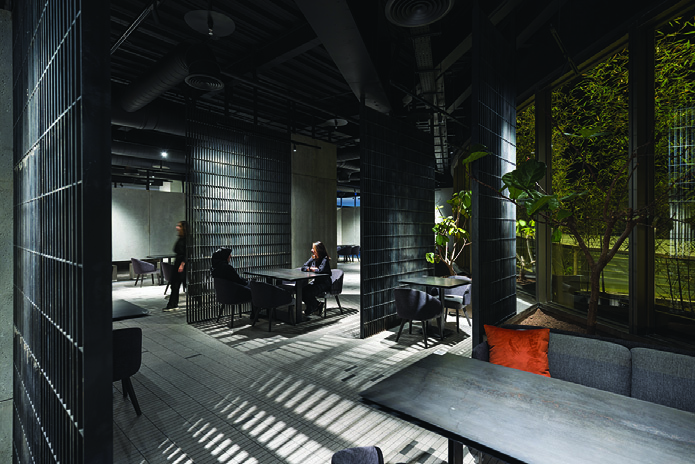
Since the earliest discovery of iron, human effort has consistently been directed toward shaping this hard material to suit one's needs. The use of iron in building and architecture is not limited to the skeleton and structure of a building. This material is also widely used in facade work and architectural ornamentation. In the past, shaping iron for building decoration was carried out by master craftsmen using rudimentary tools through a difficult and laborious process. Today, however, industry and machinery have come to humanity's aid, greatly easing the burden of execution.
Nahamin Industrial Company is the first workshop in Iran equipped with fully computerized German-made machines capable of producing shaped metal components in any form and any size. In this company, all forging operations are transmitted to the machines by computer. The iron is first patterned through cold rolling, then placed in the forging machine where it undergoes shape transformation. The press and twisting machine gives the iron its final form.
A selection of the company's products, offered in a wide variety of designs, includes:
- Various types of railings (for balcony fronts, staircases, parapets, courtyard and park walls, etc.)
- Various types of partitions
- Window guards
- Various formed metal components and prefabricated elements for assembly
- Various parking entrance doors
- Guards installable on wooden and aluminum doors
- Various balusters
- Street clock posts, urban signage, and pedestrian bridges
- Playground and recreational park equipment
- Park benches, lamp posts, and park seating
- Various furniture and interior decorative elements
- Various chandeliers and outdoor lighting fixtures
The diversity of building materials production has increased architects' options for achieving higher quality and greater beauty. Yet despite the availability of a certain variety, among products such as shaped iron, there are still many buildings where unfinished and unshaped iron is used. The use of wrought iron in the production of interior building furnishings and equipment — such as bookshelves, partitions, writing desks, and lamps — is not yet widespread. Nahamin Industrial Company has thus far produced and executed successful designs in collaboration with the Tehran Beautification Organization, and by introducing its products in Memar magazine, it hopes to promote the broader use of these products among consumers.
Bijan Nik
Born 1333 (1954). Graduated in civil engineering from the University of Mazandaran in 1355 (1976). Holds a certificate in wrought iron design and production from the Wrought Iron Manufacturers Association of Malborg, Germany. Instructor at industrial vocational schools in Shiraz, and author of a book on residential buildings on urban lots.
Parviz Amiri
Born 1322 (1943). Bachelor of Architecture from Germany in 1972. Master of Architecture and Urban Planning from Shahid Beheshti University. With experience at consulting engineering firms in Hamburg and seven years of supervisory experience in municipal construction in Tehran, and fifteen years of activity in architectural design, execution, and supervision of residential buildings.