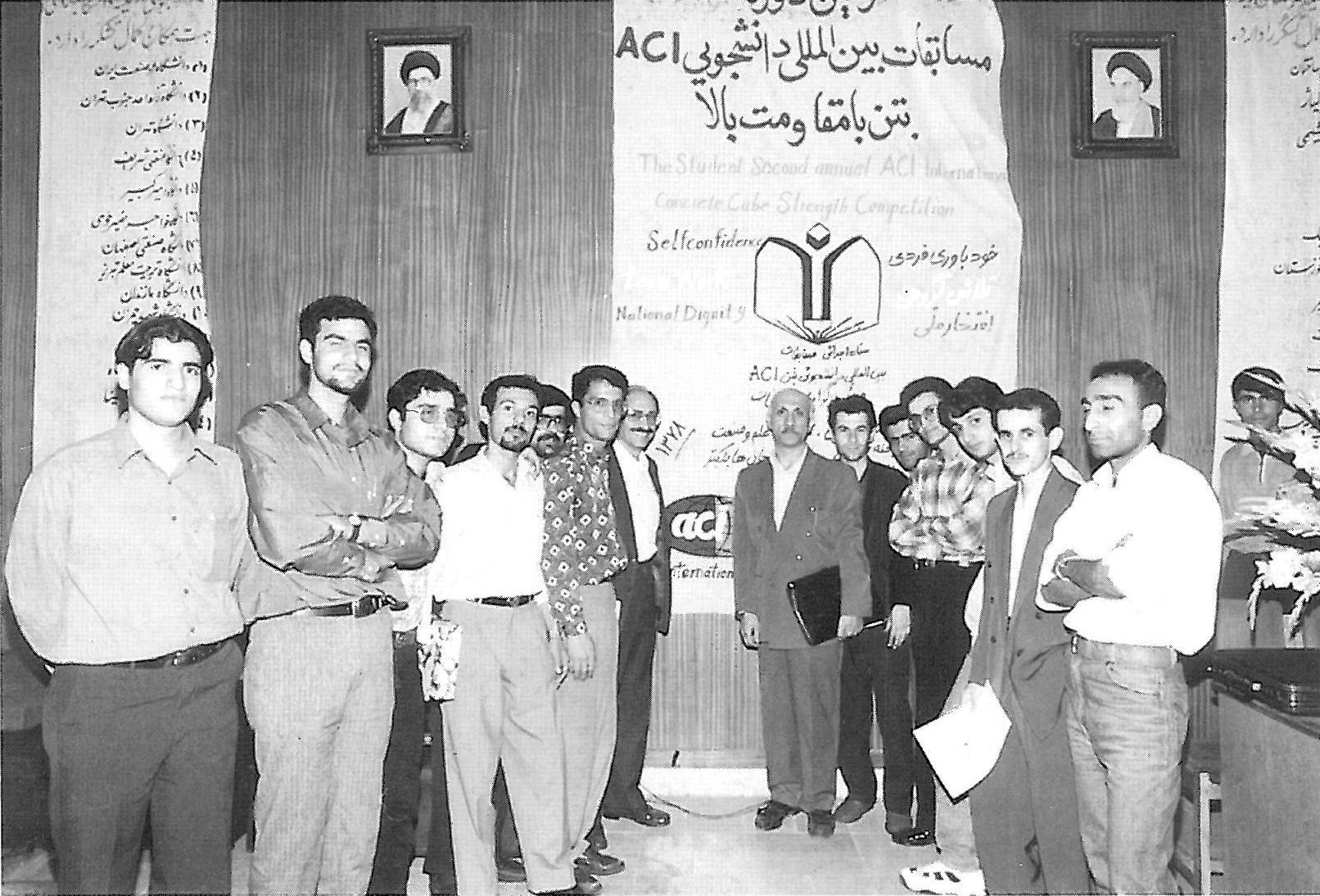
After three years of sustained effort and activity, Iranian students have for the second time succeeded in taking part in the international concrete competitions. The American Concrete Institute (ACI), whose head office is in the United States, is engaged in research, in developing technical education and in drafting building codes. The Institute holds a convention every year in the United States. One of its important activities is running a concrete competition among students. The nineteenth competition and conference, in 1998, was for the first time held not — as previously — for the American continent alone but internationally, and Iranian students took part in it. The twentieth round of this competition was held this year in the city of Baltimore in the United States, and the participating Iranian students took seventh place. These students had been selected from among 60 student teams from 22 universities that had registered for the competition.
The competition was run under the management and sponsorship of the Vandshimi Sakhteman company, through the efforts of the members of the student committee for running the concrete competitions, and with the financial support of the Islamic Azad University and the Tehran Cement companies, the Bouzarjomehr company, the Fard Alliage Iran company and the Atropat Chemical company, in cooperation with the authorities of the University of Science and Technology, at that faculty’s concrete laboratory, on the fifth of Mehr this year.
The members of the competition jury were: Dr Hormoz Famili, Eng. Mostafa Ahmadvand, Dr Alireza Khaled, Eng. Bijan Ghaznavi, Eng. Firouz Hadavi, Dr Abdollah Keyvani, Eng. Javid Khatibi.
This panel drew up the competition regulations and supervised their precise application.
In the domestic competition, four teams were selected — from Isfahan University of Technology, the University of Mazandaran, the University of Kurdistan and K. N. Toosi University.
After the American consulate in Istanbul refused to issue travel visas to the representative of the student committee and to the supervising professor, who were to carry the 5×5×5 cm concrete specimens to Johns Hopkins University, the specimens were sent with a traveller bound for the United States. At the same time the ACI student committee in the United States examined the problem of sending the specimens and charged three of those responsible for student activities with resolving it, so that the difficulty of sending specimens would not recur in the competition of the year 2000.
Winners of the domestic competition
The winners of the domestic competition, whose specimens were sent to Johns Hopkins University, were:
Isfahan University of Technology: Majid Nozhati, Navid Taheri, Mohammad Nilipour
University of Mazandaran: Mohammad Moghimi, Amir Masoud Fakhari, Payam Shafighi
University of Kurdistan: Mohammad Zahed Amiri, Khalil Rahimi, Saleh Moradi-Nia
K. N. Toosi University: Kourosh Keshvarian, Mehran Seyed Razzaghi, Mohsen Sharifi
Results of the international competition
The first three winners of the international competition were, in order:
– Southern Illinois State University, USA — specimen weight 309 grams, compressive strength 1989 kg per square centimetre
– University of Nuevo León, Mexico — specimen weight 283 grams, compressive strength 1342 kg per square centimetre.
– Bordeaux University, USA — specimen weight 307 grams, compressive strength 1341 kg per square centimetre.
The Iranian students took seventh place in this competition; the holders of first to fourth place in that standing were, in order:
1. K. N. Toosi University — specimen weight 310 grams, compressive strength 605 kg per square centimetre.
2. University of Mazandaran — specimen weight 310 grams, compressive strength 533 kg per square centimetre.
3. University of Isfahan — specimen weight 297 grams, compressive strength 516 kg per square centimetre.
4. University of Kurdistan — specimen weight 310 grams, compressive strength 488 kg per square centimetre.
The executive committee of the ACI international student concrete competitions has already begun work towards the international competition of the year 2000, and intends, by holding a regional competition at the Asian level, to secure a fitting place for Iran’s young people. All those interested in research and investigation are therefore invited to contact this committee.
It is to be hoped that in future, through the efforts of the students and the esteemed professors of the universities and the support of the managers of our country’s industries, we shall witness the ever-growing distinction of young Iranian talent in international gatherings.
Committee address: Tehran, Vali-Asr Street, Vanak Square, Shahid Khodami (Bijan) Street, Kuy-e Leyli, No. 7, Plaque 6. Tel: 8787452 Fax: 8797454



