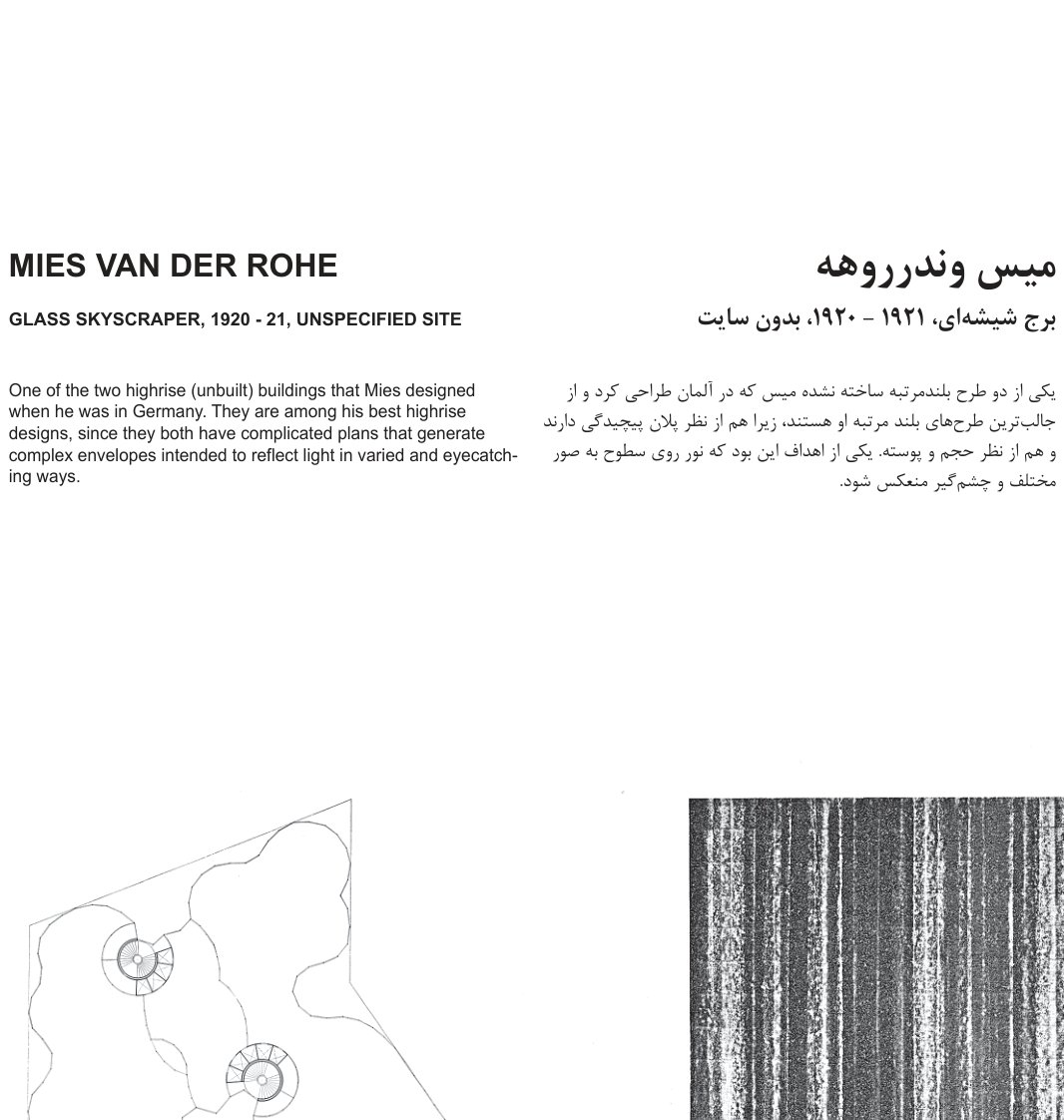
One of the two highrise (unbuilt) buildings that Mies designed when he was in Germany. They are among his best highrise designs, since they both have complicated plans that generate complex envelopes intended to reflect light in varied and eyecatch- ing ways.
GLASS SKYSCRAPER, 1920 - 21, UNSPECIFIED SITE
A complex plan composed of many different curved lines. In part, they had the role of creating enticing reflections of light when forming vertical planes. How- ever, such an adventure was never seen in Mies’s later works!
اسكيس مدادىPencil sketchماكت در صفحه مقابلOpposite page: model
Unlike the other high-rise design of Mies that has a complicated plan and uses curves, here the external envelope consists of straight lines. Another difference is that it is symmetrical on one axis.
OFFICE BUILDING, FRIEDRICHSTRASSE, BERLIN, 1919
Mies’s American period, marked primarily by elegant rectangular volumes that served also as residential. They became the main model for high-rise building in America and elsewhere.
SEAGRAM BUILDING, NEW YORK, 1958 - OPPOSITE PAGE
APARTMENTS, 860 LAKE SHORE DRIVE, CHICAGO, 1951 - below



