New methods and materials have made it possible today to produce nearly any product with any shape and at any price. It seems as if plastics have been luckier than any other material and play the role of intelligent materials in the today process of production and design. The compound chassis and the body of Mercedes-Benz Class A automobile front seats made of reinforced Polyamide; the top section of the new generation EVO vacuum cleaner designed and produced with ABS; the NeopTex new glasses; Nike football boots; Volkswagen's new Golf VR6 motor manifold; Compopure's recyclable plastic spoon and forks; and the Dutch Campina and Coberco companies' new plastic dairy bottles — these are among the examples that show a revolution in the confrontation of Man and material.
The designer's preoccupation with the limits of materials and production processes does not belong to a very distant past. Perhaps in the years when form, function and material had a smoothly compounded existence, design had a different mood and atmosphere. To this day, looking at the work of designers such as Castiglioni, Magistretti and Mangiarotti gives a particular pleasure. But mere nostalgic attachment to a kind of design cannot sustain pioneering design. The current of design was, on the whole, very quickly subjugated by the advance of technology, by its effect on the way new products are presented, and by the rise of newer needs. Materials and methods of production have made it almost possible to produce any product, in any form, at any price. Perhaps in this connection plastics have shone above all other materials. Plastics, aluminium alloys, the various adhesives and synthetic compounds are the unrivalled rulers of production technology at the start of the third millennium. In this period, plastics play the role of "intelligent materials" in the production and design process. Until a decade ago, designers and production engineers conceived their parts and components on the basis of the properties of the materials at hand. Today plastic, by altering its compounds, molecular structure and production process, harmonises itself with the needs of designers and production engineers — and this can be seen as the dawn of a great revolution in mankind's encounter with material.
The history of civilisation is the history of human effort to grasp the properties of materials and the way they behave in different situations. Mankind's successes along this path are the milestones of civilisation. The naming of past ages — the Stone Age, the Iron Age and so on — reflects the human acquaintance with that material and the gaining of the ability to form, process and work with it. At the dawn of the new millennium plastic, by surrendering its properties and behaviour to the will of technology, can be regarded as a symbolic step in the metamorphosis of the relationship between Man and matter. Creating a molecular structure tailored to the behavioural characteristics needed in plastics may be important enough that the new age be called the Age of Plastic. Surveying the wide range of applications of plastic materials in new products is a challenge that design is forced to engage with. The capacity of plastic to adapt to design and product needs may be regarded as a leap in the realm of materials and the beginning of the use of intelligent materials in production. The following examples bear witness to this claim:
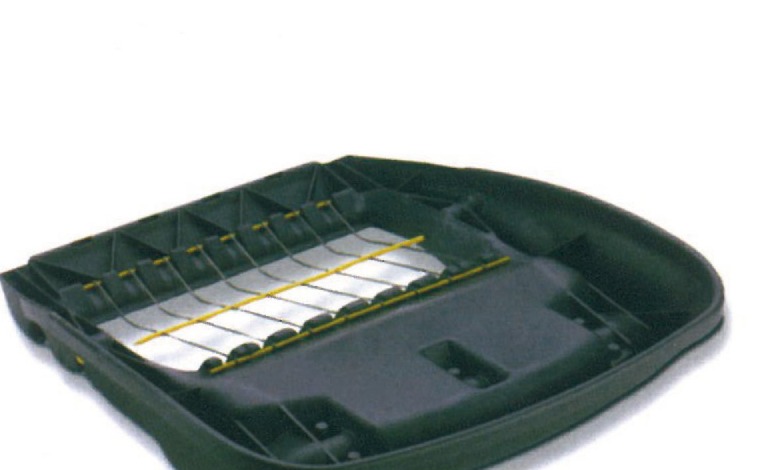
Mercedes-Benz Class A front seat shell. The combined shell-and-chassis of the Mercedes-Benz Class A front seats is built from polyamide reinforced with mineral fibres. Engineers and designers from Recaro and Daynamit Nobels, working hand in hand, have devised a wholly new design for an inexpensive but highly capable shell for the Class A seat. High weight- and pressure-resistance, while remaining light, are among its qualities. For the first time, the entire suspension behaviour of the seat is performed by part of the shell itself, with no separate reinforcing element. Every fitting and accessory of the seat — the foam, metal and fabric components — is part of the shell itself. At the same time the shell has demonstrated excellent performance in front- and side-impact tests.
EVO vacuum-cleaner housing (ABS). The EVO company has devised a new method for designing and producing the upper housing of its new generation of vacuum cleaners. In the inventive design of this part — which forms a major share of the product's moulded form — and by selecting ABS for its very suitable properties, the company has been able to design and produce a continuous part with side-walls up to 7 cm deep without the need for added cores.
NEOPTEX sunglasses (Aliphatic Polyether TPU). In the sunglasses of the company NEOPTEX, designers have used a plastic material in producing both frames and lenses. Aliphatic Polyether TPU, with its possibility of rapid production, low price, light weight and quick easy assembly into the frame, has made it an excellent substitute for conventional sunglasses.
Nike Mercurial football boots. Nike's Mercurial football boots, weighing less than 200 grams, are perhaps the lightest football boots so far brought to the market. Designed and built professionally, they offer all the qualities professional footballers ask for in their boots: a flexible sole that retains its flexibility even at low temperatures; tensile and torsional resistance combined with twelve under-sole studs that resist abrasion exceptionally well, with a high rebound capacity and good shock-absorption — performing well on both soft and hard ground. The upper has a high resistance to water absorption and dirt. The high resistance to abrasion and tearing in this upper — one of the merits of the thermoplastic polyurethane used here — places it at a higher rank than conventional leathers.
Volkswagen Golf VR6 air-intake manifold (Polyamide / lost-core). The intake manifold of the new Golf VR6 model has been produced by an exceptional process out of polyamide as a single integrated piece. First, a core made of a metal alloy with a low melting point is placed in the mould. Polyamide is then injected around it, surrounding it. The metal core is then melted out by submerging the part in hot oil and removed from inside. In this way a manifold is produced at a lower cost and with a more polished interior surface, providing an excellent fit to the aluminium cylinder block — and at the same time good resistance to oil, petrol, diesel fuel and the dirty greases of the engine compartment.
Compopure biodegradable cutlery. For many years environmental campaigners have insisted on the recyclability of industrial materials, to the extent that in most industrial countries this has become a legal requirement. At the more advanced level are materials that return to the cycle of nature; without the need for any recycling process they spontaneously decompose and are absorbed in nature. The polyester amides used by the company Compopure to design and produce disposable spoons and forks are an example. These parts are produced by injection moulding and are similar to those produced from ordinary plastics. These plastics, only when buried in the soil, leave behind organic matter, carbon dioxide and water.
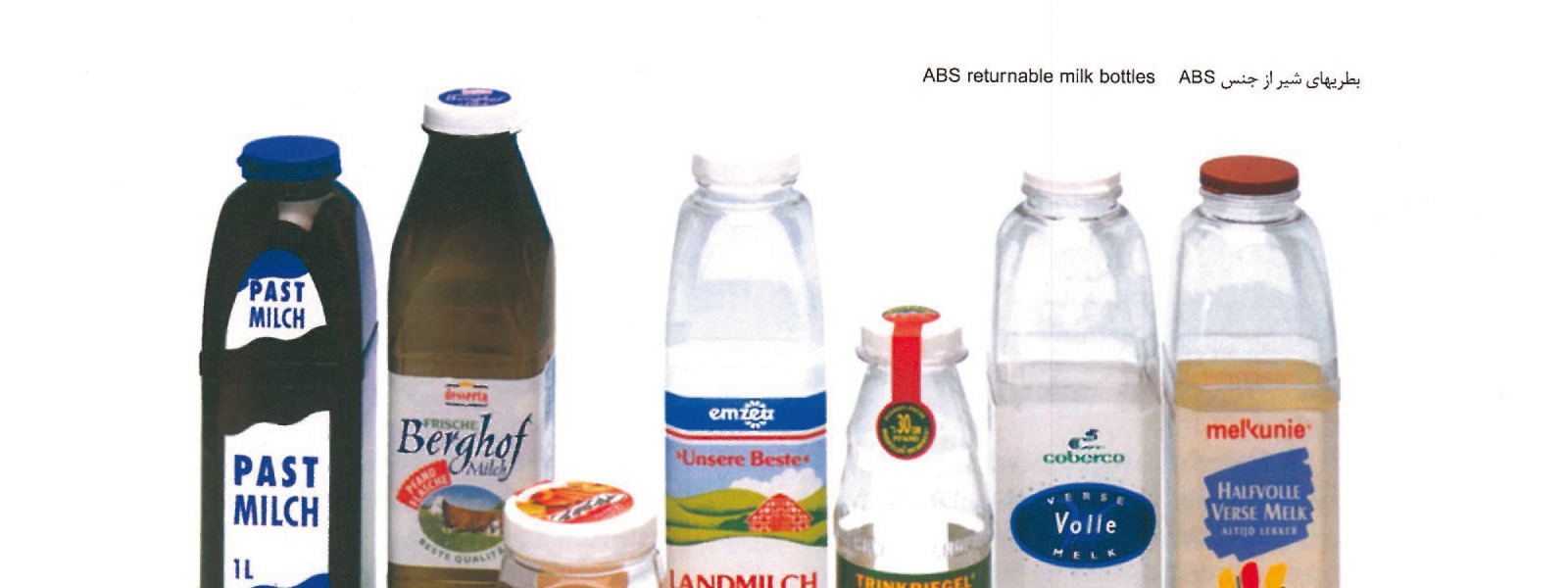
ABS returnable milk bottles (Campina and Coberco). Dutch dairy companies such as Campina and Coberco — instead of using glass containers and PET bottles, which carry high recycling costs — have made the use of returnable bottles produced from ABS part of their working programme. Strength, the possibility of repeated reuse in the packaging cycle (up to fifty times), very light weight and savings in transport costs are among the advantages. Used bottles, when their useful life is over, are collected for recycling.
Footnotes: 1. Daimler-Benz, Bayer, Johnson Controls, BS, Recaro, Daynamit Nobels. 2. Aliphatic Polyether TPU. 3. Nike. 4. Polyester amide. 5. Biodegradable. 6. Compopure. 7. Campina. 8. Coberco.
Captions on the printed pages: The front seat shell of Mercedes A Class · Top section of the housing of E10 vacuum cleaner · Mercurial football boot, NIKE · Sunglasses & prescription lenses of NEOPTEX, Inc · Air intake manifold of VW VR6 · Disposable cutlery made by bio-degradable polymers, Compopure GmbH · ABS returnable milk bottles.



