An opening
Shopping centres and shops are among the shape-givers of the urban body. The street-elevations, in urban design, count among the city's details and signs. The visitors of shopping centres and shops are buyers, citizens, and even tourists who take pleasure in looking at the shop windows. The design of these shops, then — beyond pointing to taste and trade culture — plays an important architectural role in the contemporary urban body. In this article, drawing from Domus, several examples of contemporary shops in Milan, Paris, Saint-Honoré, and Berlin are surveyed; the article closes with a perfumery and cosmetics shop in Tehran.
Shop in Saint-Honoré
This shop in Saint-Honoré occupies two storeys. The work of drawing the customers up to the upper floor has been given to spiral staircases. It seems that the gentle motion of the stairs draws visitors directly upward. Here one of the prominent symbols associated with the act of shopping — the moving stairs — has been used in the manner of the entertaining devices of an amusement park, to give a fresh reading to the belief that 'spending money is a kind of entertainment.'
In keeping with this same spirit, a curtain made of clear pendants defines the shop's interior with high working capacity, in which the motion of revolving tables draws customers toward the goods on display. Another invention is the dressing of the entire wall opposite the entrance with coloured stretching cords, with new models placed between them.
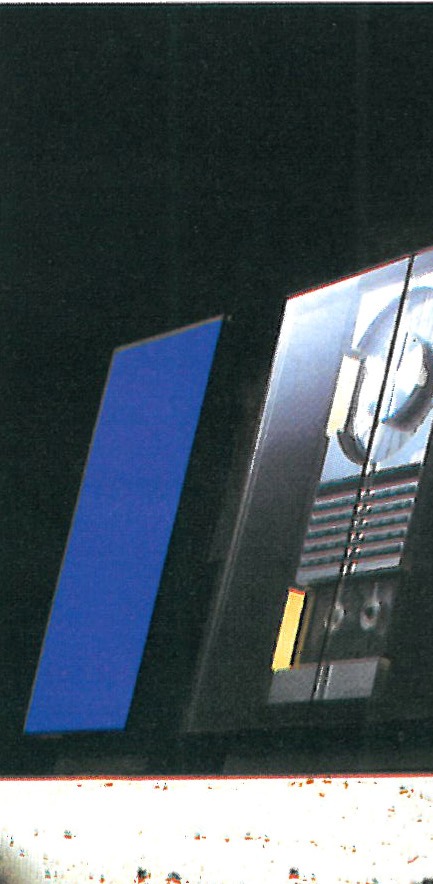
Shop in Milan (Via Manzoni)
The designer of the new (Carasmith) shop in Milan, on Via Manzoni, has joined architecture with humour, and mocks the professional skill that relies on the use of glittering elements.
Shop in Paris
Now, twenty years after Bernard Tschumi's winning of the spectacle work in red colour at the Parc de la Villette, the pure red colour has been used in his shop in Paris in an interesting way.
Shop in Berlin: BALLY
The Swiss brand BALLY, famous for its shoe-making products, and which has recently entered the market of comfort shoes and shoe accessories, in order not to fall behind the involuntary up-to-the-minute trend that periodically invades the fashion halls, has — by following the design of Andrée Putman — sought to give its shops a fresh identity.
From the start the principle was that the building's solid platform should carry an aesthetic and the professional virtuosity of Swiss work. Wholly clad in oak, the goods displayed there — by the gentle radiance of the colours of the display niches — have been placed in a space whose uniqueness more resembles an artwork than a shop.
Perfumery and cosmetics shop in Tehran
The judgement of the two shops at the start of this article shows that, mostly in the streets, the upper storey cannot easily be used for a shop. But in shops with much foot-traffic in bazaars and office buildings, the upper storey is sometimes put to use. The general body of the perfumery and cosmetics shop in Tehran, designed by Mr. Kashayeshi, with the windows decorated by Ms Shabnam Nourbakhsh in cooperation with him, is an example of this use.
The seeming stability of these windows — which appears to be carried by only two horizontal cylinders on the sides — induces an unstable feeling. In the execution of the interior parts of the mezzanines or the spiral stair, faults are visible that lessen the quality of the interior space. Such problems generally arise from the failure to use experts — something often seen in our cities.
Source: Domus, issues 833, 837, 838, and 849.