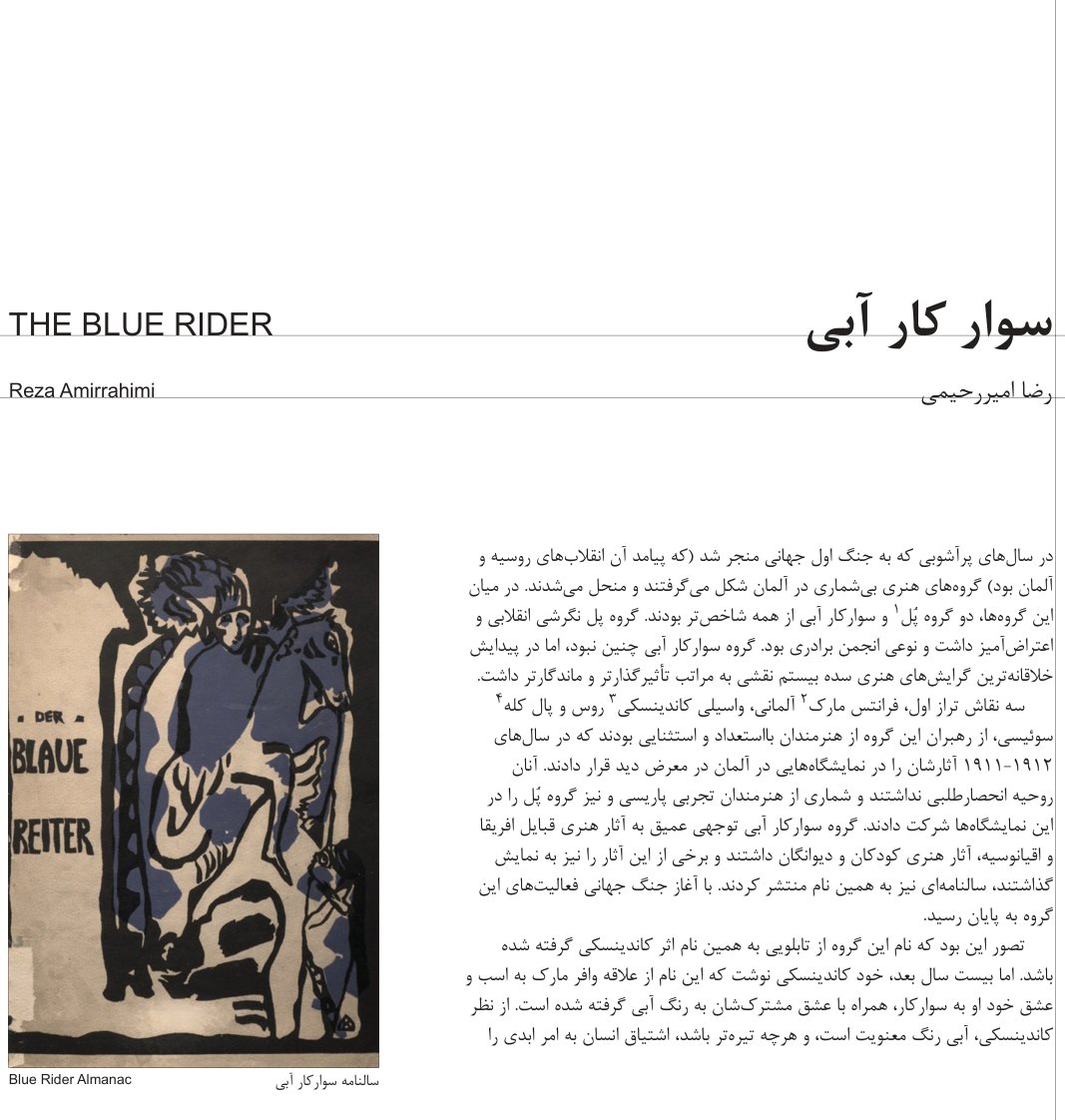
In the tumultuous years leading up to World War I — which would give rise to the Russian and German revolutions — countless artistic groups were forming and dissolving in Germany. Among these groups, two stood out above all others: Die Brucke (The Bridge) and Der Blaue Reiter (The Blue Rider). Die Brucke had a revolutionary and rebellious outlook and functioned as a kind of brotherhood. Der Blaue Reiter was not like that, yet it played a far more influential and enduring role in the emergence of the most creative artistic movements of the twentieth century. Three first-rate painters — Franz Marc, the German; Wassily Kandinsky, the Russian; and Paul Klee, the Swiss — were the leaders of this group of exceptionally talented artists who exhibited their works in shows across Germany in 1911–1912. They were not exclusionary in spirit and invited a number of experimental Parisian artists, as well as members of Die Brucke, to participate in these exhibitions. Der Blaue Reiter held a deep interest in the art of African and Oceanian peoples, the art of children and the insane, and exhibited some of these works as well; they also published an almanac bearing the same name. With the outbreak of the World War, the group's activities came to an end. It was assumed that the group's name derived from a painting of the same title by Kandinsky. But twenty years later, Kandinsky himself wrote that the name came from Marc's great love of horses and his own passion for riders, combined with their shared love of the color blue. For Kandinsky, blue is the color of spirituality, and the darker it becomes, the more it
Blue Horse I, Franz Marc, 1911
The Blue Rider Almanac
Blue Rider, Wassily Kandinsky, 1903
The Little Blue Horses, Franz Marc, 1911
Dreaming Horses, Franz Marc, 1913
Deer in the Forest II, Franz Marc, 1914 / Dream, Franz Marc, 1912
The Tower of Blue Horses, Franz Marc, 1913
stirs the human longing for the eternal. They held a deep belief in the relationship between the visual arts and music, and imagined that colors are evocative of the spiritual and the symbolic. Their common bond was a fascination with depicting the spiritual dimension of the human being. After World War I, Kandinsky and Klee joined the faculty of the Bauhaus school of design, leaving a lasting influence on several generations of architects. The attention to color in Rietveld's designs, in the interiors of Adolf Loos's houses, and later, in a different manner, in the works of the Dutch architects Aldo van Eyck and Herman Hertzberger, is perhaps not without the influence of the ideas and works of Der Blaue Reiter.
For further acquaintance with the works of the architects listed in the final paragraph, see respectively Memar issues 120, 128, 121, and 122.



