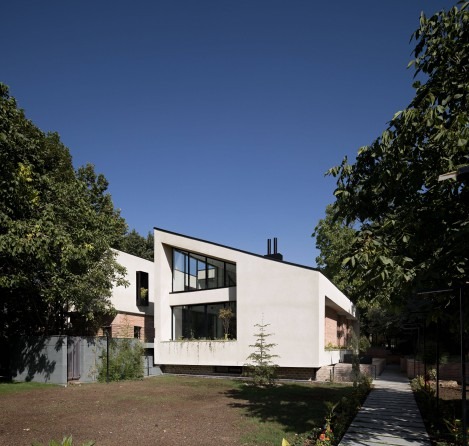
Amjad Villa in Karaj began as a confrontation with a ruin — as if an earthquake had struck, leaving only the roof, a few perimeter walls, and the basement. The architects faced two challenges: whether to accept a project in such critical condition, and what could actually be done with it. Rather than erasing the problem by declining the work, they chose to find an architectural response to conditions that conventional and academic architecture has no ready answer for. Since the perimeter walls had to be preserved, they became the basis of the design as load-bearing elements. A decisive axis was defined within the building to create a connection with the garden, brought to life with a pool and living area, and a new roof built using wooden beams salvaged from the previous building. An independent kitchen was designed as a completely self-contained space, defining the entrance and achieving the necessary functional relationship with the living hall. The basement was revived in its original form using the building's own old materials. The architect's responsibility in this situation became far more pronounced than in conventional projects — demonstrating that architecture needs, above all, small but responsible works that avoid issues rooted in imported architecture. Amjad Villa won Second Place in the Renovation category at the 20th Memar Award (2020).
Galerie
Emplacement
ApproximateLoading map…
Karaj, Iran(35.793, 50.853)



