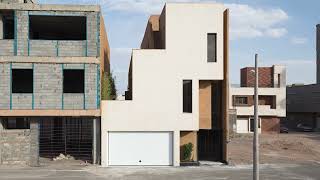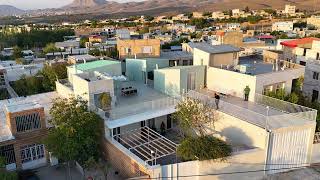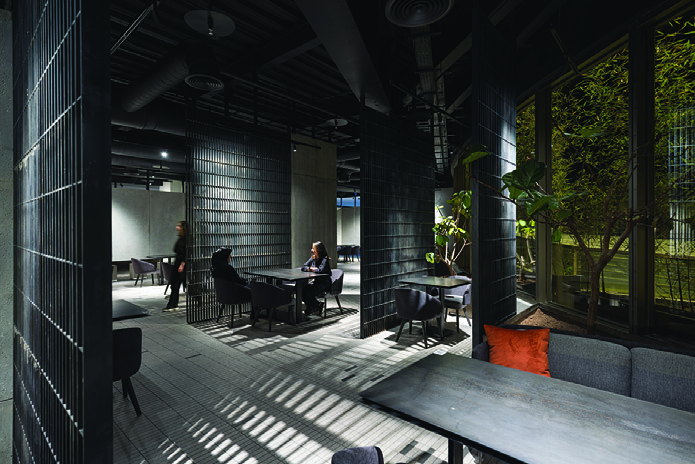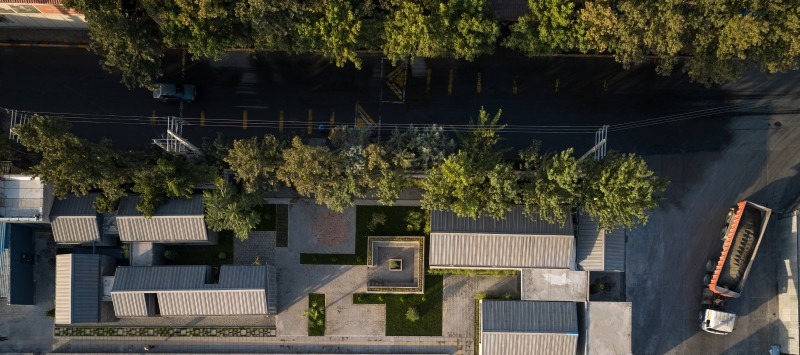
The Aptus Iran Concrete Factory in Karaj began with a brief to design indoor and outdoor exhibition spaces along with office buildings within an industrial site producing concrete blocks. The intellectual challenge starts where questions arise about the boundary between construction on agricultural lands, industrial zones, and residential areas on the city periphery — all intertwined in a race that typically ends in favor of low-quality residential fabrics, where green spaces and agricultural lands are the losers. The project posed a question about creating a model for a win-win dynamic between green space and built space. Combined with the need to showcase factory products, this gave rise to the material idea of eliminating interior and exterior finishing entirely — the factory's own concrete blocks were used to construct the complete system. The mass-forming strategy sought to simultaneously shape exterior, interior, and landscape: instead of placing function as one large box on the ground, each space was given independent character. Each spatial box was treated as a separate volume based on its functional definition, with the voids between creating green space connected to the interior. Layered connections between spaces and the simultaneous experience of exterior and interior emerged through intersections of transparent layers. Reducing materials to a single type increased the perception of outdoor space, and as daylight changes, this quality undergoes variations across the different layers of each space. The Aptus Concrete Factory won First Place in the Public Buildings category at the 20th Memar Award (2020).
Galerie
Emplacement
ApproximateLoading map…
Karaj, Iran(35.822, 50.990)