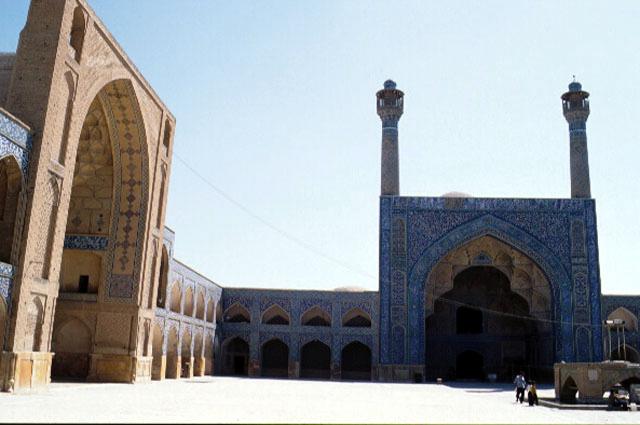
Located in Isfahan, 340 km south of Tehran, the Friday Mosque of Isfahan is a prominent architectural expression of the Seljuk rule in Persia (1038-1118). In 1051, Isfahan became the capital of the Seljuks, who arrived in Khwarazm and Transoxiana from central Asia in the eleventh century. Defenders of Sunnism, they sought the restoration of the Abbasid Caliphate. The conquest of Isfahan by Tughril Beg elevated the city's status, which was manifested in the rich architectural projects representing the Seljuk's powerful empire - the first of which was the Friday mosque. The Seljuks planned the city center and central square near the existing Friday mosque, so that the square was bordered on the north by the mosque's northern elevation. Later, Safavid ruler Shah Abbas would supersede the Seljuk center with his new maydan, built in 1602, thereby shifting the city's focal point further south. Therefore, many contemporary architectural historians consider the Friday Mosque to epitomize the style of the Seljuk and early Safavid periods and to be the core of what can be considered the "pre-Abbas city". Historical accounts differ on the condition of the mosque under Seljuk rule. The renowned historian and geographer Yaqut al-Hamawi reports that the people of Isfahan were forced to demolish the mosque "for the lack of wood" in 1051, when Isfahan was captured by Tughril Beg. Another account by Nasir-i-Khusrau recounts that the mosque was "great and magnificent" around 1052. What is certain, however, is that, prior to the Seljuk conquest of Isfahan, a Friday mosque of a hypostyle plan dating to the tenth century stood on the site. The Seljuk's capture of the city caused religious disputes (between Hanafite and Shafi'ite sects). During the reign of Malik Shah, riots and fire significantly damaged the mosque, prompting a renovation during which some of its old architectural elements were restored, and others were introduced. Consequently, the mosque's plan evolved from a hypostyle plan with a rectangular inner court (65 by 55 meters) surrounded by prayer halls comprised of round columns carrying a wooden roof (7 bays on the southwest; 3 bays on the southeast and northwest; 5 bays on the northeast), to a four-iwan plan established/augmented in the twelfth century after the additions of the four iwans, the southern (southwest) domed chamber, the two minarets flanking it, and the northern domed chamber. Especially noticeable among the later reconstructions and additions to the mosque is the double-story arcade surrounding the court (added around 1447), which supplants the original one-story arcade and unifies the elements of the court, thereby linking the various spaces of the mosque. What distinguishes the mosque is its integration into the urban fabric through numerous gates and entrances that weave it into the city's activities and blur the boundaries between city space and mosque space. This is also a result of a cumulative history of construction and reconstruction, producing a mosque that comprises an assemblage of structures built in different periods. Access to the mosque: The mosque is woven organically into the urban fabric, with the two towers flanking the southwestern (qibla) iwan and the large domes on the northeastern and southwestern sides of the complex rising above the horizon of Isfahan's silhouette and serving as visual landmarks. This integration into the city fabric allows for multiple points of access to the mosque along on the shared walls demarcating the boundary between the mosque's area and the adjacent buildings. It is impossible to circumnavigate the building, both because of this blurring of boundaries and due to the absence of defining outer walls in the ever-expanding mosque. The current entrance gate to the mosque is located on the southeastern area (southeast entrance portal). The exact date of the gate, which was restored in 1804 as part of the restoration projects ("Ta'amir") is obscure; however, an inscription on the adjacent space leading to the madrasa on the southeast part of the complex, mentions the Muzaffarid sultan Mahmud (ruled in Isfahan between 1358 and 1374). Most historians assume that this was the main gate during the fourteenth century, perhaps replacing another which is no longer extant. This gate leads to the upper part of the eastern wall closer to the southeast corner. On the opposite side, on the southwest part, another gate, still in use, dates from 1590-1, the period of Shah Abbas's rule. It connects the corner of the southwest and northwest arcade walls with the adjacent areas of the city, facilitating movement between the city's parts which were disconnected as a result of the insertion of the mosque. A large monumental gate, no longer in use today, is located on the north, adjoining the northeast wall of the northeastern dome. It dates from 1366 and bears inscriptions from the Quranic Surah 76 describing eternal life. This gate is aligned on the east-west axis, unlike any other elements in the mosque. The fourth gate in the northeast segment, also no longer in use, is decorated with brick instead of the colored, glazed tiles found on the other three gates. A Quranic inscription on the gate addressing forms of mosque desecration mentions that the mosque was restored after a fire in 1121-2. The winding covered bazaar with its intensive mercantile activity connects the new Safavid center in the maydan to the Friday mosque. The pedestrian flow leads to the northern portal. The court: As aforementioned, the (recently restored) court comprises a two-story arcade acting as a two-dimensional screen decorated with glazed bricks forming floral and geometric patterns in dark and light blue, white, and yellow. The arches of the two-story arcade are symmetrically arranged around the four iwans situated in the center of each one of the four walls, and are uniformly equal in height, except the two bays flanking the eastern iwan, which rise higher than the other arches. In addition, the northern half of the northwestern arcade is given a different treatment through a monumental gate that extends as high as two stories, defining an area of a winter mosque. Although constantly modified over the different historical periods, the mosque retains unity by its architectural forms and decorative elements of different materials, patterns, and colors. The four elevations of the court are flat screens, but they also embody passageways that lead to the different sacred spaces of the mosque and the profane, living spaces of the city. The earlier southwestern dome (maqsura): As part of the reconstruction of the damaged mosque, in 1086-1087 Nizam al-Mulk, Abu al-Fath Malik Shah's vizier, ordered the building of a domed chamber (15 meters per side, approximately 30 meters high) on the southwest. Two preserved inscriptions on the dome's drum mention the names of Abu Malik Shah and Nizam al-Mulk. The ribbed dome rests on a muqarnas transitional zone. These in turn are carried by a bearing wall and eight massive piers which belonged the old mosque. Historians contend, based on archaeological investigations, that this chamber was erected on top of an earlier hypostyle area and was a freestanding structure. This maqsura became a prototype for later mosques, among them those in Ardestan, Qasvin, and Zavareh. The northeastern dome: Commissioned by Taj al-Mulk (the successor of Nizam and main advisor of Malik Shah's mother), the northeast dome was built in 1088-1089 for Terkan Khatun (Malik Shah's wife and Sultan Tamghach Khan's daughter). Because of the dome's initial freestanding position, many historians have speculated that it served as a private prayer space, a women's mosque, or even a library. Smaller in size and placed on the same lateral longitudinal axis as the southwest dome, the northeast dome rests on a square base of square, massive piers (with three slim round engaged columns), with an octagonal transitional zone formed by four squinches, on top of which rests another zone of sixteen arches with a drum comprising an inscription band with religious inscription. Ten double-ribs emerge from the dome's drum and ascend to inscribe a pentagon. Most scholars consider this architectural act of Taj al-Mulk to be an attempt to surpass the dome built by his rival, Nizam al-Mulk, in the south. This dome could be accessed from the south and west. On the inside of the dome are Quranic verses inscribed in letters formed by bricks. Architectural historians often draw comparisons, regarding structure and ornament, between the earlier southwest dome, built by Nizam al-Mulk, and the later, smaller northeast dome, also referred to as Gunbad-e Khaki (the earthly dome) built by Taj al-Mulk. They view the northern dome an epitome of mathematical perfection, evident in the harmony of its horizontal and vertical divisions, and achieved by a hierarchy of the fitting of its parts, adhering to the Golden Section. For this reason, many historians find that it evokes later French High Gothic architecture. The two domes are also distinct in their system of ornament. In the southwest dome, remnants of stucco ornament are still found in situ, while in the northeast dome, bricks constitute a structurally integrated ornamentation. With different degrees of projection, they create a multitude of patterns through their varied alignments. This consistency in the architectural language (i.e., brick as ornament) is lacking in the southeastern dome because it was built on an existing structure and had to adapt existing structural and decorative elements without a leading unifying principle in an overall design as in the case of the northern. As parts of the structure were destroyed by riots and later fire, there is an incongruity between the new and the old: the massive original infrastructure of the double piers and arches differently curved vs. the lighter new design of the dome and its transitional zone. This "rivalry" betwee...