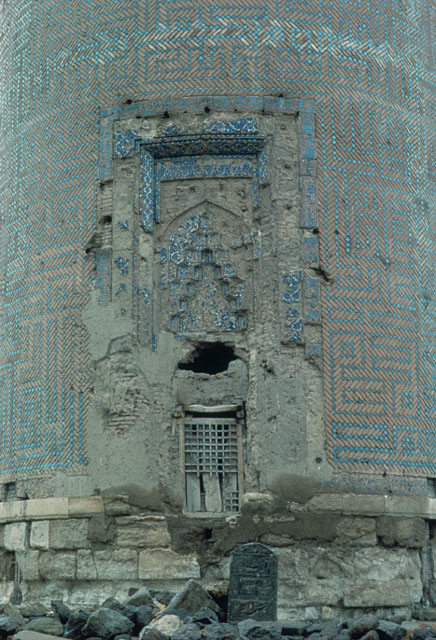
Cut stone forms the foundation and a plinth, above which a brick revetment of geometric letters covers the entire cylindrical exterior, terminating in a mosaic faience inscription band and cornice. Three blind windows and a portal mark the axes, each set within a mihrab-like composition with muqarnas; these in turn each within a soaring rectangular frame. The cylindrical exterior envelops a dodecagonal interior that is articulated with corner strips, a high ring of niches and a muqarnas cornice. Without an inscription to provide a date, features of this structure suggest that construction took place around 1330. Source:Donald N. Wilber, The Architecture of Islamic Iran, (New York: Greenwood Press, 1969) 175
Galerie
Emplacement
Loading map…
Meshgin Shahr, Iran(38.401, 47.681)



