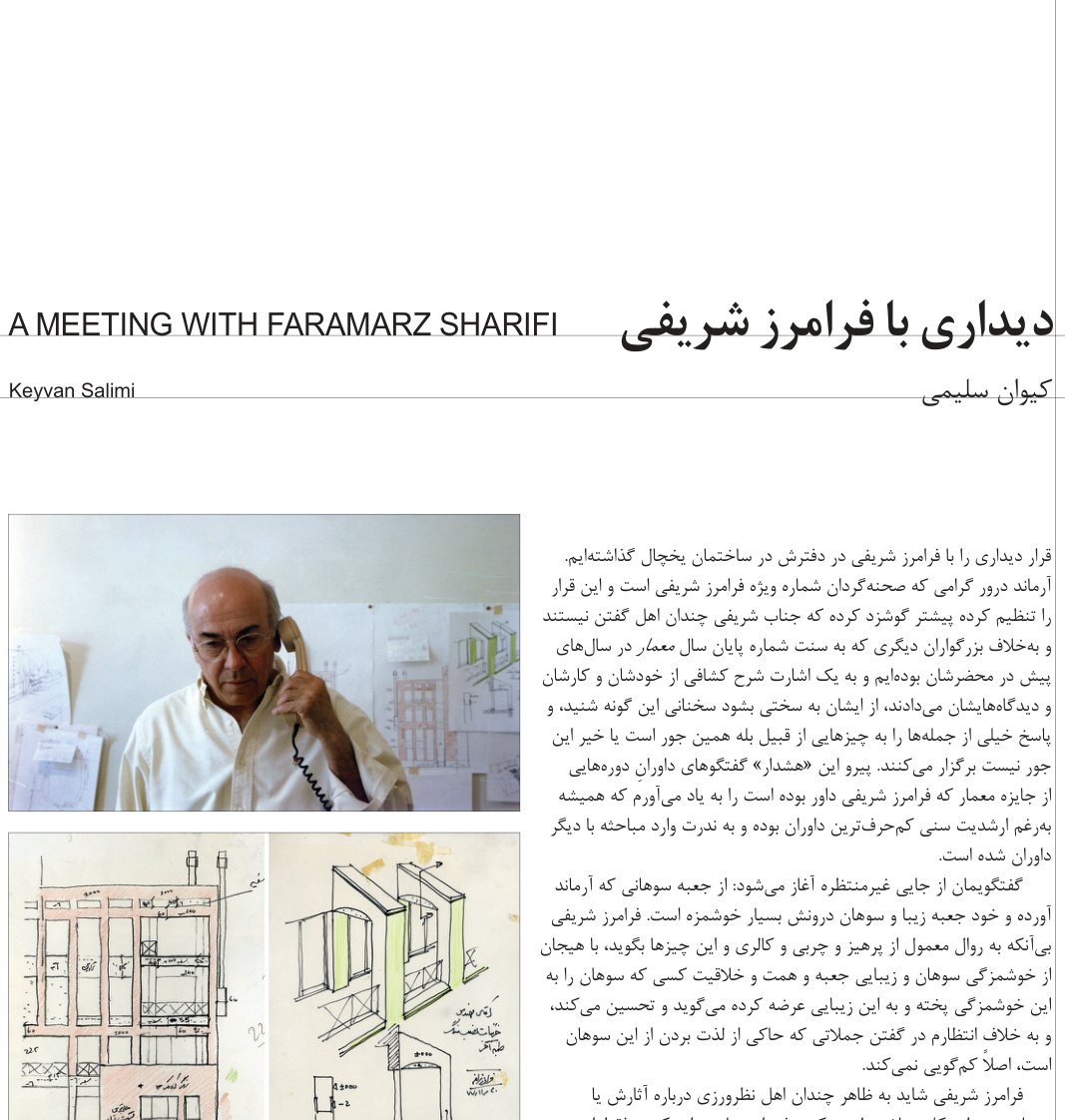
We have arranged a meeting with Faramarz Sharifi at his office in the Yakhchal building. Armand Deror Gerami, who is orchestrating the special issue on Faramarz Sharifi and organized this appointment, had forewarned us that Mr. Sharifi is not much given to speaking. Unlike the other distinguished figures in whose company we have been at year-end Memar special issues in previous years—who at the slightest prompting would deliver expansive accounts of themselves, their work, and their views—from him one can only with great difficulty draw such remarks, and he tends to respond to many questions with something along the lines of "yes, that's how it is" or "no, it isn't." Following this "warning," I recall the jury deliberations of those editions of the Memar Award in which Faramarz Sharifi served as a juror—where, despite his seniority, he was always the most taciturn among the judges and only rarely entered into debate with his fellow jurors. Our conversation begins in an unexpected place: with a box of sohan pastries that Armand has brought—the box itself is beautiful and the sohan inside is exquisitely delicious. Without resorting to the customary talk of dietary restraint, fats, calories, and the like, Faramarz Sharifi speaks with enthusiasm about the deliciousness of the sohan, the beauty of the box, and the dedication and creativity of the person who baked it so well and presented it so beautifully—and offers his admiration. Contrary to my expectations, in expressing the pleasure he derives from this sohan, he is anything but reticent. Faramarz Sharifi may not appear, on the surface, given to theorizing about his works or about architecture in general, yet he possesses a profound understanding of beauty—such that he is not only moved to rapture by anything beautiful, but in his works he leaves no detail and no corner deprived of beauty. Perhaps it is for this reason that his numerous works, built over a span of roughly sixty years, even if they have not followed a uniform path in terms of theory or style, share a common thread: taste, beauty, order, and eloquence in the expression of both wholes and parts. In virtually all of Faramarz Sharifi's works, form and geometry are simple, pure, and manifest; the interior spaces and consequently the plans are legible and explicit; the building elements—walls, ceilings, stairs, windows, and the structural frame—all possess clarity of expression and a distinctive character of their own, undiminished among the other elements. The structural frame in particular is not merely not imposed upon the space but is beautifully seated within it. And finally, all these virtues have been achieved through creative and intelligent detailing. Such quality in architecture goes far beyond compensation and duty; it is the result of a combination of taste, passion, and, of course, immense labor. Most of Faramarz Sharifi's works are residential houses. Moreover, most of them possess a quality that clearly announces who their designer and builder is. These characteristics might from a distance raise the suspicion that projects of the same function and occasionally similar details are mere repetitions—something simple for a firm that has accumulated experience in this work, akin to ninety-six-bed hospitals or Karim Pirnia's standardized schools. There are still those who imagine that residential architecture can be excluded from the realm of architecture altogether,
Entrance of Deno 5 office building, Qolhak, 2006
and that architecture means a project whose subject matter departs from the ordinary and that naturally admits of grandiose rhetoric. But Faramarz Sharifi, who has extensive and effective experience in designing and building houses, holds the view that the architecture of the home is extremely challenging, because every home has an occupant and user with their own personal circumstances and preferences, and to build a worthy home for them, one must understand their temperament and devise a design on that basis—no two houses can ever be alike. Faramarz Sharifi adds: Among my clients I have good friends; in fact, it is because I became friends with them that I was able to build houses in which they have lived for years with satisfaction and contentment—and even those who have passed away, the next generation continues to use the house. The question of how far an architect who is principled, thoughtful, and committed to professional ethics can accept a client's wishes, and from what point onward they must assert their own creativity, knowledge, and experience over the project—this is a perennial discussion that inevitably arises in the presence of experienced and prolific architects. Faramarz Sharifi says on this matter: The architect's judgment and "I say so" belongs in the domain of architecture and the creation of space and the construction process, but defining the project's totality and requirements is the client's right, and naturally the architect must defer to them—especially in the home, where the quality and atmosphere of the space must suit its inhabitants. He also fondly recalls Houshang Seyhoun (for whom he has great esteem) who used to say: If a client offers opinions on the design and architectural details, say "yes sir," but do your own work—if the finished product is good, they will be satisfied. And he adds that a good client either knows nothing at all and entrusts everything to the architect to proceed according to their professional conscience, or knows a great deal and serves as a fine advisor and intellectual companion for the architect.
He mentions the owner of the Amiri house on Ammar Street (adjacent to a Gio Ponti work) as an example of the second type of client: In that project they wanted a sense and atmosphere of the Persian garden; we had excellent discussions and I was compelled to undertake an extensive study and learn a great deal. I steer the conversation toward government clients and the prevalent "mediocrity" of most of them—those who generally know nothing yet refuse to acknowledge their ignorance, and who, through such agents as technical bureaus, deputy planning offices, and relevant experts, impose devastating corrections upon designs—and how Faramarz Sharifi has managed to deal with them. He says: The last government project I undertook at Artiman Consulting Engineers was the gas company's residential complex in Kangan, which led to my having heart surgery. After that, I resigned from Artiman and never did government work again. The commitment to professional ethical standards is clearly visible in Faramarz Sharifi's works: he speaks of the concept of honesty, meaning the architect's forthrightness with the project and with themselves—for without honesty, the architect will fall into pitfalls such as inappropriate imitation, and the work will yield no worthy result. He himself attributes this characteristic of his works—that despite all their temporal and thematic differences, they are generally recognizable as his—to this very forthrightness with oneself. Beyond this, there is a palpable clarity and distinctiveness in Faramarz Sharifi's works—in form and geometry, in the components and elements of architecture, structure, and mechanical systems, and in materials—each one clearly seated in its proper place, with nothing playing the role of something else. This quality can be interpreted as a kind of spatial forthrightness. Another moral quality conspicuous in Faramarz Sharifi's person (and naturally in his works) is architectural humility: not humility in its conventional sense, which pertains more to behavior and conduct with others, but rather stepping out of the cocoon of self-regard to see and understand rightly and without preconception the exigencies of a project and to discern the welfare of the user—without sacrificing these to personal preferences. Furthermore, the effort and energy far exceeding the norm that Faramarz Sharifi devotes to every
Tabrizian Villa, Royan residential complex, known as Qamar Khanom House
project can be seen as yet another manifestation of architectural conscience and commitment to professional ethics. Faramarz Sharifi, despite his inherent reticence, never hesitates—whenever the talk turns to a fine work of architecture—to speak with ardor and delight about that project and its architect, and about the pleasure he has taken in being in that space. When our conversation arrives at the house on Servati Street (which he himself, based on its spatial structure, calls Qamar Khanom's house) and I make a reference to the beautiful old house across from it, his eyes brighten with excitement and, with the enthusiasm of an eager student, he gives an extensive account of that house—which is a work of Farrokh Esalat and was apparently the house of Alikhan-e Vazir—and also recalls Farrokh Esalat and alludes to his other works. A significant part of the outstanding qualities of Faramarz Sharifi's works is the result of their fine execution: beyond the correct and intelligent design of construction details, capable builders who properly understand and faithfully execute those details are also a key factor in the final crystallization of projects. Any discussion of Faramarz Sharifi's works is never complete without a fond remembrance of his colleague Hassan Tajoddin, who has been the builder of most of his projects—and he even says that when negotiating for projects, wherever possible, he stipulates that the contractor must be Hassan Tajoddin. Faramarz Sharifi says about the importance of details: A building with average design
Khabiri Villa, Emameh
Ali Sharifi House, Michigan
but good details is better than a building with outstanding design but poor details. And: Good details are the factor in a building's longevity. It is no accident that in Faramarz Sharifi's works, craftsmanship skills are prominent and thoroughly effective in the quality of the built space—skills of the kind once practiced by master builders of the past, where, for instance, a window or tilework was the "art" of such-and-such a master. Although comparing an entire building with all its details and complexities to a single window or plasterwork may be a flawed comparison, Faramarz Sharifi's works are not unlike the work of those same masters in that they are founded upon a deep love for the craft and a reverence for it—and the master's hand is evident upon them. Works that, with all their subtleties and refinements, possess a deceptively effortless quality and settle upon the heart without fuss, commentary, or interpretation.
Footnotes: 1- Abdollah Riazi, Dean of the Faculty of Engineering at the University of Tehran in the 1960s, was so zealous about his own specialty of mechanical engineering that he regarded all other fields as inferior. Apparently, when Hossein Amanat—who had initially enrolled in mechanical engineering by mistake—approached him intending to change his major to architecture, Riazi expressed surprise and regret at this decision and reportedly said: "Architecture?! Architecture doesn't require university study—everyone understands that every house has a living room, a kitchen, a bathroom, two or three rooms. Now one puts this one here and that one there." 2- I do not have statistics on the "person-hours" expended on his projects. But anyone with the slightest experience in design or construction can clearly discern such quality in his works. 3- At several other points in our conversation, the discussion turned to other buildings. It was entirely clear that Faramarz Sharifi's positive or negative opinions about those buildings were genuine and based on their qualities, and not influenced by personal or professional relations with their architects. 4- Hassan Tajoddin is an architect, and Faramarz Sharifi considers this an important factor in understanding the spirit and essence of spaces and details, and in the correct execution of projects.
Amiri House, Ali Sharifi House
Deno 1, Gouy Abadi, 2000



