A NEW APPROACH TO SOLVING URBAN PROBLEMS
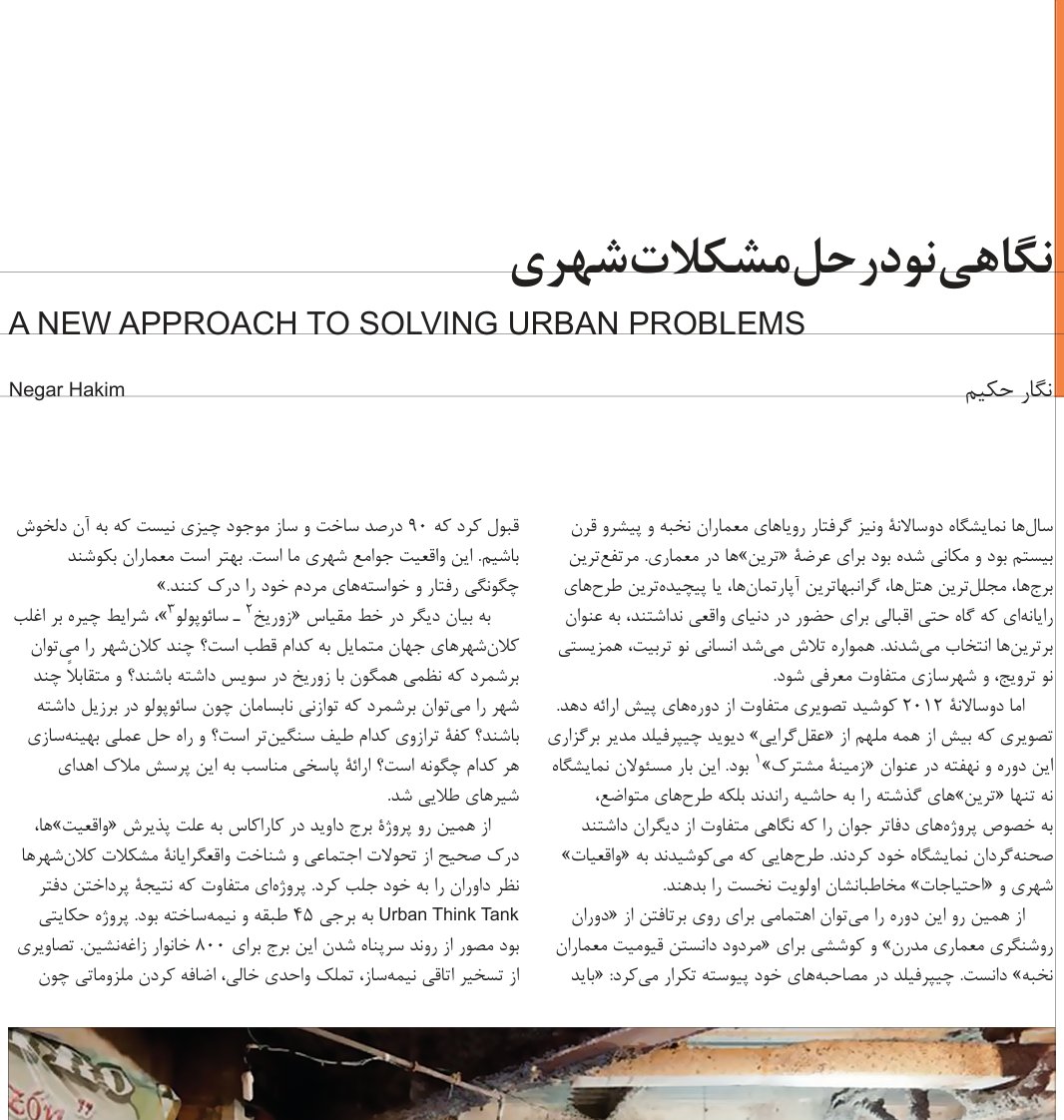
برج داويد، كاراكاس، ونزوئلا، انريكه گومزDavid tower, Caracas, Venezuela, Enrique Gomez
For years, Venice Biennale—entangled in the dreams of the 20th Century’s most elite progressive architects—had been host to architectural extremes. Likely winners were the most luxurious hotels, most expensive apartments, tallest high-rises, or most complicated computer-aided designs with no chance of existence in the real world. The Biennale constantly tried to encourage the generation of a new humankind, a new symbiosis, and a new urbanism. The Venice Biennale 2012, in contrast, attempted to present a different image, one which was most strongly influenced by the rationalism of Biennale Director David Chipperfield and his chosen theme of ‘Common Ground’. This time, organisers of the exhibi- tion not only marginalised the previously lauded ‘mosts’, but gave centre stage to modest designs—particularly the projects of young architectural offices that followed a different approach. These designs gave priority to urban realities and the demands of their users. As such, this Biennale can be seen as an attempt to turn away from the ‘Enlightened Era’ of modern architecture and move toward a defiance of the dominance of elite architects. Chipperfield has repeatedly stated in interviews that, ‘One should accept that 90 per cent of current construction is nothing to be fond of. This is the reality of our urban societies. It would have been better if our architects tried to understand people’s behavioral patterns and demands.’ In other words, on the ‘Zürich-to-São Paulo scale’, toward which pole do the dominant conditions of metropolises lean? How many metropolises can be found which enjoy an order similar to that of Zürich? How many are as chaotic as São Paulo? Which is more common? What is the most practical solution for optimizing each of these? A proper answer to these questions became the primary criterion for the awarding of the Biennale’s Golden Lions. The David Tower in Caracas attracted the attention of the jury because of its acceptance of realities, a thorough understanding of social developments, and a realistic approach to the problems of metropolises. This different project resulted from architectural firm
Urban Think Tank’s approach to an unfinished 45-storey tower. The project consisted of an illustrated narrative of how a shelter and community was created out of this abandoned tower for 800 shanty dwellers. Images include the occupation of half-finished rooms, photographs of problems such as illegal connections to the electrical grid, the hardship of acquiring water, and the use of high staircases without railings. The result of a year-long effort, the architects narrated the story of this vertical slum: an extremely disorderly and chaotic but lively and dynamic city within the larger metropolis of 11 million inhabitants. The project demonstrated how one can easily but greatly enhance the conditions of cohabitation with small modifications such as the addition of a supermarket, a café, or a playground. The architects hoped that their critical ap- proach to a ‘part’ would become an example for understanding of the ‘whole’. The awarding of the Golden Lion to this project conveyed the message that, considering the context of current realities, urban designers today have no other choice but to understand the de- mands of their addressees and accept the disorder and deficien- cies of their cities. The era for the ‘Big Brother’ type attitude of enlightenment from the top down, exemplified by the ambitious projects of modernist masters such as Le Corbusier, is over. A new movement is in action. Even if architects regard this movement as limited and restrictive, this movement exemplifies a new logic based upon experimentation—defining architecture from the bottom up, looking for sources of inspiration in those living at the core of society and searching for potential in unordinary forces.
* Negar Hakim born 1971 in Isfahan. She received her PHD in history of art from the University of Vienna. A member of Art historians of Austria, and is a researcher of modern architecture. In Vienna she has co-curated exhibitions on topics in the field of art and architecture. She is actively involved in cultural management and cultural transfer between Iran and Europe, not least through the organization of art exchanges. She has written numerous articles on modern architecture, which have been published in respectable and official magazines and books in Iran and Europe. Currently she is teaching at the private university Linz (Austria).
پانوشت ها: 1- Common Ground 2- Zürich 3- São Paulo 4- Vertical Slum



