A treasure lies in this house that the universe cannot contain This house and this master are all action and pretext The dust and straw of this house are all ambergris and musk The sound in this house is all verse and melody In sum, whoever found a path into this house Is the sultan of the earth and the Solomon of the age — Rumi
The vague rhythm of a heartbeat announced the first tangible sign of another person's presence in our lives... boom... boom... a sound as though life itself, the smallest particle of existence, a moment of silence between two beats, a moment between being and non-being... and blurry images on the ultrasound monitor spoke of the dormant presence of another human being, in the house of the mother's womb... It was hard to believe that just a layer a few fingers thick — flesh, skin, and fat — had provided a safe haven and a calm free from the frenzy of the mad world outside.
— Congratulations, it's a girl...
In the busy afternoon on Amadegah Street, we left the ultrasound clinic, both silent and immersed in colorful dreams and multicolored worries and concerns. From the direction of Chaharbagh we headed to our apartment, when suddenly the continuous blare of a car horn and the coarse cursing of a driver rushing to warm up for the Iran versus Argentina match very quickly threw us from the peace, silence, and sweetness of a dream that seemed to have lingered from the mother's womb, into today's noisy, fast, and colorful world... How much can one get used to this high rhythm of life and the haste of the contemporary world?
That same night we decided to sell our 130-square-meter apartment and find a house somewhere in this city. Now that our world is filled with small and large happenings around us and bad and worse news, now that the speed of life has risen so much that we sometimes feel if we pause for a moment we fall behind ourselves — where is the remedy? If we accept that life, like the sound of a heartbeat, is a moment between opposites, then where is the counterpoint to this haste? Where is greater stillness, silence, and slowness? Should architecture align itself with this current, or could it perhaps become a balm for this social pain?
Now that there is no choice but to synchronize the rhythm of our steps with the rhythm of this new world, perhaps we can create a space in which to recover some of our lost peace and stillness. Perhaps the best gift we can give our unborn child is to not let her grow up in a box, with windows facing the neighbor's wall, deprived of the pleasure of playing with water and dirt, experiencing life without a courtyard.
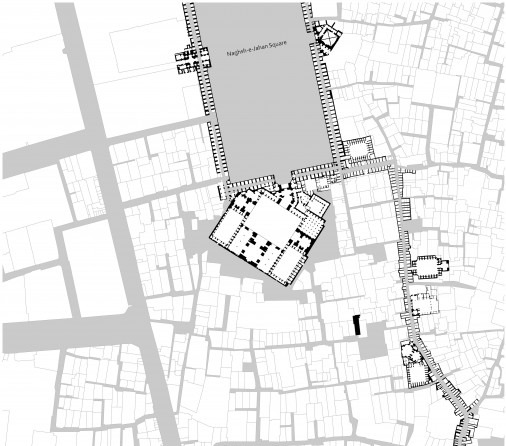
Two months had passed since that night and now we were on our way, so the real estate agent could show us a plot of land that lay behind the turquoise dome of the Abbasi Jame Mosque. From the southeast corner of Naqsh-e Jahan Square, that unparalleled void, we stepped into the labyrinthine fabric surrounding it. A fabric that is truly Isfahan's worthy heir — a narrow, winding passage, where behind every turn an unpredictable image opens up before us. We moved through a collection of contrasts — light and shadow, full and empty, tightness and openness — all in continuity and harmony with each other... and as Rumi says, day and night appear as two opposites and enemies, yet both weave one truth. Here too, it seemed another parable of the heartbeat was in motion — being and non-being set us in motion.
It was not an unfamiliar neighborhood. On this path, I recalled a few years earlier when we were supposed to find a solution for organizing and revitalizing this fabric through urban planning, which was of course to no avail. Now parts of its houses are abandoned or turned into warehouses and workshops supporting the bazaar, parts have been acquired and demolished by the municipality, and a few houses, as a result of recent developments and the growing concept of tourism, have been converted into accommodation and tourism spaces. But what is missing is the presence of a resident human and the effects of their daily life in this neighborhood. Is the presence and settlement of contemporary man — a human dependent on and arising from all concepts of modern life — returning solely for residence and permanent living, not the only real solution for revitalizing such fabrics?
Let us move on... We passed by the empty Qajar houses, inward-facing houses that had hardly any opening to the inside except in a few places. We passed through Dark Alley, a covered passage with low and high ceilings that sometimes closed and sometimes opened up, welcoming volumes of light. We passed by the two- and three-story houses of thirty or forty years — houses whose sharp smell of fried onions and the chatter of their residents had erased the boundary between home and neighborhood. We passed through and it felt as though passing took a hundred years! How much we learned from this passage. Can one find a new way between this duality of introversion and extroversion — a way for the presence of the contemporary self, a way that, like ourselves, is both this and that, and neither this nor that?
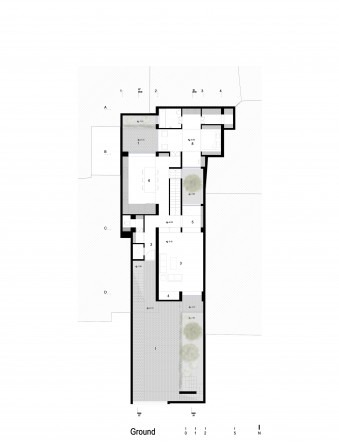
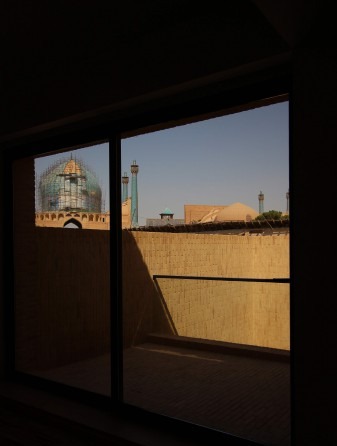
The voice of the real estate agent announcing our arrival pulled us from this labyrinth of thoughts. We entered the plot from the south — a 250-square-meter lot, thirty meters long; its width in the south was seven and a half meters, which, with its irregular breaks, reached ten meters in the north. The shape of the land echoed the organic fabric around it — shapeless and multi-faceted — and the further north we went, the more width and more silence we gained. At the far end, slightly to the west, the four-hundred-year-old shameless and graceful neighbor was watching us — this blue dome was the first to welcome our presence in this place.
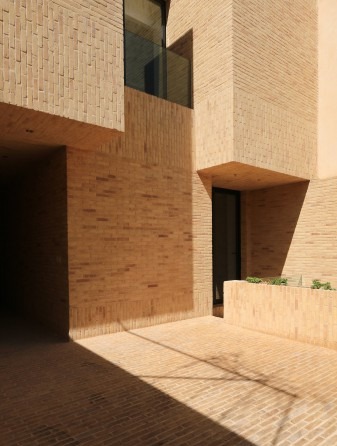
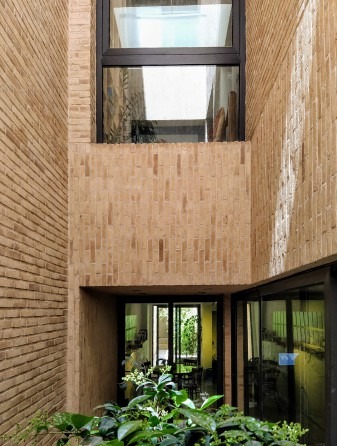
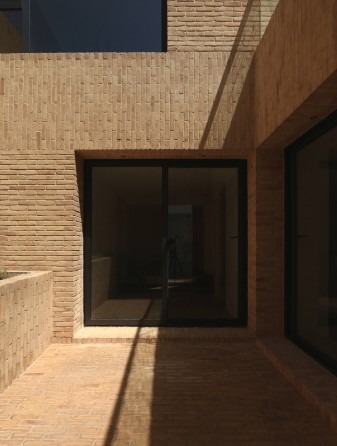
The child who was to live behind this blue dome was named Aban, and the house we built became Aban House.