



Abdolhossein Sarrafha, born in 1940, graduated from the Architecture Faculty of Tehran University in 1975. Before that he had already cooperated with various consulting engineers. In 1973 he set up his own private office. Sarrafha was head of the Hozeh Consulting Engineers' directorate from 1975 to 1979, cooperator of Beta Consulting Engineers from 1981 to 1989, and head of Azad Consulting Engineers' directorate from 1989 to the present.
Three examples of his work presented in this issue demonstrate his skills and interests: continuous architecture down to the smallest spaces, details and instruments; the use of traditional Iranian logos for decorating modern spaces; and the planning of every small detail with an artistic view — drafting even the smallest details clearly and beautifully in order to bring a thought or dream to fruition.
Chehelcheshmeh Garden in Kelardasht — Employer: Hamid Hamidein. Project Designer and Director: A. Sarrafha. Project Team: Azita Ghafouri, Ahmad Souresrafil. Design Team: Negin Maleki, Mohammad Jahangiri, Aliasghar Mohajeran, Hamidreza Najafi. Structure Design: Farhad Nafisi. Mechanical Engineer: Farhad Nafisi.
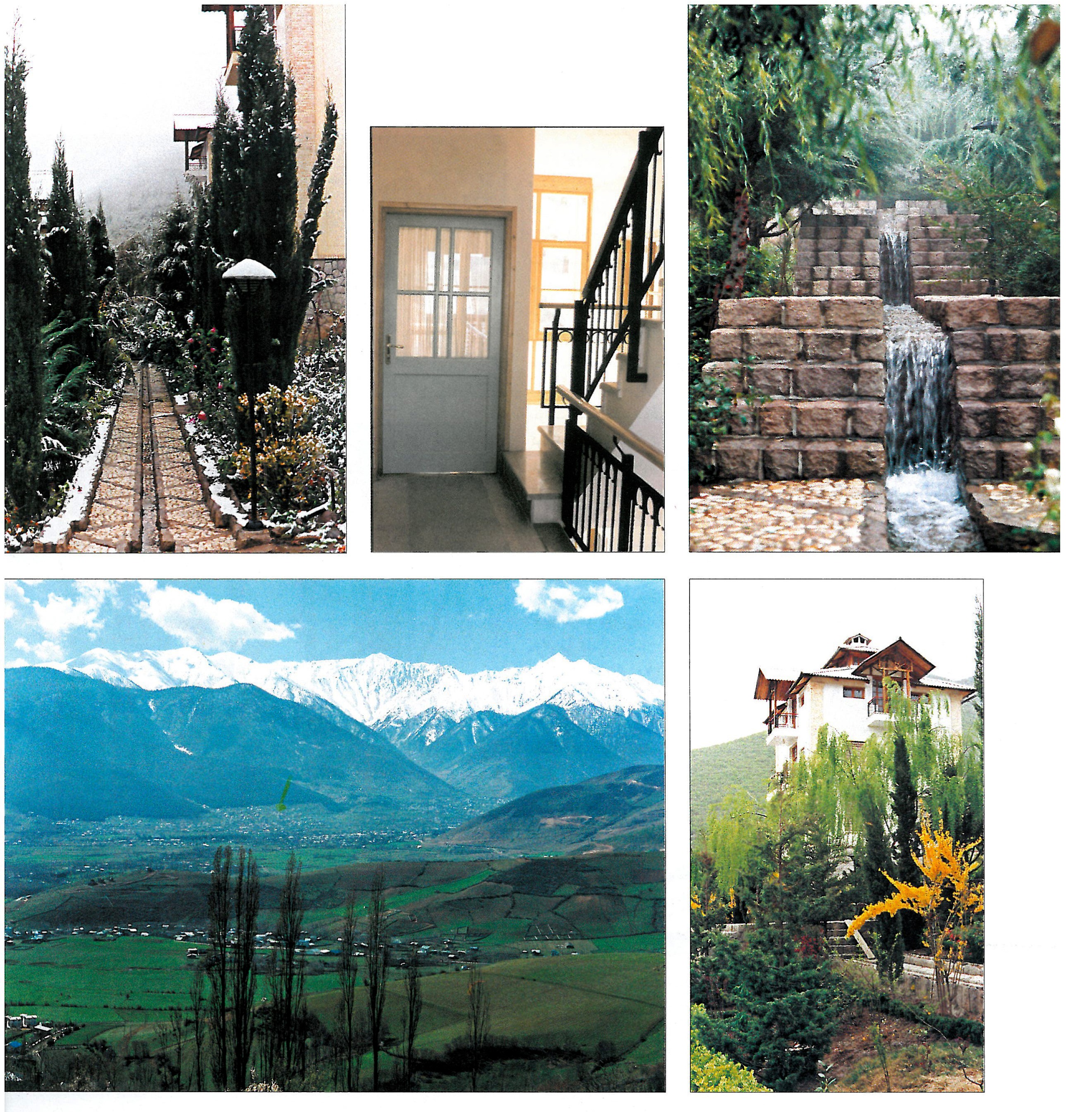
In the mountainous setting and pleasant climate of Kelardasht, after choosing the site, surveying the area and visiting the surrounding villages, the design of a garden with residential pavilions began in 1991. Construction work began in June 1992 and continued until November 1996. There are now six pavilions in three types — two of each type — laid out around a central water axis. The main slope of the land, of about 8 percent, runs north-south; the principal middle access, with a fifteen-metre change in level, runs along it. The water channel traverses that level change in a series of waterfalls and, at several points, enters water features inside 6 × 6 m platforms, set within small garden plots. The platforms are linked east-west to one another. The water of these pools flows in narrow channels in the middle of the walkways; the shorter pavilions sit at the lower levels and the taller pavilions at the upper. Each pavilion has views in all four directions and enjoys north-south (toward-mountain) and east-west (facing-mountain) cross-breezes. Narrow vehicle tracks have been provided for necessary access to the pavilions, but car parking is kept near the main entrance of the garden so that the pedestrian routes, main access and interior spaces remain undisturbed by cars.
Mr. Sarrafha describes his engagement with the dream of the Iranian garden on this Kelardasht project thus: "When, in 1991, the design of this complex was handed over to me, I was dreaming of bringing a garden into being. I said to myself, can one imagine a better place than a garden to dwell in — a garden set within a beautiful natural landscape? And is there a more delightful landscape than a mountain range that at every hour of day and night offers a new face? The space of the old Iranian gardens — beyond the heavy, earthly world — sets the soul to flight. The space of the old Iranian miniatures is likewise: what is present in them — the building, the pool, the tree, the flower, the cloud, the sky, the throne, the earth — all hang suspended, free from the hold of earth's gravitational laws. The cypress tree, figure of the old dreams, holds a special and magnificent place in the miniatures. How consoling it is to plant and tend the growth of cypresses in a garden where, because of heavy winter snows, planting cypresses is not the habit. Now, after a few years, looking at the grown cypresses of the garden, I think that dreams one day come true. Dream, garden, miniature — and the image of a tall cypress beside a pavilion evoking the dream of a garden — were imaginings that, from the start, held me."
"Man has long been searching for a better place to live in the infinity of the heavens. Are the heavenly gardens as beautiful as the earthly gardens — especially the Iranian ones? What will the heavenly gardens bring us? Spaces beyond the daytime preoccupations and the nighttime anxieties; imaginary, suspended spaces like Iranian miniatures and the imagined heavenly gardens — reflections of the mental space and of the eternal station of the blessed. Will it one day be possible to live in gardens of such a kind?"
Alvand Office Building (1991-95) — Employer: Larestan Company. Design and Project Team: Azita Ghafouri, Negin Maleki, Mohammad Jahangiri (CAD). Structure: Farhad Golshan. Mechanical Engineer: Farhad Nafisi. Electrical Engineer: Ahmad Mohagheghi. Geotechnique: Iran-Khak Consulting Engineers. Construction Manager: Behrooz Feizi (Larestan Co.). Photographs: Ataollah Omidvar.
The design of the Alvand Street office building in Tehran began in the second half of 1991. Construction started at the beginning of 1993 and was completed in 1995. Because of made-ground and the results of the soil-mechanics tests, deep foundations (concrete piles) were recommended — driven at least three metres into undisturbed soil and ending as truncated cones at 30 degrees upon bed-rock. The building's columns therefore rest on twenty concrete piles 12-14 m deep and 80 cm in diameter. There are two basement floors and nine floors above ground. The ground floor comprises the entrance lobby, reception and a waiting room, with part given over to car parking. The building has two 8-person lifts and a fire detection and suppression system. The connections of the glazed façade are 60 × 150 mm aluminium lamellae with bolt-and-nut fixings, and on the north elevation (facing the street) the glazing is a triple-layer 6 mm with two layers of safety-film to prevent shattering in the event of an explosion, and an evacuated cavity within the wall.
Office in Mohseni Sq. (1991-92) — Project Team: Azita Ghafouri, Ahmad Souresrafil, Negin Maleki, Mohammad Jahangiri (CAD). Fireplace and Bronze & Copper Luster: Yadollah Zamannejad. Woodcraft: Hassan Mahmoudi and colleagues. Pyramid-skylight Metalwork: Tebras Mirzakhanian. Construction: the mason Lotfi. Mechanical and Electrical Engineering: Firoozabadi. Photographs: Ataollah Omidvar.
The upper floor of a four-storey office building, about 340 sq m, which had long been left unused, was renovated and in eighteen months prepared for the office of a commercial company. Given the twenty-year age of the building, all mechanical pipework, electrical wiring and roof drainage were replaced. Most of the interior walls were removed and new partitions were designed to suit the required spaces. At the centre of the building — where roof-removal was possible — natural light was provided via a glass pyramid; the central space is related to all the spaces around it. The structure of the building, the services risers and the plant-room equipment were reviewed and repaired. The pyramid skylight rests on two intersecting steel beams supported by four columns; the skylight's roughly 20 sq m surface has been carried with a minimum of steel sections by means of trusses and connections that taper upward from below. The pyramid surface is covered with 10 mm safety glass. The doors, surface finishes and fan-coil covers, skirtings and cupboards are of mulch wood, floors are of several kinds of travertine (including Azarshahr), and etched glass work and a bronze-and-copper composition in the fireplace, plus patterns on the glass, are among the works executed. About 1,500 hours of design work and continuous personal supervision were spent on this project.
Decoration and Decorative Patterns in Iranian Arts — by Abdolhossein Sarrafha
The enduring values of the various Iranian arts — such as architecture and the decorative arts related to Iranian life — have from time immemorial been mingled with art, with no border between the two. The degree of mingling of art and life is unparalleled in any other nation. It is as though Iranians did not consider art and life to be separate and valued both equally. This feature has given Iranian life a distinctive colour and form and set it apart from other peoples. Iranian art — as it appears in the instruments of labour and the utensils of everyday life — has served life; and for this reason the Iranian or decorative arts adorned the tools and items of daily need with such taste, love and commitment that many of these items are counted as masterpieces. The stairs of the Apadana Palace at Persepolis with their bas-reliefs, the dome of Sheikh Lotfollah, silver and brass plates adorned with flower and leaf and script, the astonishing stucco of a mihrab, the fine craft of stonecutters, or the decoration of a doorway, window or ceiling in an old house — all are examples of the decorative arts.
Basil Gray writes: "Anyone who has seen some Iranian artwork — a piece of fabric, a tile, an Islamic book — immediately feels that Iranians are among the great designers of the world. It is colour and balance that give a miniature majesty and loftiness, and in these two fields the Iranians reached mastery. Animal forms and geometric patterns are abundant in Iranian art. From the Sasanian period onward, a real unity emerged in Iranian art that has always endured, and the continuous evolution of the Iranian arts stands in this same close relation with life." The Iranian decorative art has a deeper meaning, too, because each pattern is a symbol that arises from a fruitful mind and interprets the truths of life and the dreams and inner feelings of human beings. The relation between Iranian art and poetry, mysticism and philosophy is no accident. By the testimony of a thousand years of brilliant Persian literature, Iranians are the most poetic of all peoples. Iranian decorative arts have been called visible music. Behind the simple patterns lie composite objects and aims, bespeaking the strength of imagination and the skill of mind.
All this shows that the makers of these arts possessed mathematical knowledge and deep insight. How could so many shapes and so many lasting masterpieces have arisen without sufficient learning and mathematical awareness? The means of reaching this degree of mastery and perfection — in the immediate grasp and the understanding of the laws by which forms and geometric shapes relate — requires a presence in the boundless space of love, which lies beyond the attributes of the material world. The technical and artistic skill applied to the creation of the legendary figures of the Luristan bronzes can still, after thousands of years, serve as a model to present-day students of art. The manner in which the unparalleled glass vessels — whose antiquity dates back three thousand five hundred years — were made also bespeaks an industry extraordinarily advanced in its time. So too do the examples of metal engraving — in copper, silver and bronze — or the latticed sculptures used for burning aromatic plants, or the craftsmanship of artists on wood, or the inlay on the bodies of pulpits, Qur'an stands, or the doors of sacred places.
The ancients of this land had always to do with art; in the mosque, the bath, the bazaar, the caravanserai and the home — and in all their hours — their life was mingled with art. They recognised beauty and proportion and so lived in a more beautiful world. A set of decorated implements surrounded them — from a simple wooden sherbet spoon, to glass and metal vessels for eating, to a set of decorated pieces for rest, a carpet underfoot, or a fabric worn on the body — all full of taste and of great care in testing varied patterns of animals, lines, geometric shapes and angels. As Professor Pope says, the finest carpets the world has ever seen had their patterns drawn in Iran in the eras of Shah Ismail and Shah Tahmasp. Designers and weavers of no other country reach, in clarity and precision, in poetic imagination and refined insight, the level of the Safavid-era carpet weavers and designers. The value of these carpets, like the value of the palaces, is the product of the collective toil of the illuminators, dyers, weavers and designers.
Note: this text is adapted from a paper presented at the Seminar on Decorative Patterns in Iranian Architecture, held in Farvardin 1370 (March 1991).