Has modern architecture truly died, as Charles Jencks has claimed, "on 15 July 1972, exactly at 2:30 in the afternoon"? Jencks' reference is to the Pruitt-Igoe project in St. Louis, USA, designed for low-income families (figure 1); its architect, the American Minoru Yamasaki, had received the gold medal of the American Institute of Architects (AIA), awarded — in their estimation — to the best architect of the year. The question here is not whether that building was demolished because of its architectural design or because of the corruption and decay of the classes that inhabited it; it is enough to note briefly that prostitution, drug trade and homosexual hustling ply both in the great old quarters like Chicago's "Old Town" and in a building like Pruitt-Igoe in St. Louis.
Setting that debate aside, our question — which we raised at the outset — is whether modern architecture has been in decline since the 1960s and then suddenly died in 1972, or whether modern architecture has adjusted itself and, rather than a sudden death, one should speak of a dramatic transformation. Since Jencks' sharp but crude rhetoric may have bewitched some surface-lookers and simple minds, and reduced architecture — in Mies van der Rohe's phrase, though he was not referring to this remark of Jencks — to the level of a "playground for children" (Tummelplatz für Kinder), of which we are witnessing certain manifestations in the world today and in Iran as well, the discussion of this question will be the chief concern of this essay.
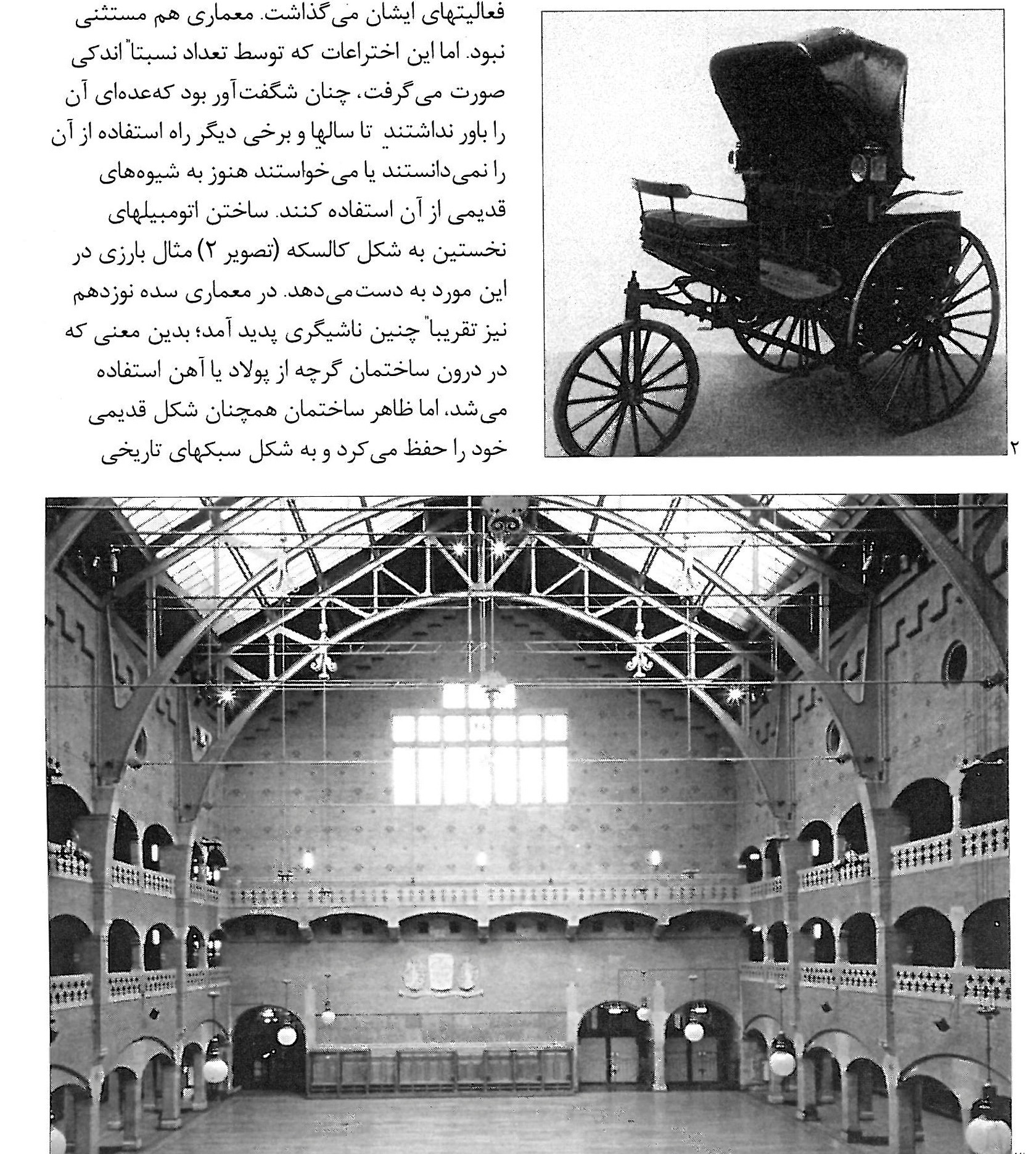
One might gather that modern architecture was the fruit of the night-dream of one or of a few pioneering modern architects, and that on the morning after that dream they cast aside the architecture of the late nineteenth century and set about creating works wholly cut off from neoclassicist tendencies. But reality is not so. Modern architecture was not born of the dream of this or that architect. It was born of its own age — an age in which, by the advance of science and reason at an unprecedented pace, inventions were made each day that opened fresh paths before human beings in every field of life. This was not unique in history; but these inventions, made by a relatively few, were so astonishing that some did not believe them for years and others did not yet know how to use them, or wanted to use them in the old ways. The making of the first automobiles in the shape of carriages (figure 2) is a telling example. In the architecture of the nineteenth century much the same clumsiness appeared: steel or iron might be used within the structure, while the façade still preserved its imitative appearance and came out as Classical, Gothic, Renaissance, Baroque, even Palladian and Elizabethan — the only thing being that building was now easier because of the new materials.
The rejection of the term "style" — a term that referred to this surface imitation — by the first modern architects was for exactly this reason. When those pioneering architects rejected the term, what they meant was that modern architecture had no "style" one could brand "international." Berlage's remark that "architecture of appearance means lying" (Schein Architektur; d.h. Lüge) had the same imitation of past styles with new materials in view. With his design for the Amsterdam Stock Exchange, Berlage swept away that lie and built something that had no "style" but in which outside and inside were one, the skeleton of the building displayed through exposed iron trusses (figure 3). The same tendency was shown years later by Le Corbusier in his design for the Palace of the Soviets — with far greater artistry (figure 4) — until in the seventies Richard Rogers and Renzo Piano carried "de-lying" to its limit in the Pompidou Centre (figure 5), displaying the building's very "viscera and entrails" naked on its façade. One may take this "architectural striptease" as the endpoint of the conception of architecture of the late seventies — even as the swan-song of early modern architecture. But these buildings and these architects showed that a new age had been born, the very same age that Le Corbusier, before anyone else, had long earlier recognised. He and his peers strove, by grasping — if not the spirit of the age, then the nature of the age — to bring its architectural equivalent to crystallisation and embodiment in their works.
What truly made these innovations possible? If, by some impossible supposition, these innovations had not come about, what quality would today's architecture have? The continuation of the nineteenth-century antiquarian neoclassicism? Would that form of architecture not be laughable? Even looking at the clothes of people of a century ago, do they not seem absurdly affected? What led people toward the plainness and unadornment that modernism produced? What, if not the logical, scientific reason, and the advanced technology it brought forth as its offspring? Today one can easily condemn rationalism and offer children who know nothing of the past an excuse to reject anything belonging to the recent past and call themselves post-modern. But the reality remains. With noise and commotion one cannot disprove it, ridicule it or deny it.
This is not to say that I am the unqualified partisan of reason and science. In science there is always the possibility of error; in science there are uncertainties. The true scientist is the one who says: I know this far, and beyond this my knowledge is small and conditional. I always accept with certainty only what the available evidence supports. For example, I accept that the earth is spherical and rotates on itself and around the sun, because I experience day and night and the change of seasons every twenty-four hours and every year; and, in rejection of this scientific acceptance, I have not heard a convincing explanation or experienced a more logical evidence. About what I do not know, I have guesses; but only future scientific progress can show whether my guesses were right or wrong. The wise person is the one who knows the border between facts and guesses and who is aware of the limits of science; and the foolish person is the one who shuts his eyes to visible reality and, on the basis of personal and empty guesses, prefers stillness and stagnation and ignores the advance of science.
Though today scientific reality has led to inventions one cannot escape using, who today can deny the computer and the Internet and the hundreds and thousands of other inventions that appear in the world every day? Who, on a journey, prefers the use of horse and mule and cart and carriage to the use of train and car and airplane?
But what effect have these changes had on architecture, and what effect can they have? By these remarks I mean to remind us that modern architecture was not the night-dream or bubble-like whim of this or that architect, suddenly appearing only to — in Jencks' expression — meet its end in a single day, at a certain hour. Modern architecture was demanded by the possibilities of the age and by scientific and technical progress; and this architecture enjoyed both the freedom and ease that modernism had brought and was itself the embodiment and crystallisation of that freedom in the field of architecture.
Undoubtedly the building "skeleton" replacing the thick, load-bearing walls — one of the essential features of modern architecture — was an effective factor in this architecture's freedom. Le Corbusier's plan libre (free plan), the equivalent of which in Mies's architectural vocabulary is the "universal plan," is a perfect example of this freedom, because it freed the plan from the structural considerations of the building and in particular allowed it to fit the needs of whatever institution later occupied the building. We have all read and known all of this. Why then does the young architect ask himself — and those with experience — what path to take and from what source to draw inspiration? The path is the very discovery and recognition of the features of the age, and a disbelief in bombastic pronouncements.
Some of those who say too much and know too little, and whose expression is muddled and ambiguous, have said that Jencks' words are "journalistic." This judgement may be somewhat unfair and, to some extent, superficial — Jencks' own background is English literature; for that reason he writes English well and fluently, and, unlike Venturi say, he is able to convey what he means. Moreover, in his books, especially Architecture Today and The Language of Post-Modern Architecture, he has put together an album of the architectural work of some of the most brilliant contemporary architects. Our complaint against Jencks is that he has, in painters' language, "a broad brush," and in some cases confuses issues. The lines we quoted above, which announce the "sudden death" of modern architecture, are of this order. Architecture Today opens thus: "Since about 1960, MODERN ARCHITECTURE, or THE INTERNATIONAL STYLE and its related models, has changed dramatically" (p. 12).
This sentence is written with a "broad brush": by means of his "or" he slyly introduces modern architecture to his readers as a synonym of the International Style. One could read it as an accidental slip; but this "deliberate slip" takes place many times in Jencks' writings, while the reality is otherwise and the account of the International Style must be separated from that of modern architecture. Although what was called the International Style did take hold during the modern period, it must not be taken as the sole expression of modern architecture. Modern architecture had — or has — a language that Bruno Zevi, perhaps more than anyone, has explained in his book The Language of Modern Architecture. Many of its principles are, fundamentally, not in accord with the principles of the International Style. For instance, Zevi's "Break the Box," or his principle of "anti-perspective," stand in clear contradiction to some of the masterpieces of the International Style. It should not go unsaid that "International Style" was a term that Hitchcock and Philip Johnson invented in their youth and for which they published a book of the same name. Hitchcock was a historian and critic of art and it is highly likely that in those days Philip Johnson did not truly know modern architecture. In any case, this term was never accepted by the first modern architects and their partisans — among other reasons because the word "style" recalled the neoclassical imitations of the nineteenth century. In that time, the antiquarians classified every building by a specific style taken from historical periods; for innovators, the word "style" meant — and still means — the same antiquarianism.
If we truly were to take modern architecture and the International Style to be one and the same, would we not then be placing the works of Mies and Le Corbusier and Wright and Aalto and Gaudí and Mendelsohn into one heterogeneous pile? Johnson, to be sure, with a certain impudence and wilfulness, called Gaudí the greatest architect of the nineteenth century; but who today can doubt that Wright's works are modern? The greatest feature of modern architecture was its grasp of the spirit of modernism and the freedom it gave to architecture — whether or not Hitchcock and Johnson and their present-day epigones understood this. To emphasise our insistence on distinguishing the International Style from modern architecture, it is enough to look at two buildings in Berlin that by chance stand opposite each other. The first of the two is the New National Gallery in Berlin, whose design is among Mies van der Rohe's late works (1962-68) (figure 6), and in Jencks' classification this work must be placed within the "International Style." The second is the Berlin Philharmonic hall (1956-63) by Hans Scharoun — an architect of Mies's generation who never attained Mies's fame and standing (figure 7). Both buildings were shaped in the decade of modernism in architecture, yet the features of the two projects differ wholly.
The question is: if modernism is confined to the International Style, and if Scharoun's architecture is not modern, what other name can one give it? Must Scharoun's architecture be counted as an exception? In that case, what name can be given to the architecture of Gaudí, Mendelsohn, Aalto and dozens of architects of their kind? Even Le Corbusier's early works — buildings like the Villa Savoye — differ immensely and undeniably from his late works such as the Ronchamp chapel; yet all these works must be counted within modern architecture. It seems that, willingly or unwillingly, modernism in architecture brings freedom with it — the same freedom that neo-modern architects now pursue, striving to free architecture from the shackles in which modern architecture had itself been the pioneer.
In architecture, as in the expression of its tendencies, there are usually a few pioneers and forerunners, and the rest are either inspired or imitators — or minor epigones of the pioneers and imitators. This holds both of genuine architectures, which are memorable and lasting, and of fashions that prevail a few years and then, like bubbles, burst and vanish. I shall say nothing of those who draw inspiration from the pioneers — drawing inspiration from predecessors is customary; even in the masterpieces of the pioneers, critics have pointed out such things in many and various instances. But imitators, having no invention or initiative of their own, drag originality down into banality and turn springs into winters, so that out of that winter-sleep another spring may begin and new blossoms appear.
A state of torpor and stillness in architecture appeared roughly from the end of the sixties. But only a few years of this torpor and recession had passed when, on the old tree of architecture, fresh blossoms appeared and a new group turned to new paths of architecture. In the wake of this blossoming there were also artificial returns — returns that have no substance of their own and wish to present their imitation as originality and to claim the death of the old tree. But alongside these artificial currents there have also emerged genuine currents — currents that draw on the very freedom modernism had brought, while at the same time seeking new answers for our time.



