Rehabilitation of the city center and the main urban square, which serves as the connective joint between the historic and newly built urban fabric. Valuing the historical and vernacular buildings of Qazvin from the Safavid to the Pahlavi period as visual landmarks and nodes for citizens and tourists. Preparing a scientific and operational plan based on existing realities and the capacity of the area. Preparing an appropriate model based on the rehabilitation plans of urban squares around the world and their relevance to the historic Sabzeh Meydan of Qazvin. Reviving Sabzeh Meydan and establishing special interactions with the Ali Qapu cultural complex, the city as a whole, and the bazaar complex. Research Hypotheses: It appears that Sabzeh Meydans in every city enjoy special attention, and it should be noted that the main square in a city center represents the city as a whole. In the present research, we have transformed Sabzeh Meydan into the heart of a historic city — a cultural heart that is still alive in today's society and has adapted itself to it. The project boundary of Qazvin's Sabzeh Meydan is bordered to the north by Naderi and Ferdowsi streets and the northern historic edge of Bagh-e Saadat — the shops adjacent to the street; to the south by the Ali Qapu cultural complex, where the city's main museum is also located; from the southern side it connects with Peyghambariyeh and the present-day Red Crescent streets. The western side of Sabzeh Meydan marks the beginning of Imam Khomeini Street, along which Qazvin's main bazaar is situated, and the eastern side of the square begins with the start of Taleghani Street. Square in 2014. Pahlavi period. Aerial view of the square. Physical transformation conditions of the Bagh-e Saadat area. Image of Qazvin's Sabzeh Meydan in the Pahlavi period. Image of Qazvin's Sabzeh Meydan in 2014. Aerial image of Qazvin's Sabzeh Meydan and its surrounding fabric.
City/Country name, Image, Historical period, Description. 1. Piazza del Campo, Italy, Medieval period: One of the historic centers of this country and one of the largest medieval squares in Europe, famous for its beauty and architectural integrity. 2. Red Square, Moscow/Russia: The Kremlin Palace and St. Basil's Cathedral are located in this square, and many of Moscow's main streets lead to it. 3. Trafalgar Square, London/England, 1845: One of the main and most famous squares in London and one of the city's tourist attractions. Built in 1845, it was named in honor of the victory at the Battle of Trafalgar. 4. St. Peter's Square, Vatican/Italy: A large square directly in front of St. Peter's Basilica in the Vatican. St. Peter's Square was designed so that the maximum number of people could easily see the Pope's blessing ceremony, which is performed from the center of the church's facade or from a window of the Vatican Palace. 5. Federation Square, Melbourne/Australia: This square, considered a masterpiece of architectural engineering, ranks sixth. 6. Market Square, Krakow/Poland, Medieval period: This square, known as the seventh-largest square in the world, is located in the old city of Krakow. It was considered the city's largest square during the medieval period. 7. Plaza Casco, Lima/Peru: This square, ranked eighth in the world, is located in the historic military-political city of Lima, the capital of Peru, which was formerly considered the administrative capital of the Inca Empire (the government of Peru). Historical Background of Sabzeh Meydans in the World. Case Study: Sabzeh Meydans of England. The social importance of the upper-middle classes first appeared in London's cityscape after the Middle Ages with the construction of London's green squares and the houses around them. The middle classes created a style for residential houses that both displayed confidence in their social standing and was solid and enduring. The Meaning of "Green Square." An English architectural dictionary published in 1887 defines "green square" as follows: "A green square is a piece of land in which there is an enclosed garden, itself surrounded by a street that leads to the houses around the square." This definition, despite its brevity, aptly depicts the condition and spirit of London's green squares. As we see, the definition of a green square correctly begins with "a piece of land..." and then mentions its main feature — "an enclosed garden" (enclosed in the sense that it is used only by residents of the surrounding houses) — and finally the houses that encircle it. The essential point about London's green squares is that all of them have a garden composed of lawns and trees at their center. Initially, since the trees were still young, the gardens did not have the poetic and serene quality that was their intended purpose; time was needed for the trees to grow and create a green wall in their ranks — a wall that is not only protective and contributes to the freshness of the air, but also provides a cozy garden for the residents of each building. Urban identity was considered a general concept as long as it was not treated as an ultimate goal in plans and programs, or in other words, was not a subject of operational plans. But from the time when, for instance, discussions of Iranian identity or Islamic identity arose in architecture and urbanism, and the city was distinguished with the adjective Iranian, Western, or Eastern, and conflicting opinions and various physical models were presented, the need to address and examine the concept of identity became more urgently apparent (Mojabi, 2009). Historical Background of Sabzeh Meydans in Iran. "Sabzeh Meydan": a square in which there was greenery; a square adorned with vegetation, flowers, and plants (Dehkhoda, 1941). Dr. Heinrich Brugsch, who came to Iran in 1859 (the mid-reign of Naser al-Din Shah) as an advisor accompanying the members of the Prussian embassy, writes about Sabzeh Meydan: "...Our caravan passed through numerous streets and narrow alleys and finally through the covered bazaar, which is very cool and pleasant in summer. Along the way, we passed guardhouses where soldiers were stationed, and they saluted by raising their rifles. Finally, after traversing a winding and long road for more than an hour, we entered a large square with a flower garden in its center, surrounded by vendors selling vegetables and fruit. This square was known as Sabzeh Meydan, and on its right side there was a stone gateway with a tiled portal above which numerous Iranian banners were waving, and images of soldiers and their weapons could be seen on the tiles of the portal." During the reign of Naser al-Din Shah, Sabzeh Meydan, in addition to being a commercial center, was a gathering place for the people of Tehran on various occasions. Among them, during the month of Muharram and especially on the day of Ashura, when the processions of various city neighborhoods moved through alleys and the bazaar, they all gathered at Sabzeh Meydan for mourning and chest-beating rituals. During the first Pahlavi period, as the city grew rapidly, the Qajar-era city walls along with their gates were demolished, and Comparable Examples of Sabzeh Meydans in the World. Comparative Model Table of Similar Examples in the World.
new streets were built. At this time, the street that had been renamed Jebbekhaneh Street was widened and renamed Buzarjomehri Street. The Concept of the Presence of Sabzeh Meydans in the City. In this definition, we shall regard the city as a complete ensemble, with the ultimate goal being a logical connection between its constituent elements. In the urban and extra-urban domain, whenever elements such as residential areas, communication routes, parks, historical environments, recreational environments, cultural environments, forest parks, and so on can be placed in a pre-designed circuit, results can be achieved. If in establishing this connection we limit ourselves to vehicular roads and streets, we will gradually move away from the main objective. Qazvin's Sabzeh Meydan is like the brain of the city, capable of commanding the entire urban settlement or extra-settlement environment. These commands are classified in various packages and, in the overall urban structure and historic fabric, can become fundamental software for the city's life. Perhaps in initial examinations, this theory may be considered a localized theory for historic and urban fabrics, but this theory will never proceed as a localized matter, and the reason for this assertion is the definition and design of a smart communication circuit of urban elements. Qazvin's Sabzeh Meydan has bright spots that allow us to implement a plan suited to its vernacular and historic architectural fabric. Currently, this square has very few users, accommodating an age group of 45 to 75, and only during certain times of day. This pedestrian ring has become merely a connecting passageway, which is, of course, a positive factor, but only if other factors are present as well. These factors include personal meetings, important urban events such as exhibitions, important lectures, and so on. To achieve this result, there is no absolute formula, and it must be examined in various dimensions, such as observing the historical patterns of Chehel Sotoun and the values of vernacular architecture, preserving the status of the religious-cultural site of the Chahar Anbia mausoleum, and so on. In terms of physical structure, Qazvin's Sabzeh Meydan has many physical elements that lack specific meaning or function. The lack of proper calculations in lighting and the lack of safety compliance in utilities and installations are among the current problems of Qazvin's Sabzeh Meydan. Strategy and Practical Method. This section includes a set of research-practical measures that address the following issues: Main Objectives of the Plan: modernizing the fabric of the area using a minimalist design model, restoring the region's vernacular architecture, creating tourism infrastructure, and increasing the functional capacity of the Sabzeh Meydan area in forms of social interaction. Major Issues and Problems: high density and lack of population control, severe shortage of tourism infrastructure, absence of vernacular architectural models, neglect of existing historical and vernacular elements in the area, heavy traffic and the presence of motor vehicles. Regional Capacities and Potentials: the existence of historical and cultural opportunities based on the presence of the Chehel Sotoun mansion and its garden, the centrality of Sabzeh Meydan as an urban center, the location of the city's important banks within the area, appropriate connections with the historic fabric and the new fabric. Transportation, Utilities, and Urban Equipment Policies and Strategies: designing a controlled network for the entry of motor vehicles (public and private), strengthening the use of public transportation, using bicycles for entering the historic fabric. Structural with an operational approach. Planning Method: strategic. Reconstruction (demolition). Renovation (revival). Mode of Action: improvement (preservation). Intervention Method: local-thematic plans (Honarvar, 2000). Principles of the Rehabilitation Programs for the Sabzeh Meydan Space According to Urban Conservation Considerations. Article 1: Restoring the morphology of the facades around Sabzeh Meydan (northern, eastern, and southern sides) according to authentic models with an approach to organizing the urban landscape. Given the severe disorder of numerous facades with different forms and colors produced by the owners and residents of the area, principles must be defined for cleansing the surrounding facades in the proposed plan. These principles are designed with a neutral approach and with minimal intervention. Article 2: Correcting the typology (plan) of Sabzeh Meydan based on the removal of superfluous physical elements. Removing all superfluous elements from Sabzeh Meydan, such as fountains and excess lawns, and creating the opportunity for passage through central axes with attention to the location of Chehel Sotoun and the patterns of Persian gardens. Article 3: Selecting vernacular and, as much as possible, neutral materials for the execution of elements of the proposed plan, such as paving, platforms, fountains, and so on. Article 4: Defining directives to strengthen the Sabzeh Meydan's spatial role for tourists. Establishing tour guides, a local soldier museum in the square, cultural product sales booths, light food sales, designing a section of Sabzeh Meydan for holding local ceremonies, theater, and so on; planning various cultural, artistic, and social programs as well as important managerial lectures for the city's people at Sabzeh Meydan. Article 5: Controlling traffic during certain times of day to prevent the excessive entry of motor vehicles into the Sabzeh Meydan area, strengthening public transportation, and designing a large parking facility near the Sabzeh Meydan area. Article 6: Defining policies for the concentration and entry of local and native citizens into Sabzeh Meydan for daily affairs such as banking and so on, as well as establishing functions such as travel agencies, hotels, restaurants, and so on, and removing secondary occupations from the core of the project area. Conclusion. This article has made every effort to revive urban spaces, with Qazvin's Sabzeh Meydan as a case study, in order to cultivate the spirit of using urban spaces among citizens. A place of living is not merely the home and the workplace. There also exists a main and important element called urban space, where one can spend hours. This article has been planned based on the principles of respecting vernacular architecture and valuing the culture and history of the city of Qazvin, while also maintaining a view toward the reproduction of a useful urban space. * Master's degree in Restoration and Revival of Historical Buildings and Fabrics. Sources: Ardalan, Nader. Charter of Settlement Rights, first edition, Tehran, Yadavaran Publications. Bahreini, Seyyed Hossein. The Process of Urban Design, second edition, Tehran, University of Tehran. Tavassoli, Mahmoud. "Terminology of Urban Renovation and Improvement," Haft Shahr Magazine, Quarterly of Urban Development and Improvement, No. 2, Tehran. Habibi, Seyyed Mohsen, and Maghsoudi, Malihe. Urban Restoration, third edition, Tehran, University of Tehran Press. Habibi, Seyyed Mohsen; Pourahmad, Ahmad; and Meshkini, Abolfazl. Improvement and Renovation of Old Urban Fabrics, first edition, Tehran, Entekhab Publications. Dabir-Siaqi, Seyyed Mohammad. The Historical Course of the Construction of the City of Qazvin and Its Buildings, third edition, General Directorate of Cultural Heritage and Tourism of Qazvin Province. Fereshtehnejad, Seyyed Morteza. Dictionary of Architecture and Architectural Restoration, first edition, Arkan-e Danesh Publications. Falamaki, Mohammad Mansour. Revitalization of Historical Buildings and Cities, seventh edition, Tehran, University of Tehran Press. Golriz, Seyyed Mohammad Ali. Minudar or Bab al-Jannah of Qazvin, first edition, Qazvin, Cultural Heritage and Tourism Organization of Qazvin Province. Mojabi, Seyyed Mehdi. In Search of the Urban Identity of Qazvin, first edition, Tehran, Center for Urbanism and Architecture Studies and Research. Antoniou, Jim. "Historic Cairo," Architectural Review, 1998, Washington DC. Middleton, Michael. Man Made the Town, 1987, Baltimore, Renewal Bradley Head, London. Northam, Ray M. Urban Geography, 1975, John Wiley, London.
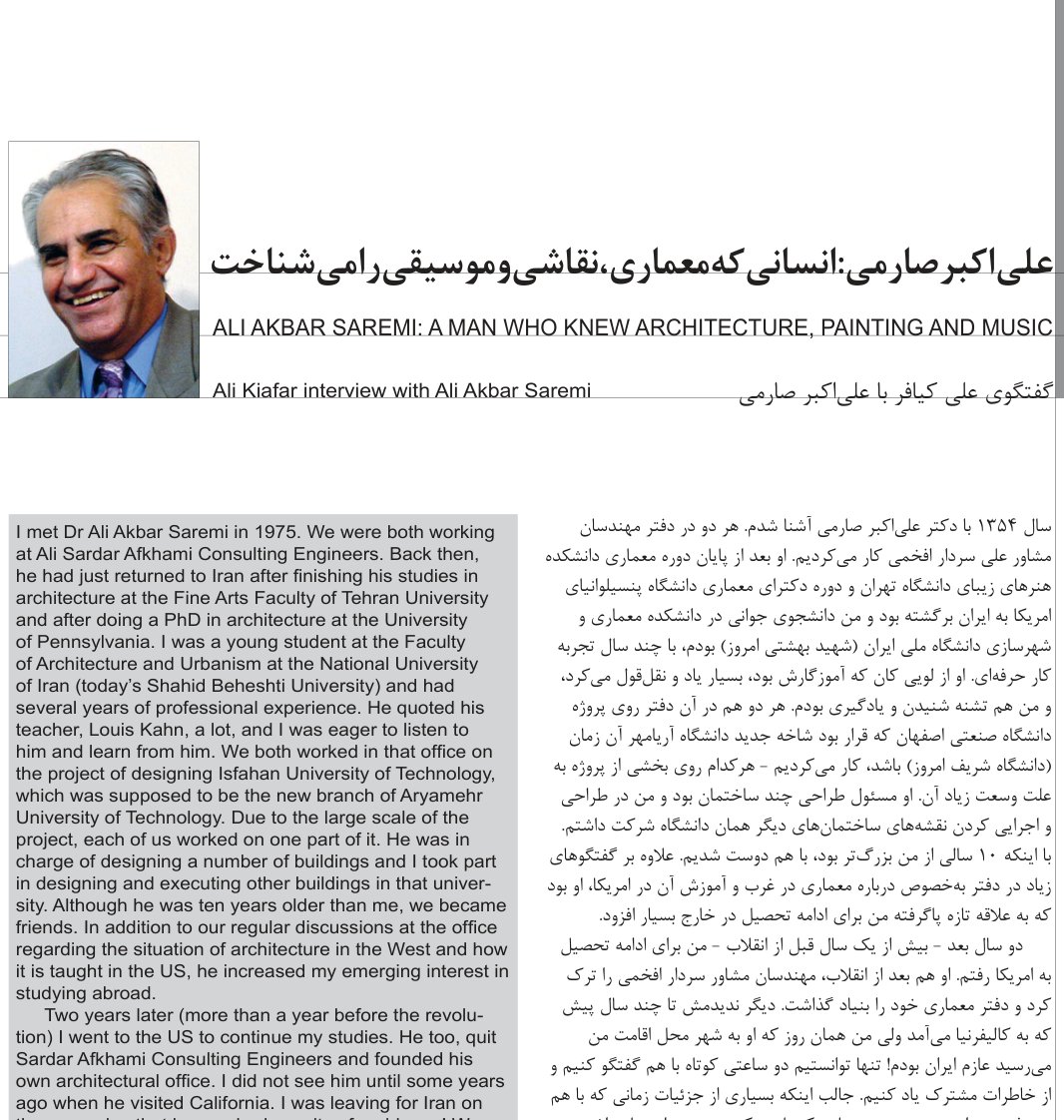
Ali Akbar Saremi: A Man Who Knew Architecture, Painting, and Music. Ali Kiafar's conversation with Ali Akbar Saremi. I met Dr. Ali Akbar Saremi in 1975. We were both working at Ali Sardar Afkhami Consulting Engineers. He had just returned to Iran after completing his architecture degree at the Faculty of Fine Arts at the University of Tehran and his doctoral degree in architecture at the University of Pennsylvania, and I was a young student at the Faculty of Architecture and Urbanism at the National University of Iran (today's Shahid Beheshti University), with several years of professional experience. He frequently quoted and spoke of Louis Kahn, who had been his teacher, and I was eager to listen and learn. We both worked in that office on the Isfahan University of Technology project, which was intended to be a new branch of the then-Aryamehr University (today's Sharif University) — each of us working on a different part of the project due to its vast scale. He was responsible for the design of several buildings, and I participated in the design and execution of drawings for other buildings at the same university. Although he was ten years my senior, we became friends. In addition to our many conversations at the office, especially about architecture in the West and education in America, it was he who greatly fueled my newly emerging interest in continuing my studies abroad. Two years later — more than a year before the revolution — I went to America to continue my studies. After the revolution, he too left Sardar Afkhami Consulting Engineers and founded his own architectural office. I did not see him again until a few years ago when he came to California, but I was leaving for Iran on the very day he arrived in my city of residence! We could only converse for two short hours and reminisce about our shared memories. Interestingly, he remembered many details from the time we worked together at Sardar's office and the conversations we had had. Two months later, I had a detailed conversation with him about the three volumes of my book, which deals with the discourse on the transformations of Iranian architecture and urbanism in the modern era. He gladly answered and discussed everything I raised, even where I challenged him — including how Iranian architecture could be found in his designs, and where he — as someone who loved Iran greatly — saw the "Iranian" quality in his work or in any corner of his designs, if he believed in the necessity of such a quality in today's architecture. And this was the last time I would converse with him, without either of us knowing it. We arranged to meet in Iran, whenever I would come. Alas, that meeting was never to be. Ali Saremi's love for the profession of architecture was clearly visible in his works. Until his very last day, he was concerned with architecture and with leaving behind his legacy. Pourya Mozhdeh, a young architect who has been my collaborator on parts of the research for my books in Iran in recent years, recounts that in the autumn of 2014, he contacted Dr. Saremi to obtain certain documents for the compilation and publication of my book. Their conversation, contrary to what Pourya had anticipated — based on his experience with several architects and veterans in the field — was not short and passing, and lasted over an hour and a half. Ali Saremi spoke about the meaning and significance of the surname "Mozhdeh" (meaning "good tidings") and the responsibilities of an architect — from self-awareness and one's own name to imbuing the surrounding environment with meaning — and his words contained compassionate guidance. At the end of the conversation, he said: "Until our very last moment, in whatever profession we practice, we must never abandon sensitivity, attentiveness, and creativity. Dynamism must perpetually be manifest in our profession and expertise. From this very conversation.