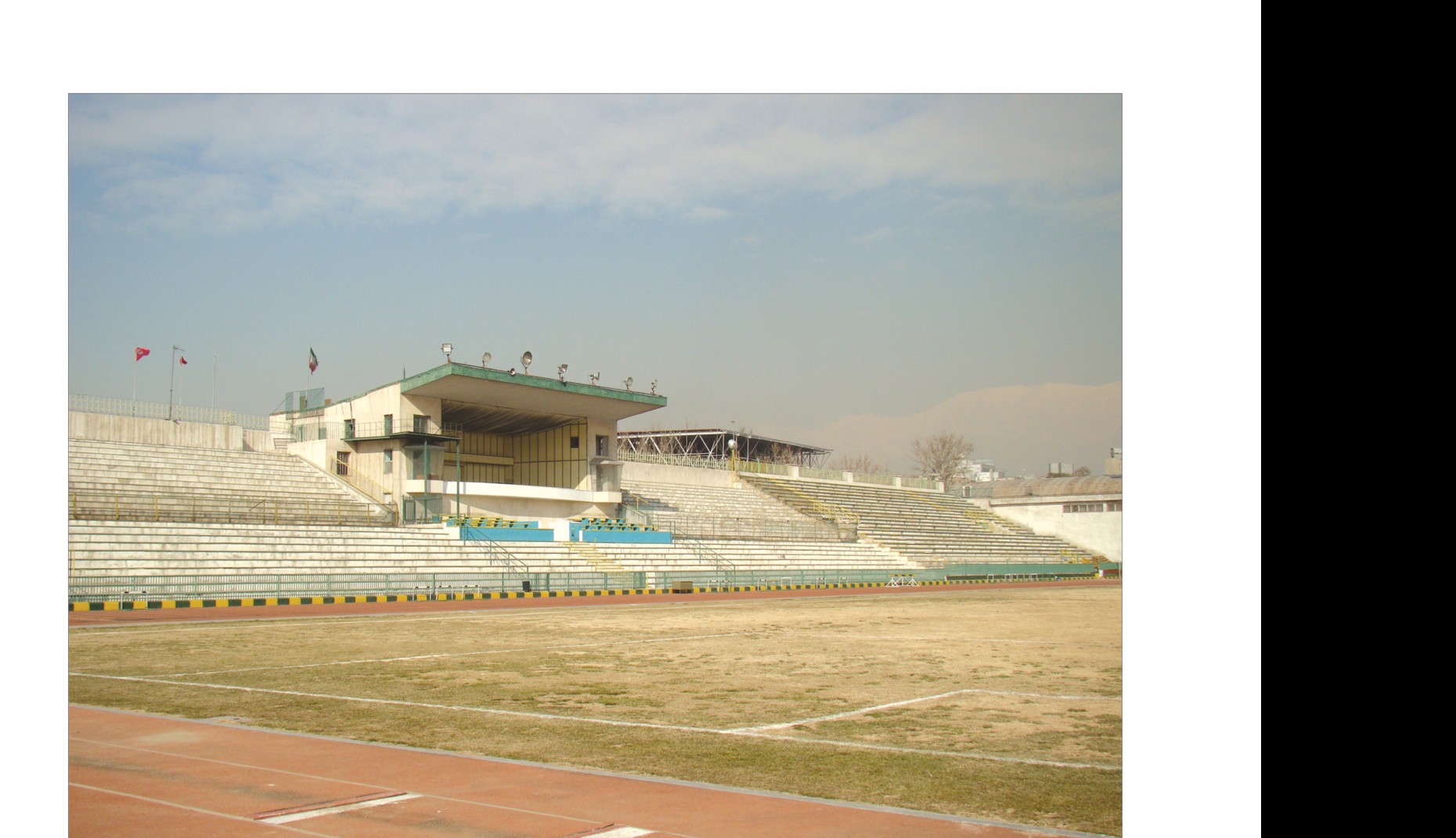
AMJADIEH STADIUM, TEHRAN
General view of Amjadieh (Shiroudi) Stadium
Amjadieh is Iran's oldest stadium, and it holds a cherished place in the memory of many residents of Tehran, and even Iran. Many national games, political events pre- and post the Islamic Revolution, Ta and Persepolis matches that were always infused in politics, etc. have all resulted in creating this nostalgic status for Amjadieh. A statue that was never gained by Azadi stadium.
Markov and Saeed were the architects who designed Amjadieh with a capacity of twenty five thousand seats. This structure is the main stadium, or court Number One. It seems that some parts of the complex were designed by De Baron, the French architect. The most beautiful architecture in this complex is that of the Football Stadium, or court Number One. On all sides its facade changes in tone with horizontal bands of white travertine over red brick. This facade, along with the metal windows, which are set in a methodical repetition in the red brick band, form the general shape of the stadium.
The construction of the stadium was started in 1315 and it was officially opened in 1318 by hosting the first championship games of the country in several sports. Over the next sixty-nine years, this complex has been subject to constant alterations and revisions, and halls for volleyball, basketball, handball, gymnastics, outdoor and indoor pools, practice fields, a wrestling hall, and most recently the half-built swimming stadium were added to it. The main stadium's building was also modified in 1358.
In any case, the additions of the past sixty-nine years have transformed the original design to such an extent that even those who still remember the past can no longer recognize the physical forms of their recollections in the present stadium. In fact, it can even be said that this stadium is in some ways a symbol of all the ups and downs and unrests of the past four decades, which are perfectly reflected in the patchwork quality present in the architecture of our small and large cities.
Amjadieh Stadium Complex
The complex includes: 1. Main stadium, 2. Pool hall (under construction), 3. Handball hall, 4. Basketball hall, 5. Volleyball hall, 6. Boxing hall, 7. Futsal hall, 8. Tennis hall, 9. Open-air pool, 10. Swimming pool, 11. Play ground 2, 12. Wrestling hall, 13. Gymnastics hall, 14. Medical federation, 15. Martial arts hall.
The complex has grown organically over decades, with each addition reflecting the architectural sensibilities and budget constraints of its era. The result is a fascinating but troubled palimpsest of Iranian sporting architecture, from the elegant Art Deco-influenced main stadium to the utilitarian concrete additions of the 1980s and 1990s. The challenge of preserving Amjadieh's historical significance while modernizing its facilities for contemporary use remains one of Tehran's most pressing architectural debates.



