An opening
The article that follows extends the theory of textual interpretation into the field of architecture. This theory, which has its roots in linguistics, has in recent years been used as a critical tool in many visual fields. The reader will see in this article the results of applying this theory to architecture clearly.
Jakobson: the six elements of linguistic communication
Roman Jakobson (1896-1982), the Russian linguist, has put forward important theories in literary criticism, communicative action, and poetry. In his view, every linguistic communication consists of a letter sent by its writer to the receiver. The same is true of news cast as a message from a radio to the people. If, in place of the message, we substitute a work of art, we have the work of art.
But the message — or the work of art — carries with it three notions: context, code, and contact. Context refers to the history, the society, the culture, and the situation in whose ground the work of art has taken shape. Code is the very signs and marks that make the work of art and that mediate our understanding of it. Contact refers to the form and the casting of the work of art. In painting, for instance, the artist places his work in the field of the viewer's contact: contact is the canvas and the very picture; the codes are the colour and the other elements used; the context is the historical-social situation of the picture.
But the form of contact changes with the time: for instance, painters' use of fabric, metal, and glass instead of canvas and frame has extended the form of the work of art. Robert Rauschenberg, the American artist, in one of his pictures has used oil paint, paper, metal, photographs, fabric, and wood (figure 1).
The bringing-forward of each of the six elements
What is interesting is that, with particular attention given to any one of these six elements and the bringing-forward of that element, the other facets are lost and forgotten. Attention to the addresser, for example, is the concern of the Romantics, in whose work the addresser's intention and aim is the important matter. Attention to reception (the aesthetic of perception) shows that Iser and Jauss — contemporary theoreticians — have addressed it. The Russian Formalists, such as Viktor Shklovsky and Boris Eichenbaum, took the contact and the form of the work of art as the principle.
Attention to code and to language itself is to be seen in the works of Barthes — particularly in his early works, in which he addresses code and the linguistic side of the work as the maker of meaning. Attention to context is apparent in the Marxist and critical views, as the thinkers of the Frankfurt School — Adorno, Benjamin, Habermas — by criticising instrumental reason, capitalism, and the issues arising from the mechanical reproduction of the work of art, give particular attention to the context of the work of art. Feminist views, too, which examine notions such as binary oppositions, hierarchical orders, and the reflection of the idea of the male's superiority over the female in the unconscious of language and society, point to the context of the work of art and to the suppressions hidden within it.
Jakobson in an architectural work
Jakobson's view can be examined in a work of architecture. In the case of an architectural work, the architect and the team — the designers and builders — are the addressers; the receivers and the audience are the users and inhabitants of the architectural work, who take it up. Contact is the architectural work itself, manifest in the form of building. A house, a temple, a hospital — each carrying its particular form — is a contact.
The codes in an architectural work refer chiefly to the architectural elements — door, window, column, ceiling, and the like — for the architectural elements are the very signs used in the architectural text. These elements, the products of technology, continually change and turn over.
The context of the architectural work carries the time, place, and the economic, social and political situation of the building.
The six elements applied to the architectural schools
Attention to the various sides of an architectural work in different schools of architecture can be useful for grasping the differences among schools and ideas.
Greek classical: in the classical architecture of Greece, contact occurs chiefly in the form of temples. There the codes take shape under the influence of the Doric, Ionic, and Corinthian orders, and fixed principles govern their bodies. The context — for instance, in the Acropolis — speaks of the inner discipline and order of society, the notions of democracy, and the presence of mythic ideas (figure 2).
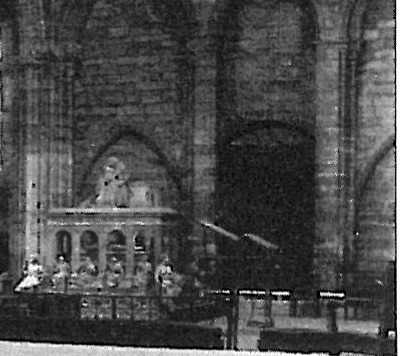
Gothic: in its codes, marker of the Christian thought of that period, attention to the soaring sky and the orientation of the altar takes the form of codes such as the tall columns and the stained glass (e.g. the church of Saint-Denis).
Baroque: in the Baroque, the complex, interwoven surfaces — born of mathematical and technological power — give place to fixed columns and ceilings (e.g. Balthasar Neumann, in his churches, draws on curved, complex, interwoven lines).
Modern: modern architecture, taking shape in a context of uniformity and simplicity, has uniform surfaces, a simple geometry, metal columns, glass and iron (e.g. Mies van der Rohe's Farnsworth House — rationalism, the International Style, and uniformity have turned the form of contact into uniform surfaces, a simple geometry, metal materials, glass and iron).
Postmodern: postmodern architects, in protest against modernist approaches, have turned their codes toward the re-use of traditional and classical architectural codes, and have drawn on arches, ornaments, and vernacular materials. This architecture has come about in the context of notions such as pluralism, the negation of rationalism, the vernacular, and regionalism.
High-Tech: the codes in High-Tech architecture are wholly technological, taking the form of connections, details, and new materials, with technology and innovation as their context (e.g. Renzo Piano, at the Kansai airport in Japan, has used wholly technological codes in the form of new connections, details, and materials).
Deconstruction: in deconstructionist architecture — the continuation of postmodernist thought in the form of different codes — the negation of single truth, the negation of foundational values, the rejection of binary oppositions, and the unfounding of classical concepts form the context. The codes in this kind of architecture have been changed with the help of computers; angled surfaces, intersecting and inter-penetrating walls and stairs make up its structure (e.g. Zaha Hadid, in The Peak project, has used different codes such as angled, intersecting, and inter-penetrating surfaces). Some of these architects even use unconventional materials — Frank Gehry, in his own house in Santa Monica, California, an extension of an old house, has used iron, pink walls, a red chimney, and crooked windows.
The architectural text: reading, not viewing
An architectural work is read like a text. To read a work of art is to engage with it, to draw out the signs hidden within the text, and to interpret those signs. We usually use the word text for a piece of writing, and take 'reading' to be the reading of its words. But the 'reading of a text' has a wider meaning.
The meaningful parts of the text, the words, combined together make sentences / lines, and from the combination of lines the text of a poem comes about. This event — which takes various forms (ghazal, qasida, do-beyti, blank verse) — within itself takes various literary devices: brevity, allegory, image, personification. As we read this poem, each one, in keeping with his own intellectual background, interprets it; gives meaning to its signs; and makes the text his own. To read a poem / text is, in a sense, to compose it again.
Painting too is a text, the words of which are made by lines, colours and objects; reading the picture is seeing and looking at it. Music too — a combination of notes and sounds — is read by lending the ear.
From this view, architecture too may be read as a text. The words of this text are made by volumes, textures, lines, and architectural elements. The kinds of composition mark the maker of composition; and style, the manner of architecture, is determined. The Baroque architect arranges his architectural elements in a manner one calls Baroque, just as a particular kind of arrangement of architectural elements has been called the International Style. Style is the result of naming; naming is the product of rules.
Travelling in the text, re-creating it
Reading this text is just to see and to travel in it. By travelling in the text, each one, in keeping with his pre-suppositions, examines its corners, re-reads for himself the signs and concepts hidden in it, and lays meanings upon them. Seeing architecture is the re-creation of that text. With each viewing and travelling in the architectural text, architecture is transformed and made anew. In this journey, an inter-textual conversation takes shape — a conversation between architects and travellers, the travellers seeking out something which they grasp differently from this text and from that.
Five potentialities hidden in the 'architectural text'
This way of looking at architecture brings out the potentialities hidden in an architectural work:
1. Each one reads the architectural text in his own way, and each one's reading is a part of truth, not the whole. This notion, which leads us to plurality and to the negation of a single truth, frees the text from the trap and the rule of certainty and totality, and makes the architectural text many-sided. Each one looks at architecture from a perspective and a vista, and reads off one of its dimensions.
2. Every text has within itself a meta-text or context. The text contains its own context. By travelling in the text, then, one can become aware of its context. In this, the viewer's interpretation gains value, since each one has the right to his own reading.
3. Architecture as text can be approached phenomenologically and many-dimensionally. But the elements are not separate or alone — the elements take shape within the framework of a structure. This structure is the maker of the world of the architectural text. By reading the architectural text we enter the world of the text.
4. This world of the text has its own coordinates. Truth, rightness and wrongness gain meaning within the world of the text. The validity and the falsehood of the propositions of any text can be examined within the relations of that text. Judgement from a particular intellectual superstructure does not lead anywhere.
5. This view weds the architectural text to time. The architectural work becomes time-bound and contemporaneous, since it rests on reading; and reading — the re-creation of the text in a fresh experience and a different journey each time — is, in the interaction of the horizons of meaning of the traveller and the text, ever fresher.
And so architecture moves from the state of product to the state of process. A product is a thing on which one cannot work or change; but the process — the result of journey, interpretation, and re-creation — finds life and continuity.
References: Babak Ahmadi, Truth and Beauty, Markaz Press, 1996; Babak Ahmadi, Structure and the Interpretation of the Text, Markaz Press, 1996; Robert Scholes, An Introduction to Structuralism in Literature, tr. Farzaneh Taheri, Agah Press, 2000.



