The article begins with how the theory and practice of Iranian art and architecture are out of proportion in terms of both quantity and quality, and how this has led some to try to compensate for the lack of theory by articulating Persian architecture in terms borrowed from elsewhere and alien to the inner logic of that architecture. Examples are cited of how such ‘lack of theory’ was at certain times intentional on behalf of Iranian artists and architects, and how more coherent and meaningful explanations for this style of art can be found in Persian poetry rather than philosophy. The text explains how Persian architectural literature will start to make more sense when read from the viewpoint of architectural atmosphere taken as a kind of poetics. It continues by a study of literary examples showing how ‘haal’ (the Persian equivalent of the term ‘atmosphere’) is an untranslatable term with a myriad of semiotic layers that are relevant and essential for a coherent and meaningful reading of Persian architecture. The essay argues that the term cannot be reduced to a modernist understanding of ‘space’, nor the postmodern notion of ‘place’, nor the contemporary concept of ‘atmosphere’. It is rather marked by a defiance towards theatricality and representation but closely connected with a specific understanding of introversion in architecture resulting from a carefully choreographed relationship between the individual and the collective.
Bring, O cupbearer, the wine that ushers in the state,
that increases bounty and brings perfection.
Pour me a draught: I am much fallen, broken-hearted,
and from these two I have come away empty-handed.
— Hafez
1
A scholar of Iranian art is quickly struck by the disproportion — in both quantity and quality — between “theory” and “practice” in classical Iranian art. The body of work in Iranian art and architecture is vast, and the work itself complex, refined and elegant; yet the surviving “written theories” on the subject are few and brief. Some Iranologists have inferred from this disproportion that art in Iran was produced extempore and that its artists had no considered view of their craft or were unlettered in it. It is even more surprising that the same has been said of Iranian architecture, despite the immense complexity of its great projects. Some have tried to compensate by manufacturing a “theory” for Iranian art; others, in the interest of logical consistency, have downgraded the standing of “practice” to fit the lack of “theory,” claiming that had there been anything worth saying, something worth saying would have been said. But the absence of things has a cause no less than their presence does.
The first reason is that Iranian artists sometimes regarded theory as useless or even harmful to practice; for example, Soltan-Ali Mashhadi (841–926 AH) in his didactic poem Serat-os-Sotur acknowledges that theorising about calligraphy is mistaken and “meaningless,” though the indictment falls on his own poem too. His argument is that the teaching of calligraphy requires “presence,” whereas the written word entails a kind of “absence” (the death of the author); accordingly, oral instruction takes precedence over written explanation. He writes:
To set down the rules of writing in verse
is, in my humble view, sheer error.
Nor can it be done in prose;
and on this point there is nothing to be said,
for writing has no limit, no beginning —
like words, which have no end…
When writing is manifest, one may speak
of its virtues and its faults, or veil them;
but to teach writing in a fitting way
cannot be done in absentia.
Your model is absent and you are not present —
your objection is meaningless.
(quoted in Golestan-e Honar, Monshi Qomi, 1387/2008, pp. 74–75)
But this lack of theory may have another reason: that we look for “theory” in a place where it was never meant to be. We sometimes wish for a kind of “philosophy” for Iranian art, as if without one the art would seem shallow and superficial. We begin by making a Greek separation between theory and practice, give theory priority over practice, and are then astonished not to find that priority in this art. But perhaps the justification and understanding of Iranian art rest not on “philosophy.” Perhaps the explanation is better found in Persian mysticism and Persian literature. The case of haal-o-hava (atmosphere) in Iranian architecture is just such a case.
2
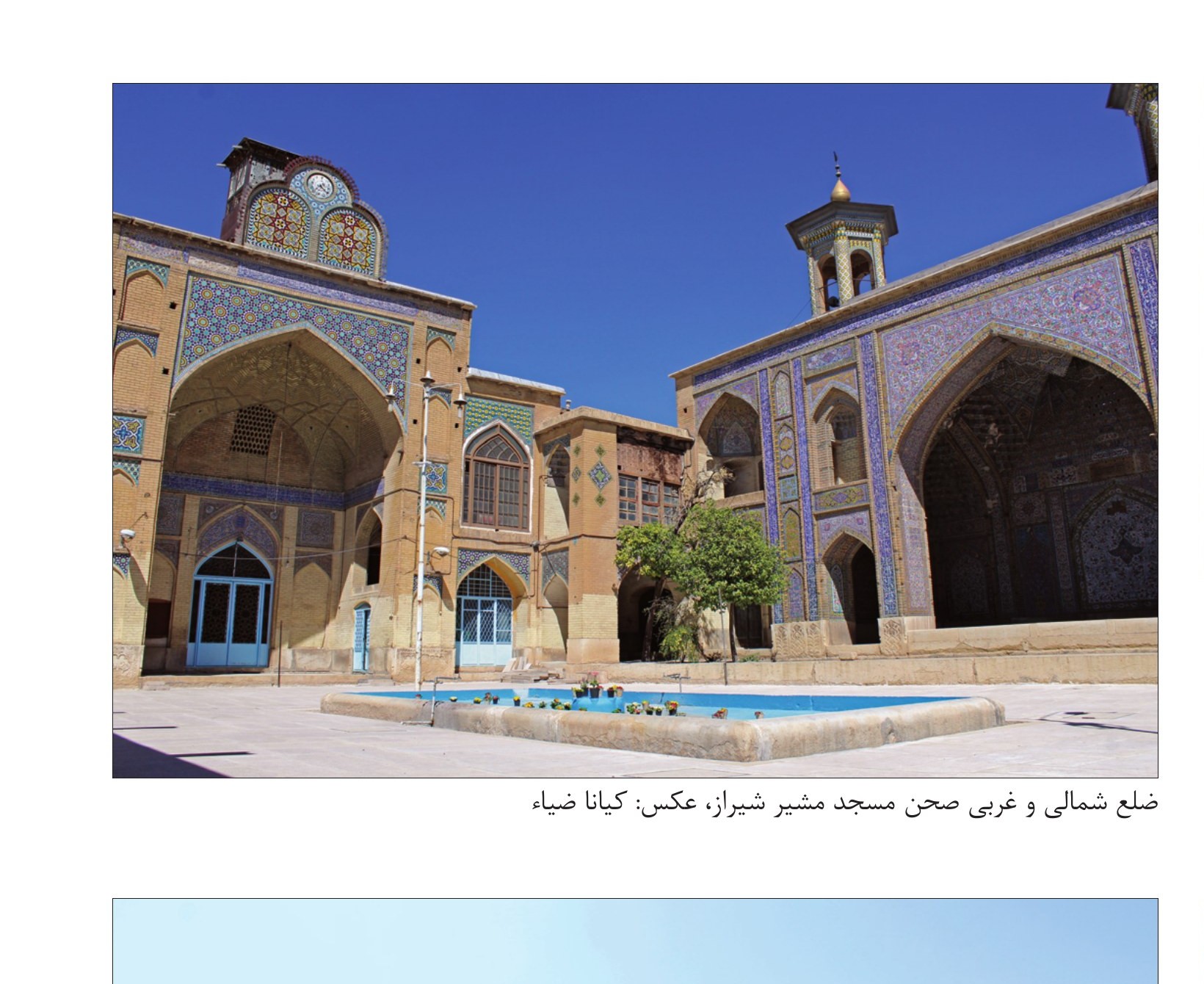
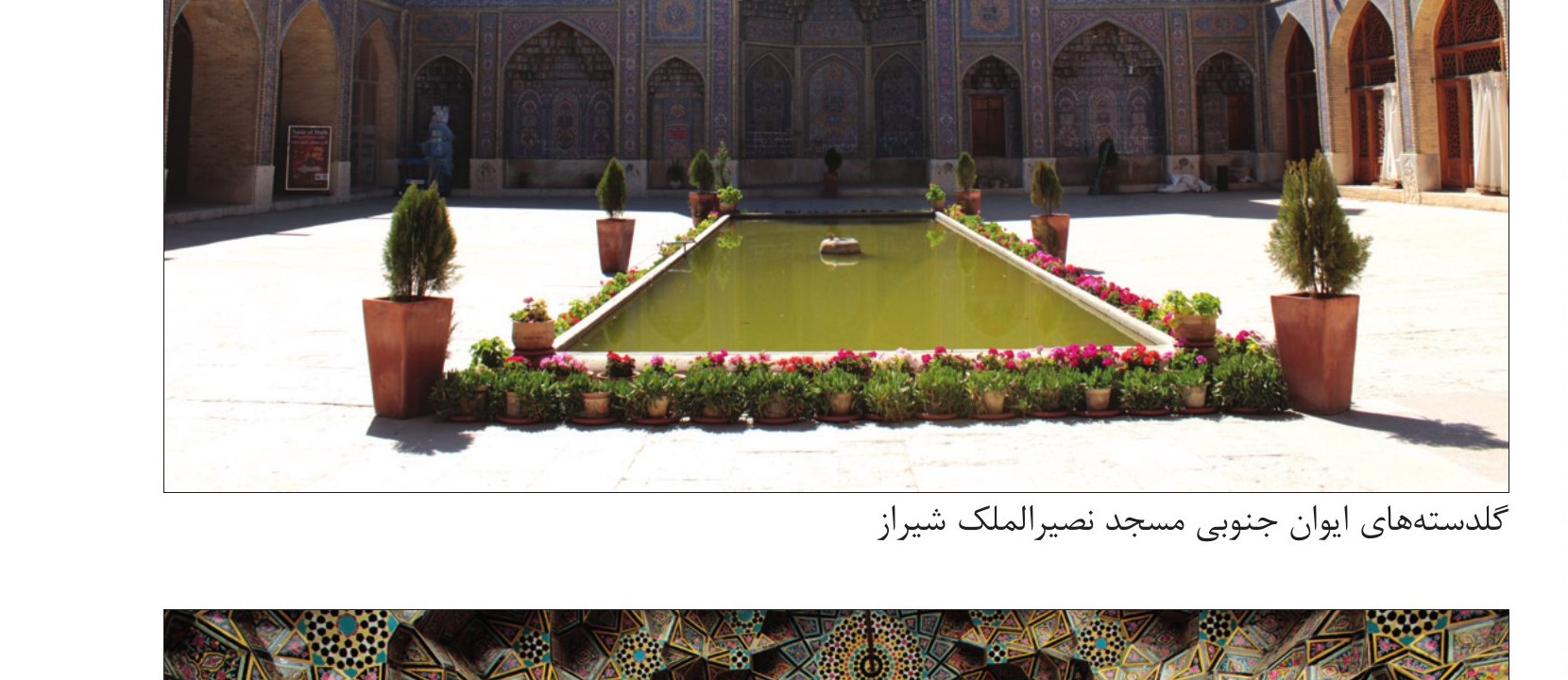
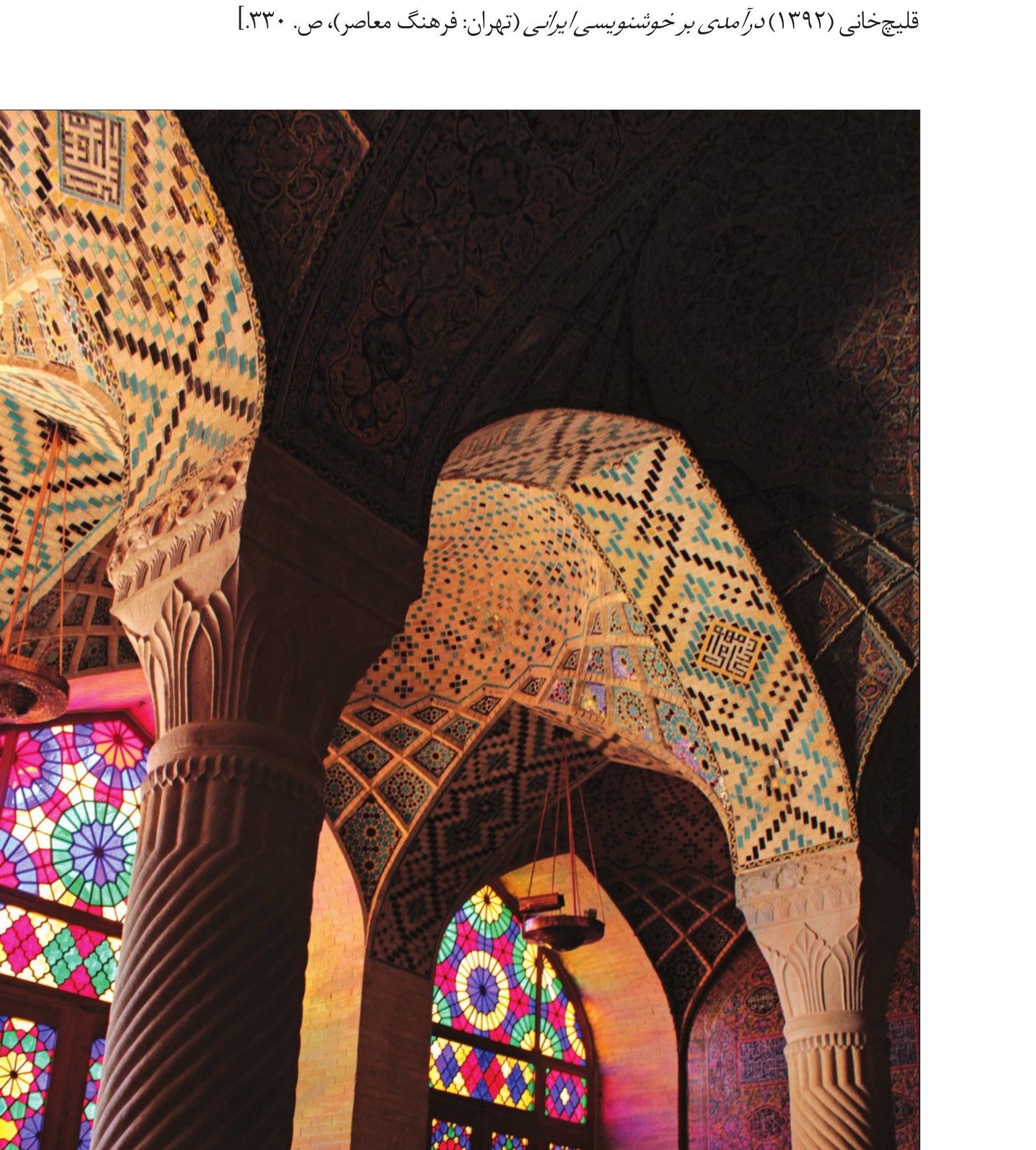
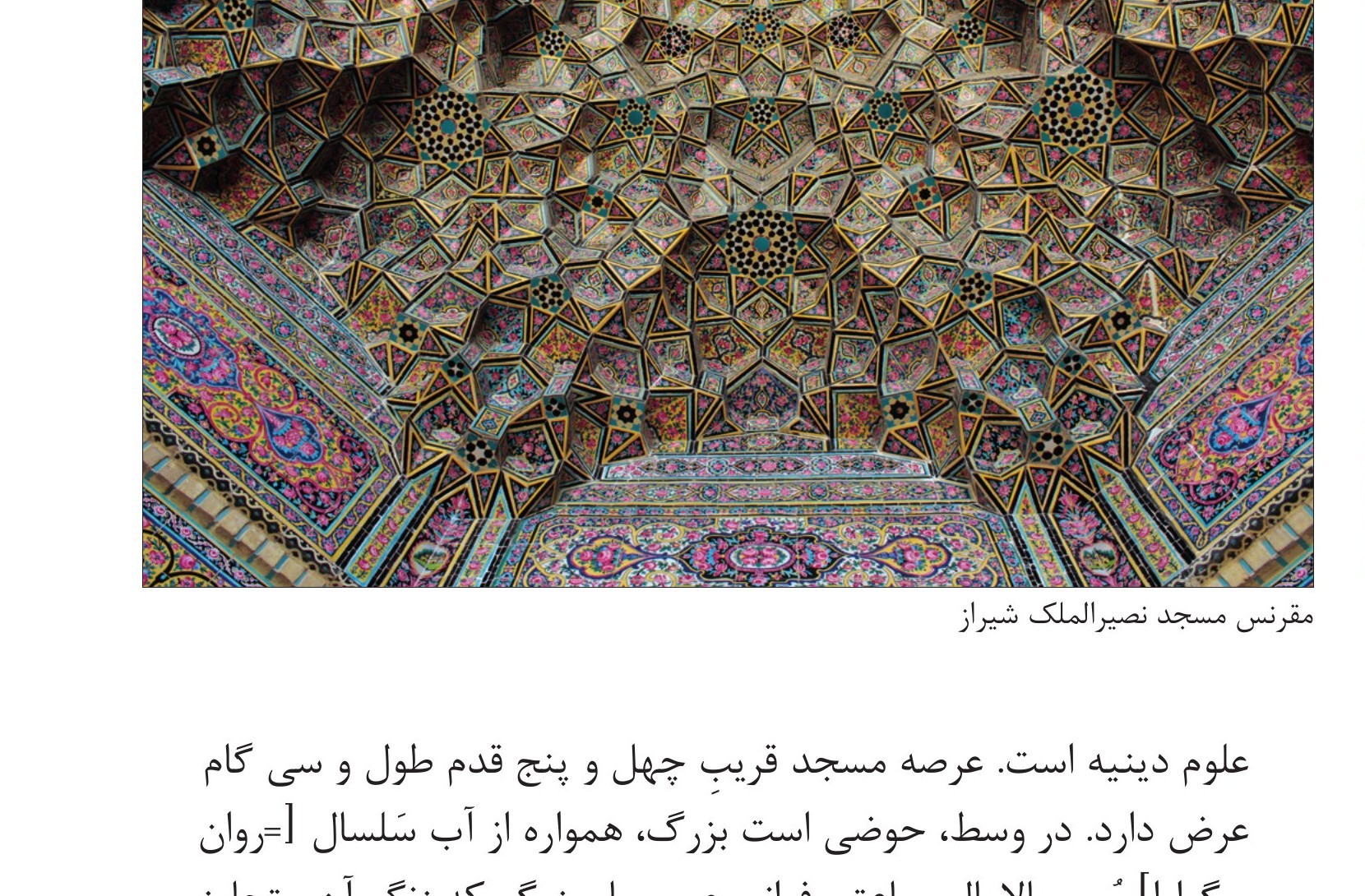
A historian of architecture seeking, in Iran, the kind of “architectural literature” known in the European sense will undergo a similar frustration. The descriptions of Iranian buildings in the historical sources are, more often than not, poetic and subjective, and disproportionate to the quantity of the buildings. For example, Forsat-od-Dowleh in Asar-ol-Ajam describes the Nasir-ol-Molk mosque in Shiraz as follows:
The mosque of Haji Nasir-ol-Molk, in the Eshaq-Beg quarter; its founder has been mentioned earlier in this book. It is a mosque of lofty foundations and firmly grounded pillars; its construction is fine, its space pleasing, with two lofty shabestans and two firm and tall minarets. The pool in its midst is like the spring of Tasnim [a Paradise-fountain] and the Pool of Kowsar, and its upper chambers are the equal of the gardens of paradise. The leader of this paradisial mosque — indeed the model for the people of the city — is the venerable, holy-mannered Agha Mirza Hedayatollah Shirazi. (Nasir-Hosseini, 1313 AH, p. 438) … this is the school of the religious sciences. The mosque’s court is about forty-five paces long and thirty paces wide. In the middle is a great pool, ever full of fresh-running water. A large French clock, whose bell weighs more than sixty manns, has been placed above the great arch facing south. Its current caretaker is Mirza Mohammad-Ali, son of the late Haji Sayyid Esma‘il Khoshnevis Shirazi, who in his accomplishments — especially in the science of clockmaking — has surpassed his peers; one might say that the said craft is beneath the rank of his other attainments, may God preserve him. (Nasir-Hosseini, 1313 AH, pp. 436 and 437)
What does “lofty arch” mean in metres? How many is “many upper chambers”? What is the size of the “great pool”? What is a “fine condition,” and what is the “charming manner”? If this is the way every building is to be described — as in this book it is — why does Forsat-od-Dowleh write Farsnameh, and why does he take the trouble of describing each building one by one? This manner of description is not peculiar to this author. Hosseini Khormouji in Asar-e Ja‘fari writes of the same building as follows:
Likewise, the newly built mosque of Mirza Abolhasan Khan Moshir-ol-Molk. Truly its building is well composed and well ordered; its foundation has the firmness [of strength and solidity] and its court is luminous and pleasing. May God grant him success in completing it. (Hosseini Khormouji, 1380, p. 23)
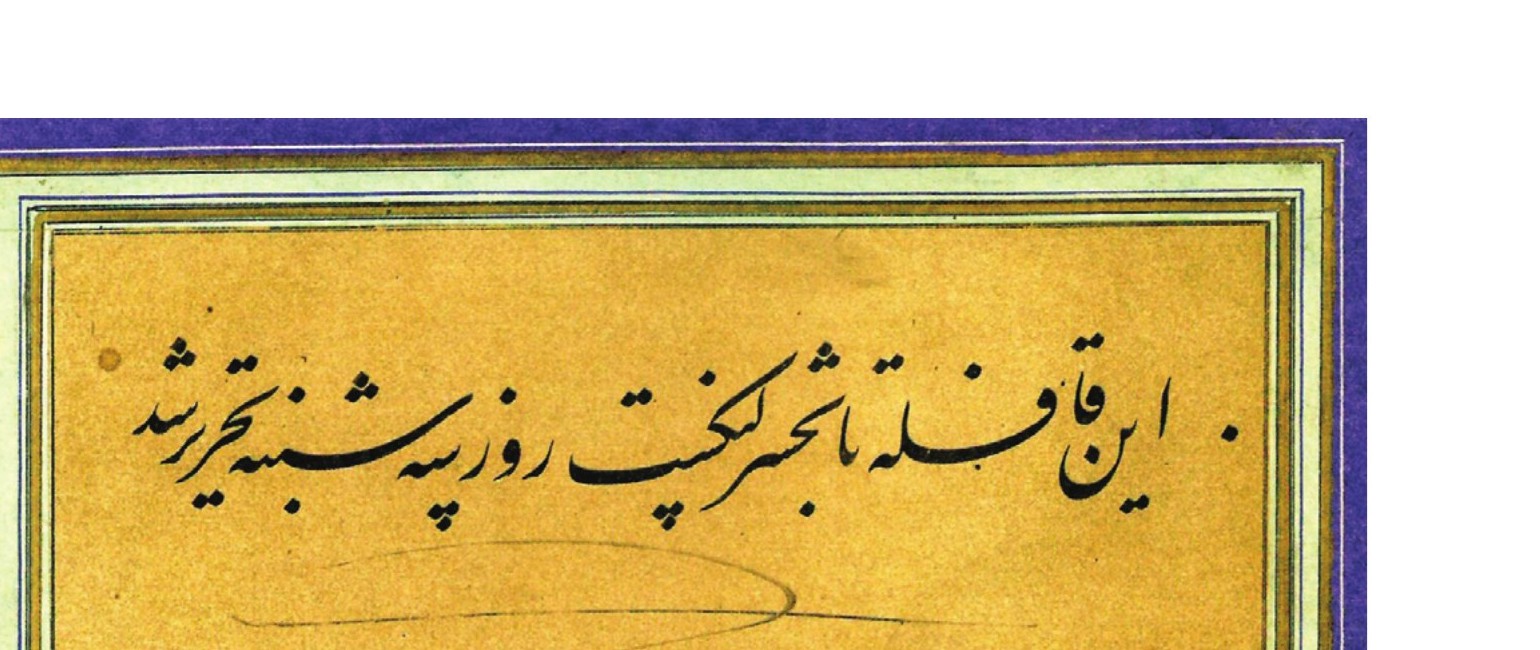
What is a “well-composed condition”? What is the “order” that makes it seem fine? In what way is its “court” “luminous” and “pleasing”? And what does “luminous” mean about a building anyway? Why must it be mentioned? In my view, a great deal. The biographers of calligraphy or of miniature painting did not write otherwise. Qazi Mir-Ahmad Monshi Qomi, the late Safavid art historian (b. 953 AH), from whose Golestan-e Honar I quoted earlier, describes the script of calligraphers as “fine,” “delicate,” “elegant,” “sweet,” “pure,” “clean,” “gentle,” “well-formed,” “graceful,” “masterly,” “uniform,” “smooth,” “moist,” “fresh,” “tasty,” “of utmost moisture and movement,” “of utmost firmness and ripeness, principles and savour,” “possessing fine principles and order,” “very ripe and chiselled,” and so on. In our own time, an art expert such as Habib-ollah Faza’eli — whose Ta‘lim-e Khatt and Atlas-e Khatt remain the standard references in calligraphy — uses the same vocabulary; a survivor of an old tradition. He writes:
Definition: a script whose attributes are all sweet, whose firmness has savour, whose beauty arrests the eye, and whose harmony brings joy, rolling and fresh — such a script draws hearts and souls towards it. The eye is not sated by looking at it, nor the heart wearied by repeated reference. (Faza’eli, 1393, p. 37)
The researcher asks himself: what does an epithet like “fine” or “pleasing” or “lofty” or “firm” add to our knowledge of this building? And are these attributes even literally true? The minarets of Shiraz mosques are, after all, not much taller than the muezzin himself. What does the simile of the “Tasnim spring” and the “Kowsar pool” say about how the observer perceives the building, when we see the same author use similar phrases about other buildings as well? For example, the same author writes of the Moshir-ol-Molk mosque of Shiraz:
The mosque of Haji Moshir-ol-Molk in the Sang-e Siah quarter. The late benefactor built it in a fine condition and a charming manner [taraz: a way, a method, a rule, a law], consisting of two ample shabestans, each with a lofty arch on three sides, and many upper chambers used as the residence of students of religious sciences.
and he places this under the heading of “Definition” — meaning that he supposes that with these words he has clarified something previously obscure; as if he were toying with the inquisitive reader. But there is another way to look at it: in my view this manner of expression communicates the “spirit” of this art’s aim and method; it is we who have come to imagine differently of “spirit” and “word.” Perhaps we understand the words otherwise, and have forgotten their older, specific meanings. The treatise Adab-ol-Mashq of Babashah Esfahani (d. 996 AH) provides for these same intuitive and imprecise expressions clear definitions:
“Safa” [clarity] is a state in writing that delights the temperament and refreshes [eases, soothes] it; it brightens the eye, and without the purification of the heart it cannot be attained. As Mowlana Soltan-Ali has said: “The clarity of writing comes from the clarity of the heart,” and this quality is of total importance in writing. Just as a human face, however symmetrical, will not please if it lacks clarity. It must not be hidden that when the “foundations” [comprising “proportion,” “composition,” and “base-line”], “clarity,” and “dignity” come together in a script, the result is what is called “taste” (mazeh), which some also call “effect” (athar). As for “sha’an” [dignity]: it is the state in which, when present in writing, the calligrapher is enraptured by gazing on it and forgets fatigue; and when his pen attains dignity, he becomes indifferent to worldly pleasures and turns wholly to writing, and the rays of the true Witness shine forth in his sight…. This quality, through commendable attributes, arises in the human soul and, with the help of the pen, is drawn on the page of paper; not everyone is granted the perception of this quality in writing. (Faza’eli, 1393, p. 106)
The Nameh-ye Daneshvaran-e Naseri (an unfinished Qajar-era encyclopedia, written by a group of Iranian scholars, 1296–1338 AH) gives a similar account of the principles of “clarity” and “dignity” in calligraphy:
As for “clarity”: it is a state that arises in writing only from the abundance of practice; and when clarity and purity are present in writing, the gaze upon it brings the temperament joy, expands the heart, and brightens the eye. This attribute is the supreme pillar of writing, and the writer’s mastery is made evident at this stage. As for “dignity”: it is the highest grade of writing; when this state appears in writing, the writer is never sated by looking at it, and in certain temperaments, once this attribute appears, the writer can no longer engage in any other craft and refuses to spend his life on anything but writing. Such a script holds great dignity among the people of the art; when a line or page of it must be priced, exorbitant prices are placed on it and bought at those prices. Precious jewels have been given in exchange for a few lines or pages, in the spirit of “I gave some inanimate things and bought a soul” — and they have never regretted the purchase. It has been observed that no precious object lost from the possession of the masters of the art is mourned, except a fine script of dignity, which whenever it returns to view brings sorrow at its loss. (Faza’eli, 1393, pp. 106–107)
As is plain, the importance of these “attributes” in the appraisal, judgement, and perception of a work of art was clear to these writers. To put it better: a work of art was counted as a “work” precisely when these attributes and states were present in it — like a possession whose “being and not-being” made a difference to the “state” of its owner.
3
On visits to the old buildings of Iran, the haal-o-hava [atmosphere] of the building draws the attention of every observer, native or foreign. It is enough to compare the simplest mosques of Iran with the grandest cathedrals of Europe — or the medieval art of Europe (usually taken as the closest “equivalent” to the machinery of Islamic art in Western art) with the cultural achievements of the same period in Iran. The observer asks himself: why do Iranian buildings, almost without exception, possess such a distinct atmosphere? In my view a simple, logical answer can be given: because the very aim of Iranian architecture was the creation of atmosphere. The signs are evident in both fieldwork and historical study: the proportion of Iranian buildings that have a distinct atmosphere to those that do not is so high that the assumption of some kind of intentionality is highly plausible. On the other hand, historical study shows clearly that the creation of this atmosphere was among the architect’s principal tasks and the patron’s basic expectations, and that is why it found its way into architectural literature. Nor is this a strange notion when we recall that “atmosphere” is among the foundational concepts of Iranian culture, and Iranian architecture, like the other arts, was a vessel for that culture and had no reason to follow another logic.
But I go further: my claim is not merely that haal-o-hava is more pronounced in Iranian architecture than in the world’s other (few) styles of architecture; rather it is that Iranian architecture alone has haal-o-hava. The buildings of Paris, London, Vienna, or Munich may possess “atmosphere” or Stimmung, but they never possess haal-o-hava. By this I mean the untranslatability of the word; and that this concept is not the achievement of one or several architects in a few particular works, but the result of a kind of consciousness that came into being, over centuries, in the very fabric of the language and that manifested itself in the form of an understanding shared by patron, architect, and user — an understanding so self-evident and impalpable that often it did not even need to be voiced.
And again my claim is that haal-o-hava is neither of the order of “space” in modern architecture, nor equivalent to the “place” of postmodern architecture; nor should we expect what is today called “atmosphere” in architecture to be its accurate description — especially for us, who in Persian have had better words for it. On the one hand, this haal-o-hava was not the result of any particular spatial structure in these buildings, as we see, for instance, in modern architecture. That is, you will not find any spatial commonality between them that would account for the atmosphere. On the other hand, it is not the result of a defined “design process” either. The Iranian buildings emerged from certain processes, but if you apply the same processes to a similar building you will not necessarily arrive at haal-o-hava. The atmosphere is fundamentally not the outcome of “design” in the sense of design. In this sense, haal-o-hava in Iranian architecture was not designed, and the architects did not simulate or test the final form of buildings in two or three dimensions. Nor is this atmosphere of the order of postmodern “place” either: it has no necessary connection to our memories of a space; it is perceptible to the foreign observer as well.
And yet this haal-o-hava is not precisely of the order of “atmosphere” either, if one takes atmosphere to be a quality that, independent of knowledge or culture, is rooted in human physicality and is universally accessible. In that case it should have been possible to produce this atmosphere outside Iran, or to find samples of it in other civilisations — but even within contemporary Iran one cannot reproduce it with a traditionalist approach. And while this case may seem strange to non-architects, anyone who has tried to “design” a contemporary building in the manner of the old masters has realised its impossibility in practice; he or she will see that this atmosphere is not produced by reproducing “spaces” or building “places.”
Let me add too that the haal-o-hava of Iranian architecture is untranslatable into other schools of architecture, just as the word haal itself (like the words jaan and ma‘ni) belongs among the untranslatables of the Persian language. Every language counts as distinct precisely by virtue of its untranslatable structures and words, and the word haal in Persian is among the most important of these. For the ancients, haal had its own language. The phrase zaban-e haal [the language of the state] was used repeatedly to denote what one person grasps of another’s condition without speech:
They came and each one asked: “what is in the tray?”
In the language of the state they answered the questioners:
“If anyone is a confidant, then what is in the covered tray?”
Soul-food, like the soul, is hidden; body-food is visible like bread. (Rumi)
Last night I saw a potter in the bazaar
kneading a piece of clay again and again;
and the clay said to him in the language of the state:
“I was once like you — treat me well.” (Khayyam)
And Iranian architecture speaks in this same zaban-e haal, which is not the language of concept and notion. It is no accident that Persian has no equivalent for “concept.” It is a language that speaks even in silence:
Come into the garden and behold the reward of deeds:
the blossom is the worthy declaration of every pure seed;
like the spring preachers in green robes, O soul!
Open the language of the state and be silent, O friend! (Rumi)
O lily, you sigh, putting out your tongue;
either keep it in, like us, or actually say something.
The lily replied: “Without speech, our tongue is the speech of our state;
had its end not been firmly green, why would our crown be?” (Rumi)
This zaban-e haal, the language of objects, is not a strictly Sufi notion. It surfaces repeatedly in the poetry of a sceptical realist such as Khayyam, and is intimately bound to the meaning of life:
Last night I broke my pitcher upon a stone;
drunk I was, who committed this folly.
In the language of the state the pitcher said to me:
“I was once as you are; you too will be as I am.” (Khayyam)
When the drunken nightingale found its way into the garden,
it found the rose’s face and the wine-cup laughing.
It came in the language of the state and whispered in my ear:
“Grasp the moment: the life that is gone cannot be regained.” (Khayyam)
In my prayer the curve of your brow came to mind;
such a state ensued that the prayer-niche cried out. (Hafez)
This is a state that has come upon him during prayer; a circumstance in which neither to look elsewhere nor to speak to anyone is permitted. This is a state caused by the curve of the beloved’s brow (which is an image), then reflected in Hafez’s face, then experienced and rendered into speech by another arch through the zaban-e haal. It is a state caused by an arch — and the arch of the prayer-niche has voiced what Hafez has not. Here, architecture and poetry tell a single thing: what Hafez has not put into words, the wall has uttered.
The body like a wall and, behind the wall, a fallen heart;
to recount its state, this tongue has risen.
Go — see the ruins of love in the house of being;
the house’s roof is broken and the threshold raised. (Rumi)
This haal is the shared possession of Iranian poetry, architecture, calligraphy, miniature painting, the carpet, music, the Iranian gathering, sama‘, mysticism, cookery and feast (though its explication need not amount to its “philosophy”). If Iran has poetry and architecture and music and calligraphy, there is a reason — that these are the appurtenances of one thing; a quality fashioned over centuries with travail, possessing, like the Persian language, its own world, intelligible only from within and reproducible only from within.
It is in Iran that poetry produces haal; elsewhere in the world, it produces other things.
4
But what is haal? One must ask Persian literature, which is the “meaning” of the Iranian arts. Haal, of course, means quality and condition; in this sense there is a word for it in every language: “The one who remains in one state is God.” (Farid-od-Din Kateb) But in Persian it also has a use in astronomy in the sense of “the state of the stars in fortune or misfortune,” which is not unrelated to the prior meaning, since the ancients held the stars to influence the state of the earth and of persons: “the states of the zodiac signs in relation to one another; the states of the stars in relation to the Sun.” (Al-Tafhim, Abu-Rayhan Biruni).
Another of its meanings is the present moment — now, just now, present time — a meaning specific to Arabic and Persian: “Such loyalty he keeps toward God’s favour, that he discharges past obligations properly.” (Tarikh-e Beyhaqi)
It also gives the sense of time generally: occasion, interval, or as Dehkhoda has it, “the time you are in”: “Mohammad Amin was killed in Baghdad, but at the time the caliph was not present.” (Kalileh va Demneh) This connection of haal with time is worth noting and is highly productive in reading Iranian art: Iranian art and literature, unlike that of Europe, was not historicist or time-bound. This inattention to art-historiography in Iran arises from attention to the moment, the “instant”: only the part of the past that was present in the present moment was considered important. The “absent past” was not safeguarded; people supposed that if something had been forgotten there must have been a reason. In Iranian art, a certain inattentiveness to the archive and to the keeping of records always shows itself. Even the “eternal” had to be “alive” and “present” in order to matter. As Sa‘di puts it: “Eternal fortune is found by whoever lived nobly / so that after him good word keeps his name alive” (Golestan), he does not consider the mere recording of a name in some place to be enough; for him being alive is a condition. In this state, a relationship arises between haal and jaan (soul) — another of Persian’s untranslatables. This same relation with time is reflected in the quality of ornament in the Iranian arts: while ornaments in European art reveal style and period and the date of an artwork can often be determined from its ornament, ornaments in Iran possess a fluid, timeless quality and indeed intensify timelessness: ornaments slip from one surface to another and from one era to another. The alphabet of Iranian art rarely changes, but its compositions are countless. Determining style in these arts is fundamentally difficult, and, as Pirnia rightly noted of architecture, is more geographical than historical — a fact equally apparent in the stylistics of Iranian literature. One might even say that Persian has crystallised this timelessness within itself, so that Persian speakers can grasp Persian texts across a millennium’s distance; an impossibility in Latin-derived languages.
Another meaning of haal, in the words of the author of Montahi-ol-Arab, is “the quality of a person and what one is at present,” or “the way a person’s temperament is, in health or sickness.” In this sense, haal relates also to physical condition, to body and matter:
From that intoxicated, mischievous lily of yours,
have you any news, O zephyr — how is his state? (Hafez)
Another meaning is the condition and manner of life — the course of affairs and dealings, the quality of events: “The judge realised what the state of affairs was.” (Golestan of Sa‘di)
Its specialised meaning in Sufism is, of course, ecstasy and “a particular state granted to Sufis.” This sense we will examine more closely. In this sense it is opposed to qaal (talk):
Do you know which ignorant fellow laughs at our state?
He who has not, in his life, had any state. (Sa‘di)
Conventional learning is all idle talk;
from it neither quality nor state is gained. (Sheikh Bahai)
If the knowledge of state were not above the knowledge of talk, how could
the rabbis of Bukhara have become disciples of Khaje Nassaj? (Rumi)
If the state of your body has been altered by the turn of time,
fittingly may the state of your soul be altered as well. (Naser Khosrow)
Clearly haal here is at once a physical and a mental, psychic quality. It must also be noted that haal is not of the order of work; it is rather set against it. It is not something achievable through outward effort in the world:
When the Spirit of Holiness kissed the shoe of his steed,
a cry rose from the shoe: behold the state and the work! (Rumi)
No one ever discovered his state and work;
the prudent man would speak of him in Turkish. (Ferdowsi)
By force or gold this work is not achievable;
come, listen to the state of the men of pain. (Hafez)
In the meadow every leaf is the chapter of a different state;
it would be a pity should you be heedless of the work of all. (Hafez)
For Hafez in particular, this haal is the precise opposite of attention to “outward show” and outward conduct:
The outward-worshipping ascetic is unaware of our state;
whatever he says against us, no displeasure is in place. (Hafez)
O Sky, how long do you wander? Look at the turning of the elements:
water is drunk, wind is drunk, earth is drunk, fire is drunk.
The state of form is thus — do not ask of the state of meaning:
spirit is drunk, intellect is drunk, dust is drunk, the secrets are drunk. (Rumi)
Were haal to denote only an outward quality, there would be no “state of meaning.” The same goes for “state of soul”:
Rejoice, O happy-fated traveller of fortune!
Strike the ball of meaning toward the state. (Rumi)
Here haal is the target to be hit, within the domain of meaning.
Beyond these, haal also occurs in the sense of affectation and coquetry — feigned expression of grief or pain. To “bring on a haal” means to put on airs, to dissemble: “And in one hour, paralysis and a stroke befell him on a Friday, and they informed the Amir [Masʿud of Ghazna], who said, ‘Bunasr [Moshkan] must not put on a haal so as not to travel with me.’” (Tarikh-e Beyhaqi). We will see that in the thought of Imam Mohammad Ghazali and among the Sufis, haal is something within which one can be sincere or hypocritical. In this sense, “bringing on a haal” is a kind of pretence of haal; they believed that two similar outward “qualities” could be the result of different inward states. This is an important point: that haal denotes both an outward and an inward quality. It is this duality that makes the translation of this word into other languages difficult:
5
This attention to haal as an inward quality accords with the introversive character of the Iranian arts. One may ask: what does it mean for art and architecture to be turned “inward”? We must be alert to the fact that this introversion is something other than the formal, outward introversion that, for instance, arises in architecture as a response to climatic conditions. It is an introversion of “meaning”; in other words, more bound up with the “state of meaning” than with the “state of form.” But what does that mean?
One of the clearest theories on this point is set out by Imam Mohammad Ghazali (450–505 AH) in his Ihya al-‘Ulum-od-Din, where he develops at length his theory of sama‘ (audition) so as to establish the lawfulness of dance and open the path of Sufism. He writes:
Anyone who loves God Most High, is His friend, and longs to meet Him, will not look upon what he does not see Him in, nor hear what is not said by Him or about Him; for such a person sama‘ rouses his longing… and from his revelations and visitations there come into being states whose quality cannot be described… and these states, in the language of the Sufis, are called vajd (ecstasy), a word derived from vojud (being): meaning, they find in their hearts states they had not found before sama‘. These states become the causes of consequents and after-effects, whose fire burns away the impurity of the heart, just as fire purifies gold and silver of dross; and because of the clarity that follows, revelations and visions are unveiled to him. (Ghazali, 1392, pp. 603–604)
A little further on he turns to “the outward and inward etiquette of sama‘,” reaching the question of “dissimulation in dance,” where he writes:
Dance, without the affectation of tavajod [the affectation of ecstasy], is permitted. The motavajed [the one who feigns ecstasy] is one in whom the affectation appears to the gathered audience as effortful; whereas the one who rises sincerely from his heart is not held heavy by other temperaments. For the state of those present — when they are masters of the heart — is the touchstone of sincerity and affectation. One who is true in vajd was asked: what is the proof of true vajd? He replied: the proof of true vajd is that the hearts of the ecstatic accept it, since they are alike, not opposites. (Ghazali, 1392, p. 659)
This is an important point that recurs repeatedly in Persian literature: the relation of introversion with the presence of the group. It is a kind of introversion in the midst of others’ presence; a presence that is at odds with “show” and representation: it speaks with the zaban-e haal and turns away from pretence and pose. Notice that one of the abiding concerns of Iranian architecture — like Iranian gardening and city-making — is the delicate calibration of a relation between inside and outside and between the individual and the collective; a relation whose nature and aim differ from those of other architectural schools.
And the result of this avoidance of show is not a kind of outward simplicity (as in Protestant Christianity); this art can have a highly elaborated outward face yet remain untouched by affectation, because it makes the “truth of state” an inward condition, not an outward one. It is in this sense that haal stands in relation to safa (clarity), just as it does to jaan (soul). And in such a condition, the “work” that carries this ecstasy appears “fine,” “delicate,” “pure,” “clean,” “gentle,” “well-formed,” “graceful,” “masterly,” “uniform,” “smooth,” “fresh,” “tasty,” “animate,” “firm,” “ripe,” and “of fine principle and savour.”
There is a subtlety here: that haal in art belongs to the vocabulary of “dance,” not of the visual or literary or theatrical arts. Especially when one bears in mind that dance, in the sense of sama‘, is not for spectacle but a kind of existential experience, or more precisely vajd; unlike European classical ballet, which provides a scene designed for the eye. An art directed to haal can be prepared like a gathering but cannot be designed. Haal sometimes happens and sometimes does not; its “touchstone” (as Ghazali puts it) is inward. Outward criticism cannot reach its essence, though one may still speak of its rightness or wrongness — this last, however, belongs to the order of qaal, not of haal.
But if we set aside the mystical idiom and still wish to answer the questions raised at the outset, we ask: what is it that prevents this haal-o-hava from being reducible to a kind of arrangement of architectural elements, or to the making of a “place” (in the postmodern sense)? The answer is this: architecture directed toward haal-o-hava is as much the “work” of the architect as it is the production of the building’s users. In these spaces, architecture happens within the audience. The audience, in his or her experience of the building, does not dance a dance someone else has designed; he or she must actively produce this “state.” Hence in Iranian architecture surfaces are heavy with ornament while spaces appear strikingly empty; this empty space is the empty place of the inhabitants and users, who today have left these buildings but were once an inseparable part of this architecture and produced its meaning. The thinghood of these buildings is repeatedly denied within this architecture, and ornament plays a major role in that denial. For this same reason, the hardest thing for the foreign observer is to imagine life within these buildings. He sees them as without use, monumental, alien — like the spaces of M. C. Escher, which were inspired by Islamic architecture; like a contraption whose instruction-manual has been lost. Reading these buildings from outside seems impossible, because they speak in the zaban-e haal and not in the language of form; they require the presence of a community of “the ecstatic,” not of a beholder who, in a Cartesian way, takes himself for the centre of the world’s coordinates, or, in a Kantian way, makes himself the measure of judgement. In other words, these buildings are meaningless in the “absence” of their audience and were not built for visiting; even when elaborately worked, they are not, like the European cathedral, “theatrical.” The fact that “ornament” in them is not “decorative” in nature stems from this absence of show and from their performative honesty: they refuse “décor” in the sense of outward appearance. In Babashah Esfahani’s expression, they are “works” (athar). They make a body for a specific kind of life that must accommodate itself to the building and put up with its many constraints in order to make possible a complex meaning. In this architecture the audience is the soul of the building, yet the architecture grants nothing for free; it expects much. For this reason one ought not call it “anthropocentric.” Sama‘ within these buildings has its precise etiquette. Living in them is not easy, no more than climbing their stairs is, no more than bringing water to their trees and reservoirs and pools is — just like life in an Iranian family, which demands much self-effacement; or like Iranian food, which takes time to cook; or like an Iranian carpet, which takes years to be woven by hand and brought beneath one’s feet. Iranian architecture was cut to the measure of Iranian culture, not to that of Iranian bodies; for this reason, adopting these buildings outside this culture is meaningless. These buildings are measured, but the audience puts the poem in them. In short: these buildings were spoken in Persian.
Notes
1. The most complete theories of Iranian art are to be found in calligraphy. This point, among many others on Iranian aesthetics, I owe to Reza Abedini and his fine attention.
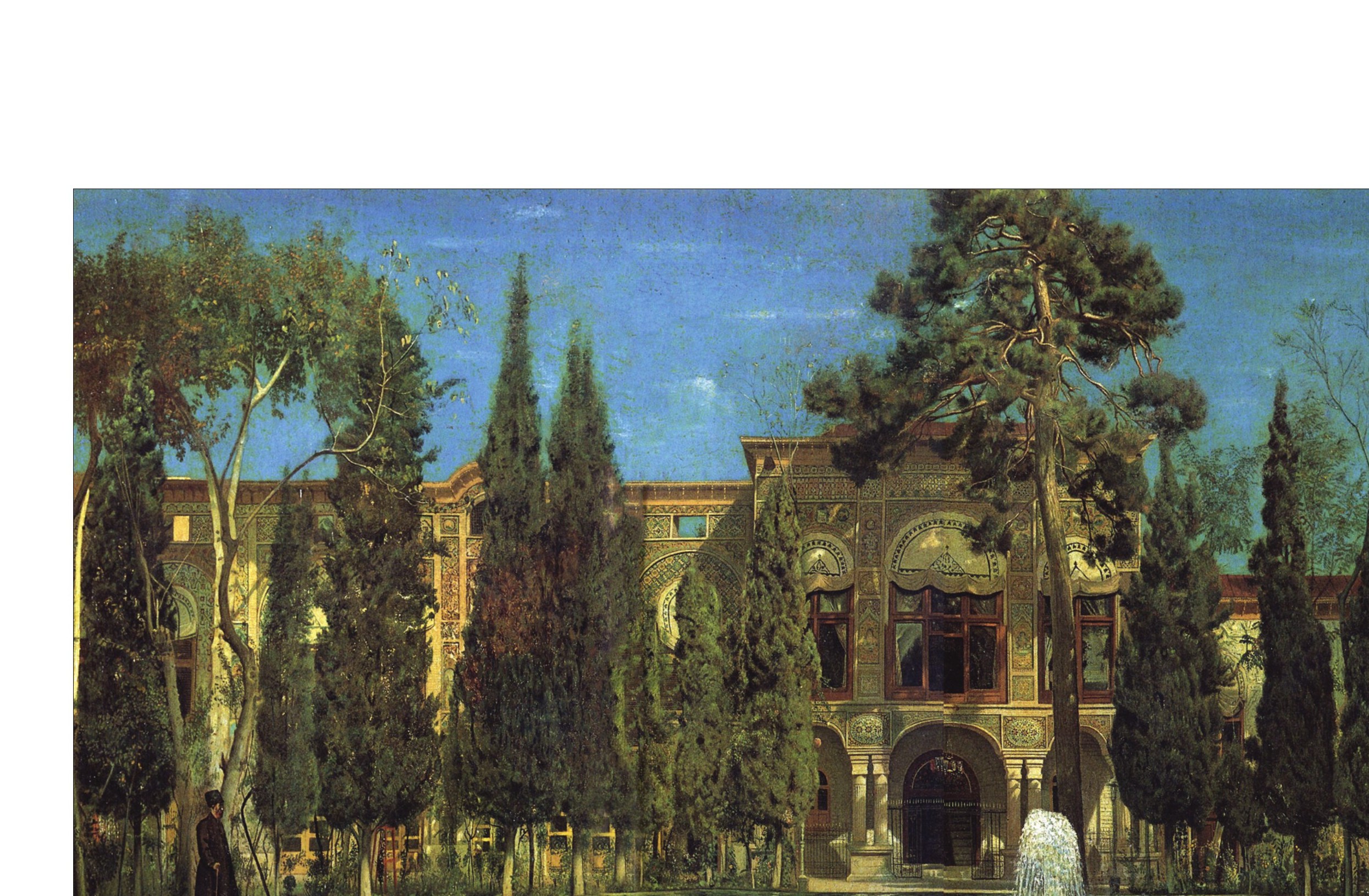
2. See, for example, the travelogues of Nasir-od-Din Shah and the judgments he makes about European buildings, and the expectations he holds of a “building.” Likewise, in Qajar buildings built in a European style and with a sideways glance at European architecture (from the Golestan Palace in Tehran to the Bagh-e Eram in Shiraz), it is the form that is imitated, not the haal-o-hava; and the expectations of the patron and the achievements of the architect — in language similar to what we have seen — are reflected on the inscriptions of the buildings. The architects of this era, although unsuccessful in imitating European “styles,” in most cases create a very distinctive and pronounced haal-o-hava, which signals the priorities of architecture in that age.
3. Perhaps this is why Persian makes no distinction between design and drawing and has no separate word for either, calling both tarrahi. Unlike Renaissance Europe, in Iran drawing was not the precondition of design, and design did not necessarily proceed via drawing; not that this means improvisation, either.
4. The same relation of haal with “time” holds for the word aan (the instant): both in the sense of “moment” and “instant” and as a quality that cannot be named: “A witness is not one who possesses hair and waist / be the servant of the beauty who possesses aan” (Hafez).
References
Hosseini Khormouji, Haji Mohammad Ja‘far. (1380). Asar-e Ja‘fari (On the History and Geography of Pars), introduction and edition by Dr. Ahmad Sha‘bani (Shiraz: Bonyad-e Fars-Shenasi).
Fasa’i, Haj Mirza Hasan Hosseini. (1275). Farsnameh-ye Naseri (Tehran: Entesharat-e Ketabkhane-ye Sana’i).
Faza’eli, Habib-ollah. (1393). Ta‘lim-e Khatt (Tehran: Sorush).
Ghazali, Mohammad ibn Mohammad. (1392). Ihya al-‘Ulum-od-Din: Second Quarter, Quarter of Customs, translated by Mu’ayyid-od-Din Mohammad Khwarazmi, ed. Hossein Khadiv Jam (Tehran: Entesharat-e ‘Elmi va Farhangi).
Monshi Qomi, Qazi Mir-Ahmad ibn Sharaf-od-Din Hossein. (1366). Golestan-e Honar (Tehran: Ketabkhane-ye Manuchehri).
Nasir-Hosseini, Mirza Sayyid Mohammad (Forsat-od-Dowleh). (1313). Asar-ol-Ajam dar Tarikh va Joghrafiya-ye Mashruh-e Belad va Amaken-e Fars (Bombay: lithograph).