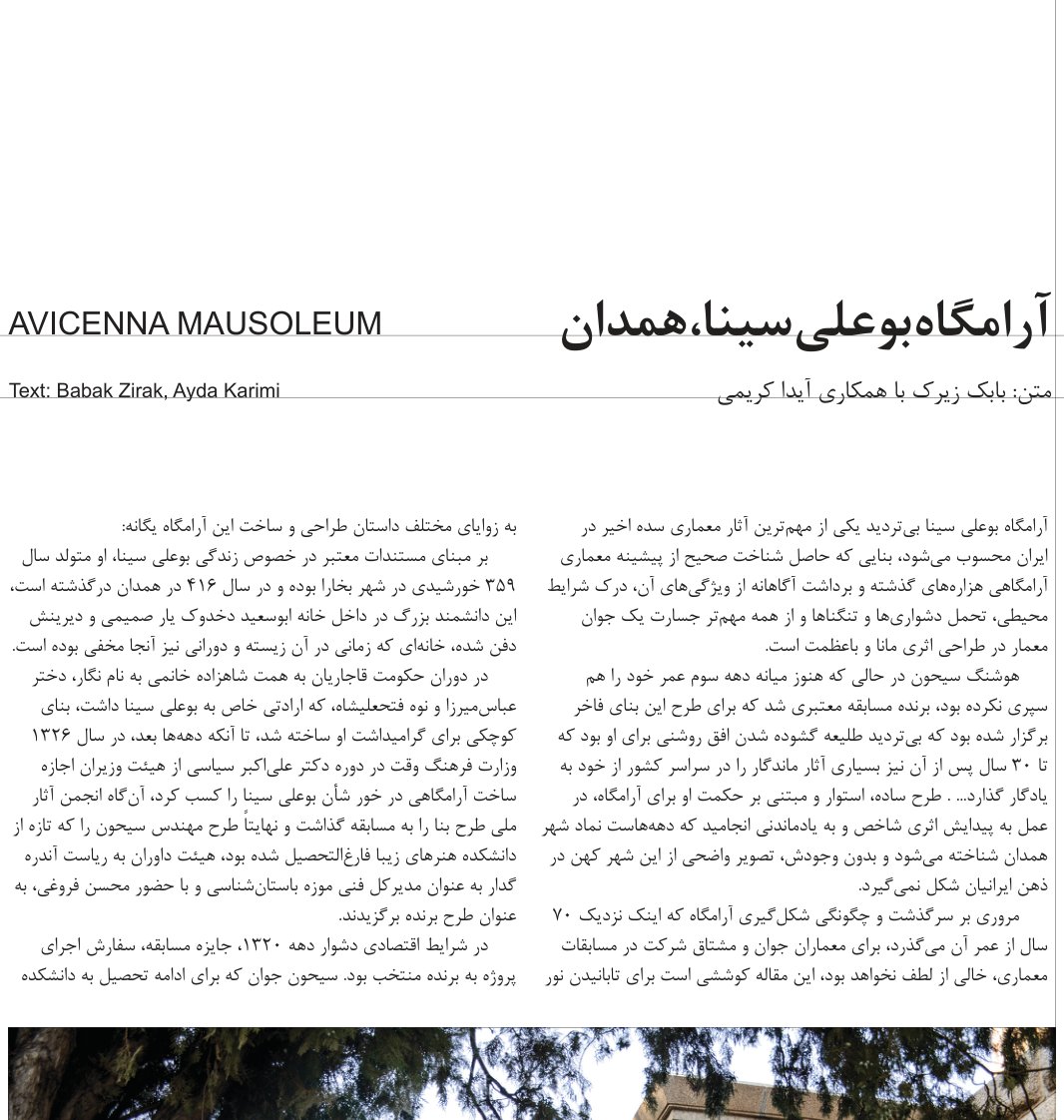
The Mausoleum of Avicenna is without doubt one of the most important architectural works of the past century in Iran — a building that is the fruit of a sound understanding of the millennial heritage of funerary architecture, a conscious interpretation of its characteristics, a grasp of environmental conditions, the endurance of hardships and constraints, and above all the audacity of a young architect in designing an enduring and magnificent work. Houshang Seyhoun, who had not yet reached the middle of the third decade of his life, won the prestigious competition held for the design of this distinguished building — an event that was undoubtedly the harbinger of a bright horizon, for in the thirty years that followed he would leave behind many more lasting works throughout the country. His simple, steadfast design, grounded in wisdom, resulted in a landmark of singular memorability that has for decades been recognized as the symbol of the city of Hamedan — without which no clear image of this ancient city forms in the minds of Iranians.
A review of the history and the making of this mausoleum, now approaching its seventieth year, will not be without interest for young architects eager to participate in architectural competitions. This article is an attempt to cast light
upon the various facets of the story behind the design and construction of this singular mausoleum. According to reliable documents concerning the life of Avicenna, he was born in the year 359 of the solar calendar in the city of Bukhara and died in the year 416 in Hamedan. This great scholar was buried inside the house of Abu Said Dakhduk, his intimate and longtime companion — a house in which he had once lived and during a period had also hidden. During the Qajar era, through the efforts of a princess named Negar, daughter of Abbas Mirza and granddaughter of Fath-Ali Shah, who held a particular devotion to Avicenna, a small structure was built in his honor, until decades later, in 1947, the Ministry of Culture under Dr. Ali-Akbar Siasi obtained permission from the Council of Ministers to construct a mausoleum befitting the stature of Avicenna. The Society for National Monuments then put the building's design out to competition, and ultimately the jury — chaired by Andre Godard as the general technical director of the Archaeological Museum and with the participation of Mohsen Foroughi — selected the design of Engineer Seyhoun, a fresh graduate of the Faculty of Fine Arts, as the winning entry.
Text: Babak Zirak with the collaboration of Ayda Karimi
Under the difficult economic conditions of the 1940s, the competition prize was the commission to execute the project itself. Young Seyhoun, who had gone to the Ecole des Beaux-Arts in Paris for further studies, continued working on the project's design, and in the end presented the completed construction drawings of the mausoleum as his final thesis in France. In Iran, meanwhile, project execution was entrusted to the contracting firm of Ebtehaj and Partners, which employed an engineer named Pollak, of Czechoslovakian origin, for precise calculations and supervision of the construction. The story of how the project's construction costs were assembled at a time when Iran had suffered enormous economic losses from the Second World War is fascinating and deeply instructive.
To finance the heavy construction costs of the mausoleum, apart from a payment of 100,000 tomans by Mohammad Reza Shah Pahlavi, it was decided that lottery tickets would be sold in several rounds at intervals of three months, at a price of 20 rials per ticket, with 300,000 tickets per round. After some time, to cover the remaining expenses, the effort extended to the printing and sale of postage stamps, and by 1951 a total of 1,200,000 tomans had been raised. Since this was still insufficient, the Red Lion and Sun Society, the Social Services Organization, and the Hamedan municipality agreed to cover additional portions of the expenses. A remarkable detail is that the Parsee community of India, upon learning of the project's commencement, also contributed financially to the construction fund. Ultimately, a project that was meant to be completed in 1952, coinciding with the millennium of Avicenna's birth, was — after tremendous difficulties — inaugurated in 1954 in the presence of the Shah and Queen and a large gathering of Orientalists, foreign guests, and Iranians.
The structural features of this building, despite the simplicity and legibility of its overall volume, far exceed what can be contained here, yet certain aspects may be described. The mausoleum building comprises a massive, monolithic stone section at the ground floor that evokes pre-Islamic architecture and the prominent buildings of that era — specifically the "takht" (platform) form. In this manner, the building bears the mark of one of the most distinctive elements of the formidable architecture of a period more than two thousand years old: a great mass and stone platform that primarily conjures images of the royal palaces and enduring structures of the Achaemenids, such as Persepolis and the Reception Palace of Cyrus at Pasargadae. In the author's view, Seyhoun was rightly able — as an architect with a profound attachment to the heritage of his homeland — to evoke, upon first approach and at ground level, such a powerfully alluring visual impression in the viewer's mind through the creation of a rock-like edifice. The fact is that from the time the Achaemenids built their "takht" structures until the construction of the Avicenna Mausoleum, stone blocks of such enormous dimensions had never been employed in Iranian architecture. Without doubt, the existence of great granite quarries in the foothills of Mount Alvand was not without effect in realizing this vision. With particular acuity and shrewdness, Seyhoun designed a closed and imposing structure of massive stones that would serve as an imperishable base and foundation for sheltering the body of this revered scholar and philosopher for eternity — perhaps in the hope that it would forever remain safe from the ravages of time. Meanwhile, it is as if Mount Alvand, too, by offering boundless quantities of granite hewn from its flanks, has generously and fittingly paid its debt to the tomb of Avicenna.
Atop the all-stone platform of the mausoleum, a tall, prismatic tower has been shaped, inspired by the lofty, polygonal Tomb of Kavus ibn Vushmgir. This tower, as a modern element bearing upon its crown the legacy of post-Islamic Iranian architecture, soars skyward from a high base just as the aforementioned tower does — with the difference that while the Gonbad-e Kavus creates a closed and rigid space to contain the body of the powerful Ziyarid king, the tower of Avicenna's mausoleum is formed by the arrangement of twelve angled concrete columns symbolizing twelve branches of knowledge in which Avicenna was a renowned master. The columns embrace a completely open space within themselves and, with their light buoyancy, emphasize the building's modernity. The columns converge at their highest point and support a cone approximately four meters tall that is not unlike the "rak" domes — atop them. Overall, the stairs and multiple access points around the platform have a commanding presence and play an important role in facilitating easy movement between the ground level and the mausoleum's roof. On the western side of the mausoleum, two perfectly symmetrical ramps flanking a secondary entrance — which serves more of a service function — evoke a mode of symmetrical upward movement atop the platform reminiscent of what is seen at Persepolis. On the eastern side, however, different stairs are arranged asymmetrically on the northern and southern flanks, guiding the visitor upward. Apart from this, on the southern side, a narrow stairway provides direct access to the funerary tower through a passage with rough, towering stone walls. In this passage, moving from ground level upward, one perceives a perspective of the luminous tower stretching toward the sky within a dark corridor — leaving an unforgettable impression on the mind as one moves from depth to summit, and testifying to the artistry of the architect and his creation of distinctive visual galleries.
This distinctive mausoleum, apart from the aforementioned main entrance on the eastern side and another entrance in the western wall, has no other connection with its exterior grounds. The architect's approach in designing spaces that are very simple yet captivating and profoundly different is intensely palpable in the mausoleum's interior as well. Filling a vast portion of the interior of this large building — approximately sixty-five percent of its volume — with earth speaks to his audacity and firm belief in building a structure according to the standards of the Achaemenid rock tombs at Naqsh-e Rostam and other great burial chambers of Iranian luminaries from the pre-Islamic period.
The open green space surrounding the mausoleum, in its utmost simplicity, evokes the layout of the Persian garden. Within this small and pleasant precinct, the presence of the grave of the celebrated poet of the Constitutional era, Abol-Qasem Aref Qazvini, who died in Hamedan, adds to its distinction. The rooftop of the mausoleum, given that a significant portion of the platform is filled with earth, provides the necessary area for creating green spaces in both the northern and southern sections of the tower, and in a sense evokes the experience of standing on natural ground at a higher elevation with a commanding view of the surroundings. As noted, the column bases protruding from the ceiling of the mausoleum's interior rest upon a square half-level raised above the main roof surface. This height difference has allowed twelve light apertures to be set into the four sides of its wall, providing the main mausoleum space below with soft, varied illumination. Given the significance the architect attributed to numbers and elements, in the simple, rectangular space designed as the main entrance portico facing east, ten cylindrical columns have been placed whose upper bases are smaller than their lower ones. The number of these columns is not without meaning, signifying the passage of ten centuries since the lifetime of Avicenna and the construction of the building at the end of his millennium. The interior of the mausoleum, upon passing through the entrance portico and a short vestibule, leads to the main square hall and the burial site of Avicenna at the center of the mausoleum — a square and taller space than the adjacent rooms, with scant light from apertures below the ceiling, serene and far from the clamor of the world outside. Here, a profoundly different space — intensely still, with an almost otherworldly light — is palpably perceptible to visitors: the gravitas of being in the presence of the philosopher, physician, and great scholar of all ages.
On the walls of this solemn and distinctive tomb, 115 stone tablets measuring 40 by 50 centimeters bear twenty lines of the famous "Ayniyyeh" qasida composed by Avicenna in raised Thuluth script — verses that are among his eloquent literary works on the subject of wisdom, philosophy, and the soul's journey, and are regarded as the poetic testament of this great sage to posterity. It is noteworthy that although the bases of the tower at their lowest visible point on the building's roof rest upon a square plinth two meters in height, this is not the end of the matter. These bases pass through the ceiling layer, reach the center of the building on the ground floor and the aforementioned hall, and extend all the way to the ground, forming a twelve-sided prism that creates a solid enclosure for the tombstone of Avicenna at their center — which is surely a modern metaphor for the ancient practice of placing the tomb of Iran's great figures beneath a dome and at its geometric center, and in a sense an architectural tribute to the deceased. At the conclusion of the mausoleum's construction, during a ceremony in which the remains of Avicenna were relocated, the remains of his longtime companion Dakhduk were also brought to the mausoleum's hall so that these two friends would continue to share a resting place side by side. Apart from the main hall of the mausoleum, two rectangular galleries are situated on either side of the entrance vestibule, running along the north-south axis. The southern gallery houses a small museum for the keeping of objects such as coins, ceramics, bronzes, and artifacts from both pre-Islamic and Islamic periods. The northern gallery contains a library of approximately eight thousand rare handwritten and printed volumes, both Iranian and foreign, as well as works by luminaries of Hamedan's cultural and literary heritage. In equipping this library — which had initially been established with 649 volumes — beginning in 2000, requests written in four languages were sent to numerous cultural and literary foundations and publishers, both Iranian and foreign, asking them to contribute books toward enriching the library. This effort, much like the call for financial support to fund the mausoleum's construction, has fortunately resulted in more than eight thousand volumes — largely gathered through this same process — now residing in the library.
In closing, the late Houshang Seyhoun, in describing the architectural features of this building and his design philosophy, spoke — beyond his emphasis on numbers and their meanings — of his profound fondness for the geometric form of the square and how it was woven into the fabric of the mausoleum's design: "Rather than building a tomb, I wanted to express the embodiment of that great figure through architecture and number. I wanted to do something no one had ever done — not in Iran, not anywhere in the world." "The square is one of the most beautiful and purest geometric forms. The Avicenna Mausoleum, both in plan and in elevation, sits within a square — a square measuring 28.5 meters." In practice, too, the square plays a prominent role in every domain of his design. Beyond the presence of the square in the overall plan and main elevation at a grand scale, each and every element and component of this mausoleum has been designed in the form of a square: the main hall of the mausoleum has a square plan; the entrance doors, with their various details, are all built with this geometry; the windows of the grand entrance portico are likewise stone light-wells that further divide into smaller squares within their own components; and still more countless squares are tucked into the corners and recesses of the mausoleum — to the point that one can emphasize the astonishing presence of more than five hundred visible and hidden squares in the body and geometry of this distinguished building, in different dimensions and different positions within its core. Undoubtedly, Seyhoun was well aware of the symbolic values of the square as an emblem of stability, stillness, and tranquility. In ancient archetypes, the square has always been a sign of the earth, matter, and being, and stands as the counterpart of the circle, which
symbolizes movement, restlessness, and the infinitude of the heavens. The young architect, with knowledge of this, connected the square plinth on the roof — the point of departure for the tower's bases — with particular finesse to the circular base of the terminal cone at the building's highest point, and with a masterful metaphor carries a square upon the earthly platform to a circle in the celestial sphere, beautifully reminding the aware viewer of the journey from ground to firmament. A passage from Seyhoun's words accurately reveals the path and method of this great architect, where he says: "...The path I have taken in architecture I will state briefly and in outline. In architecture, above all else, I always keep logic in mind. ...Nothing should ever be used in architecture without logic — even the smallest line and the faintest point must have its own particular reason and meaning — and I especially flee from meaningless, empty fantasies. ...Truth must appear naked and unveiled in architecture, even if at times it seems jarring. I am confident that truth will always possess its own particular beauty and grace." What Seyhoun expressed with great sincerity and warmth about the wisdom of his architecture, I shall conclude with this sage couplet of Avicenna, who from the pinnacles of his era's knowledge spoke with humility:
"Though the heart raced long through this wilderness / It knew not a single hair — yet split hairs aplenty"
Footnote: 1. According to historical records, Avicenna was a contemporary of Kavus ibn Vushmgir and reportedly visited his mausoleum as well.
Photo by Hamid Akbari. Statue of Avicenna by Master Gholamhossein Sadiqi, photo by Amirhossein Eslami



