



Above — Barbad No. 16 — A stone mural on the travertine facade of a freestanding house with a pitched roof. Below — Zibaye Shomali, eastern side — A remarkably three-dimensional composition — only one curved form, only one round window, only one column.
Valiasr, eastern side, Shaqayeq No. 41.
Above — Bank Sepah, 15 Khordad heading east, Architect Vartan — the concealment of lighting beneath an interior staircase: this type of detail was popular in Art Deco for the design of grand department stores and luxury hotels. Below — Enghelab, northern side, east of Villa, Niaii Alley, eastern side. Control and continuity of form through surface unity and curvature — this building is visible from Enghelab and thus acquires a doubled importance. Perhaps the finest building in Tehran. According to Manouchehr Ansari, son of the original client, in Architecture and Culture magazine No. 52, guest-edited by Mandana Yazdanshenas, the designer of this house was the Russian Alexandre Belin, who worked for the Danish company Kampsax that had been building the railway line in Iran since 1933. A complex, fascinating, and unwritten history in which unknown individuals — perhaps not even architects by profession — engaged freely in architectural practice and even produced a work of such purity.
The more commonly recognized Art Deco. But — Mellat, the Jeep Building, designed by Vartan — Below: Ekbatan. The thinness of the hollow disk against the heavy mass of the volume creates a remarkably positive effect. The metalwork is also distinctive and can be considered, in a sense, Vartan's architectural signature. Above and top of page — The exact address of this house is unknown — an example of Tehran's unpredictable quality. The house itself contains architectural characteristics with which we are becoming familiar, and then suddenly this door appears that simply cannot be explained. Zahir ol-Eslam, western side, No. 234 — Glass corner — cantilevered staircase, turning upward to the left and inward to form a smaller glass corner. The slanting lines flanking the windows and the side walls of the balcony and courtyard produce a distinctive effect. As with all examples from this period, the unity of volume and surface is achieved through the use of a single primary material, even on the undersides, without any applied treatment of surfaces. The relative rigidity of the form is rendered more engaging through the execution of delicate, thin edges around the windows and the fine, flush metal grille of the staircase glazing.
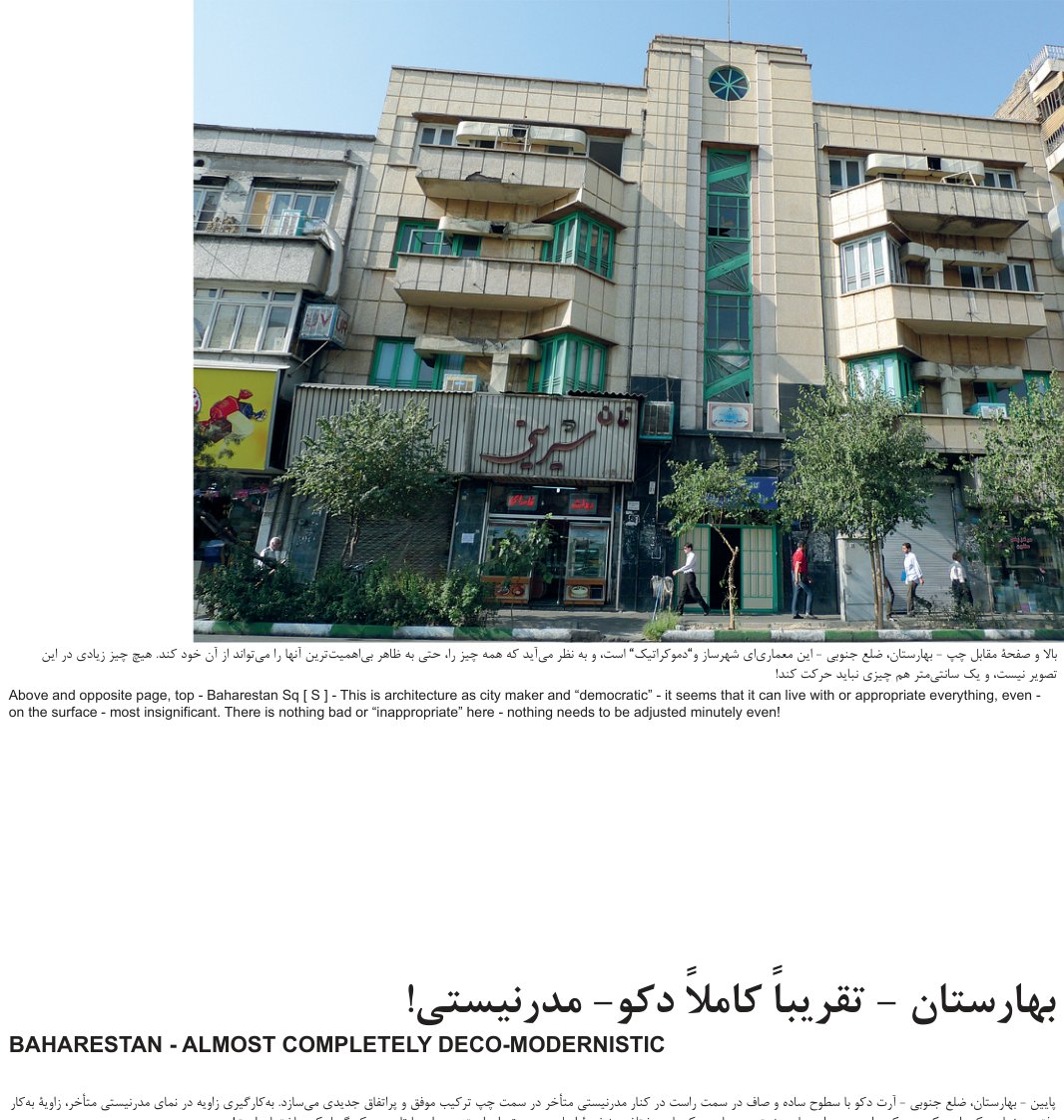
This is architecture as city-maker, "democratic" — it seems capable of appropriating everything, even the seemingly most insignificant. Above and opposite page, left — Baharestan, southern side. There is nothing superfluous in this image, and not even a centimeter should be moved! Art Deco with simple, smooth surfaces on the right alongside a later Modernistic piece on the left creates a successful and eventful new composition. Below — Baharestan, southern side — The use of the angle in the late Modernistic facade reflects the angle employed in the Deco facade — here to such a degree that they appear as a single building! These positive juxtapositions of different periods and styles are a principal and significant hallmark of Tehran — almost completely Deco-Modernistic!
Below and left — Baharestan, northern side, eastern corner of the square — The roof is a concealed pitched roof — a typical early Tehran example, not visible from street level. The screen before the staircase window, composed of horizontal stone slabs, and the detail of vertical stone strips beside it that form a semicircle at the top but then stop — avoiding symmetry — place the building squarely within Art Deco. The uppermost horizontal line of the staircase screen extends to the right and connects, by means of three additional horizontal strips, to the base of the arches. This arch has absolutely nothing to do with the "traditional" of any kind. Therefore, an arch need not be "traditional"!
Above and below — Cinema Plaza — Enghelab, southern side, No. 1126 — western cul-de-sac side. Right — Jaami, southern side, No. 54.
Above — Shahed, Khosro, No. 2. Top of page — Qaedi, southern side — The light blue color of the balcony ceilings is original. Far left — Enghelab, northern side, No. 733 — arcade type. Left — Enghelab, northern side, Hossein Ali Pour, northern side, No. 5.