The opening editorial of Memar 24, written about three months after the Bam earthquake of 5 Dey 1382 (26 December 2003), in which roughly 44,000 people died and most of the historic city was destroyed.
On the 12th of Farvardin, about three months and ten days have passed since the Bam earthquake. The city, still beneath a heavy mantle of rubble — its swollen population of a city that has lost at least half its inhabitants — cannot breathe. Yet according to Mr Reza Eshg, civil and planning deputy of the Bam governorate, by this date roughly 30 percent of the debris from the entire earthquake-stricken area, including Bam, the surrounding villages and Baravat, has been cleared — of which Bam's own share is said to be no more than 15 percent. Apparently Baravat is in better shape than Bam itself as far as debris removal goes. At first glance the city also appears a touch lighter, because of the clearing of main streets in time for Nowruz and the relatively decent rate at which administrative buildings, houses and shops have been freed of rubble — part of it done by residents themselves who have hired labour at personal expense in order to start life and work again.
Yet the general picture still offers little besides heavy debris on the ground, mounds of scattered garbage all across the city, dense traffic and crowds of mourning, black-clad people in front of the countless photocopy stalls and the still-standing buildings of the Revolutionary Court, the kiosks of the Property Registry, the Civil Registry, the governorate, the multiple housing foundations, and the twelve allocated headquarters. Nothing of any other kind catches the eye. At the same time, one senses a thin trickle of life in the work and trade taking shape inside half-ruined shops that have been turned into places to sell groceries, daily necessities and even building materials. The area around Maydan 22 Bahman has become a kind of bazaar, where in the evenings townspeople — or scavengers descending on the city from every direction, from the nearby villages out as far as Sistan and Baluchistan — come to shop, to stroll, to drink tea, to smoke a qalyan and to traffic in narcotics, which are now traded openly throughout the city.
In a sense, one could say that three earthquakes have occurred in Bam. First, the natural earthquake, which in a matter of seconds destroyed twenty thousand dwellings, five thousand commercial units and most administrative and government buildings. The second earthquake is the surge of non-local people into the city, some of whom arrived at the ruins of Bam only a few hours after the quake, and whose movement toward Bam and settlement in the city continues to this day. Some of these newcomers have come from the surrounding area and from villages that, in truth, lived off the city even while it was alive; others may be relatives, acquaintances or workers connected to the orchards and properties of those who lost their homes or perished entirely, and whose belongings and properties now seem to await new owners. It is said that a substantial share of the aid distributed in the first weeks — when the people of Bam were still searching for the bodies of their loved ones and for any trace of them — was received by this group. We have read in the newspapers that the city's population before the earthquake was roughly ninety to one hundred and ten thousand, while two hundred and twenty-seven thousand grocery booklets had been issued for residents two weeks after the quake. It is still unclear why, in those first days, no committee or council made up of people from Bam's different neighbourhoods was called upon to issue these booklets, so that the non-local population — which apparently also has a louder voice than those whose homes were destroyed — could be properly identified.
As for the third earthquake — it has been brought into being by professional spoils-hunters from every walk of life, including career criminals, who, for as long as the world has been the world, have risen to plunder in the wake of natural disasters and wars.
A Social Disaster, Not a Natural One
The Bam earthquake was a terrible blow, and what is happening there now, three months and ten days on, are the aftershocks of that devastating blow. What occurred in Bam was not merely a natural disaster — it was a social disaster. Perhaps one of the reasons for the sudden and enormous popular movement of aid and relief was precisely this feeling: an instinctive response not only to a failure of the earth, but to a failure of society, and to the collapse of any sense of security in a land where an earthquake of 6.5 on the Richter scale can, in a matter of seconds, send forty-four thousand people (according to the latest figures) to their deaths, destroy the bulk of the residential, administrative and commercial buildings, and lay flat a great city that was the economic centre of a vast region.
What else, in truth, can one call this fact — except a social disaster — that in the ruined city, every building which had even a partial bracing system, or which used steel sections, did not collapse entirely and did not produce a great toll of casualties, whereas in the majority of the buildings that did collapse, the bond between bricks dissolved one by one because of inappropriate mortars.
In a society where people and officials alike take part, all together, in a public chorus of complaint about the absence of law and the failure to enforce regulation and oversight, on whose shoulders can the responsibility for all of this be laid? And how long until this matter, like so many others — the practice of selling density rights, of selling professional signatures, of illegal seizures of land within floodways and fault-line easements, of registry and property records that quietly endorse those seizures, of tower-building on hillsides, and of negligence in any serious decision regarding land and its ownership — is also consigned to oblivion?
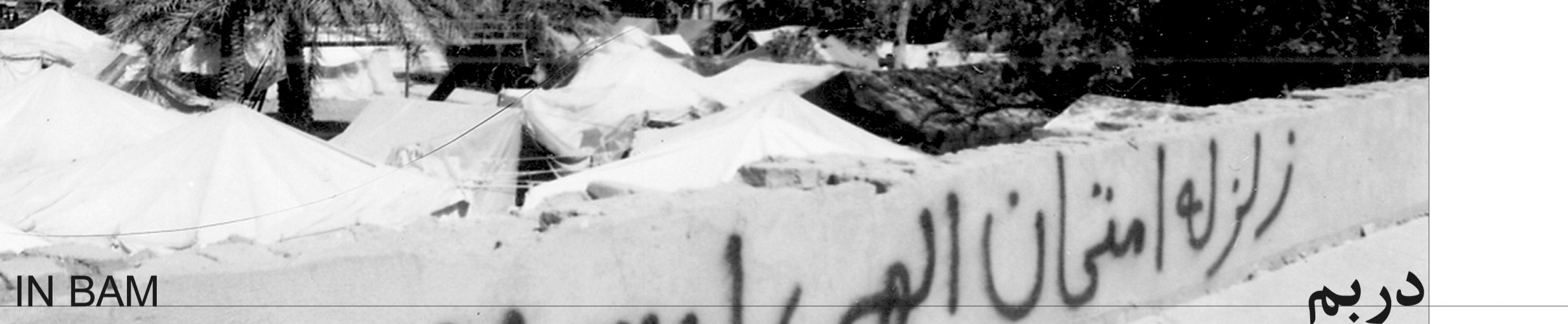
On banners in Bam we have read: "The earthquake is a divine test." Does this test extend to officials too, who, because of the responsibility they have accepted, ought to answer for it — and do not? Does this test extend also to Iran's engineering community, who complain that building is being done by those outside the profession, yet have not managed to stop the sale of engineers' signatures?
A Duty for the Professional Community
The reality, however, is that this roof will collapse over all of our heads, whether we acknowledge our share of the responsibility or not. For this reason, the duty of the country's professional community of architecture, urbanism and construction in this social disaster carries great weight. In Memar 24 — the issue you now hold — we have tried to reflect the views and proposals of a part of the professional community, and we once again invite architects and urban planners, and above all the architecture, urbanism and building guilds and associations, to cooperate with us in publicising news of their work in this field. The Memarnashr Institute, the journal Memar (Iran), and the Society of Architect Engineers also defined, in the midst of the collection of popular aid through various centres and associations after the Bam earthquake, a project whose description follows.



