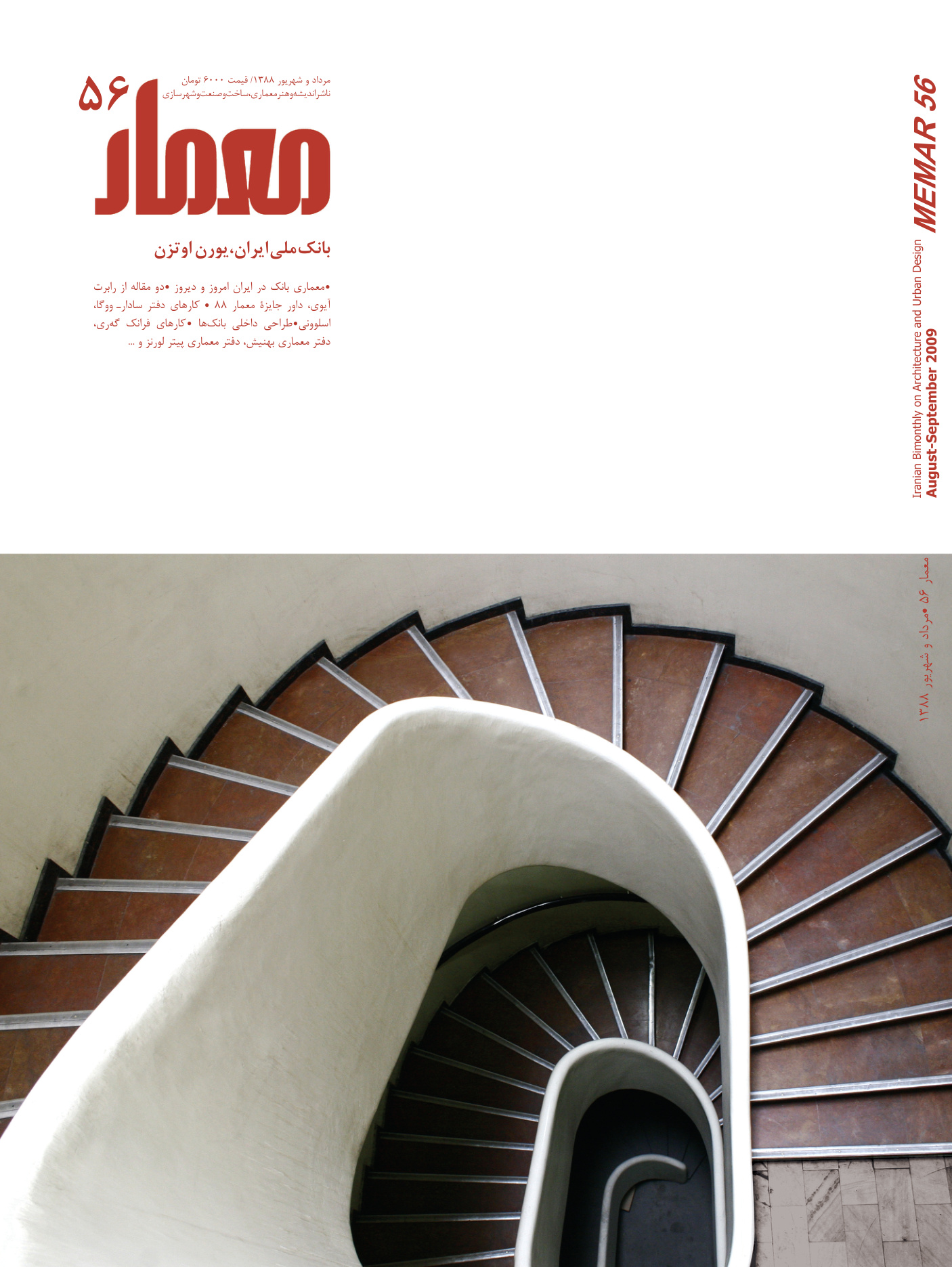
ARCHITECTURE OF BANKS IN IRAN OF YESTERDAY AND TODAY
In this issue a collection of banks built during contemporary and historic periods - beginning with the introduction of the concept of banking as one of the contemporary institutions of modern civilization to Iran - are presented, some in detail and others with only a few drawings and images.
To facilitate the comparison of different periods we have deviated from the usual format of the journal, and have introduced all examples in one segment called "do your" or "Today" and "Yesterday."
There is no doubt that this comparison does not benefit "today" and is in fact an embarrassment as it reminds us of all we have rapidly lost in the past 30 years, during which we have built a collection of typical examples of unsuitable and disproportional banks throughout the country while continuously hanging on about the Iranian and Islamic identity of our architecture. It would not be unreasonable to state that today the worst examples of buildings in Tehran and other large and small cities, even to the farthest regions of the country, where they still build mud-brick houses, are indeed banks, particularly state-owned ones that their managers, like all authorities, have been claiming possession to that so-called identity.
I remember a few years ago while making preparations for the Memar Award ceremony, I was asked by one of the officials if the judges were committed to choosing buildings with a strong identity and if there was any documentation to back this claim. I responded by explaining that in fact we ourselves strongly object to the collection of buildings constructed by their very same organization throughout Tehran, creating the worst examples of postmodern pastiche. So we are not supposed to answer to them.
Frankly we have not yet worked out what to call this style and trend. Maybe it is the fast-spreading eczema of the past excesses of the nouveau-riche who are responsible for many of today's quick-buck residential, commercial and "residential with commercial opportunity" who are also in the ranks of authority. The term "residential with commercial opportunity" which you only come across in present-day Iran, may be the key to this puzzle.
For now we can only hope and pray for a time when quality architecture filters into the realm of banks and corporations, and this may become possible when such organizations are freed from the control and clutches of the state.



