



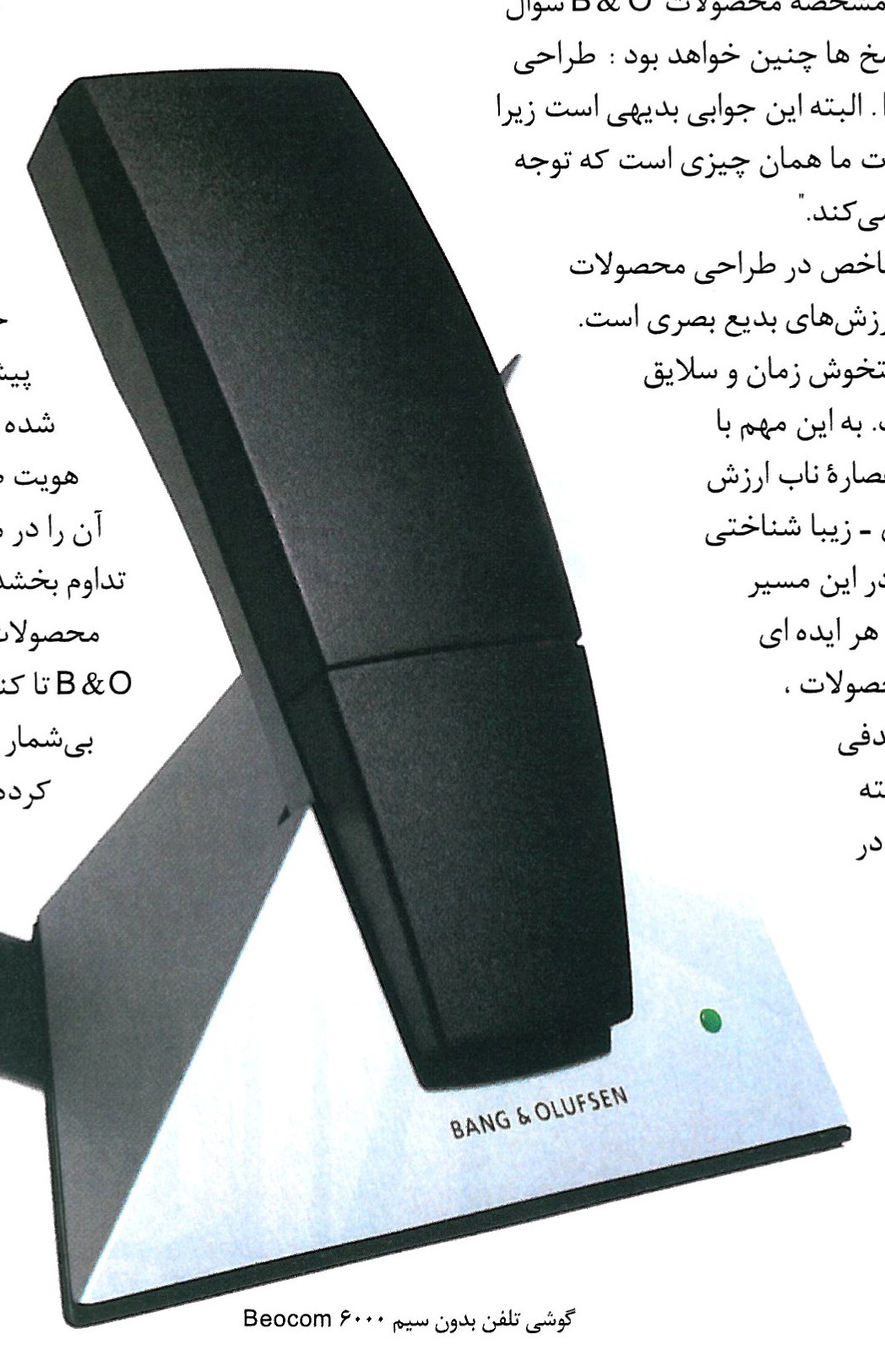
An opening: technology in the service of man
Armand Dror.
The conviction at this Danish company is that technology exists merely on account of man. They are continually engaged in a struggle to insist on the simplicity that rests on logic and on the use of technology. In the philosophy of design and making, it is constantly emphasised that every part has a function, and every function points to a particular meaning and notion. At B&O the principle is that man is the measure of all other things. Their specialism and their trade is the design and production of devices used for audiovisual media; on this basis, they hold that, in this field, the principal aim must be to help man arrive at fresh experiences of seeing and hearing in the current that today's media have set in motion — and, more importantly, that arriving at these experiences through enduring values lets man stand above the waves of that current.
Founding and history
Today, most of those familiar with the design world know B&O — the company that Peter Bang and Sevend Olufsen founded about 72 years ago in Struer, Denmark. The philosophy of design and production at this company has, for years, been expressed in this phrase: 'Hear it and feel it.'
B&O is known not only for the visual quality of its products (which is, of course, an inseparable part of the company's products), but also on account of the importance the meaning and quality of design hold for it. One of the company's bulletins reads: 'If you ask people about the distinctive feature of B&O products, most of the answers will be: B&O design. Of course this is an obvious answer, since the design of our products is the very thing that draws attention.'
Fresh visual values, beyond fashion
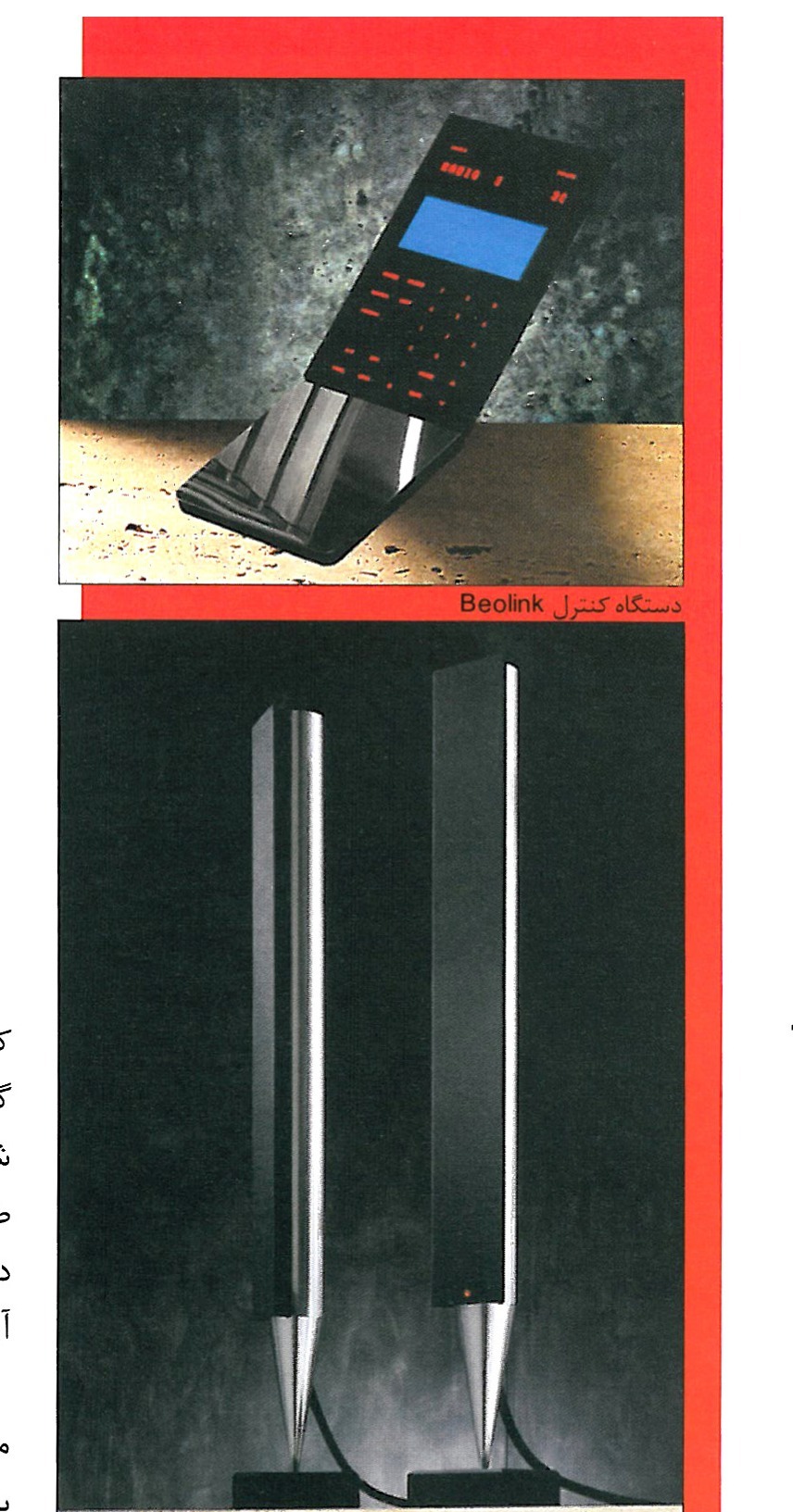
The distinctive view in the design of B&O products is the offering of fresh visual values — something not subject to the passage of time and short-lived tastes. They have arrived at this through the pure essence of functional-aesthetic values. In this path, behind every realised idea in the design of products, there is the attainment of a functional aim.
Design does not take place to meet the buyers' fleeting aesthetic interests. On this basis, a glance at the products of this company shows that the dust of passing time has not settled on them.
idealand: the design centre
When one speaks with the company's manager about the importance of the design of B&O products, he insists that the pure outward quality and the feel arising from the visual experience at the moment of seeing the product are very important. But this is only part of B&O's experiences and capacities. Important factors — including ease of use, simplicity, and the pleasure derived from working with the company's products — are no less important than the visual values of the products.
It must be granted that design, in its true meaning, plays a fundamental role in the intellectual and team organisation of B&O. For this reason, a special place — known as idealand — was set up some 15 years ago as the centre of design activity, to keep the presence of design's identity and concepts within the company's products.
Awards and museums
The products made at B&O have, to date, won countless design awards. Among these are eight Danish JD awards, the Zayn Design Award, and the special Good Design award. The presence of several products of the company — including Beogram 4002, BeoCom 2 — also in the permanent design collection of the Museum of Modern Art in New York (MoMA) speaks to the standing and the strength of the design of this company's products.
These two products are from the work of Jakob Jensen, who designed for B&O. He was the company's chief designer until 1987, and after him David Lewis took that position — the Beosound 9000 being among his brilliant works.
Aluminium finishing: a case of the production process
In the company's manufacturing department, too, a particular philosophy prevails: everything must be at the best possible quality. For this reason they use materials of the best quality, and, by drawing on the latest production processes, strive to deliver to buyers a product with very high qualitative properties.
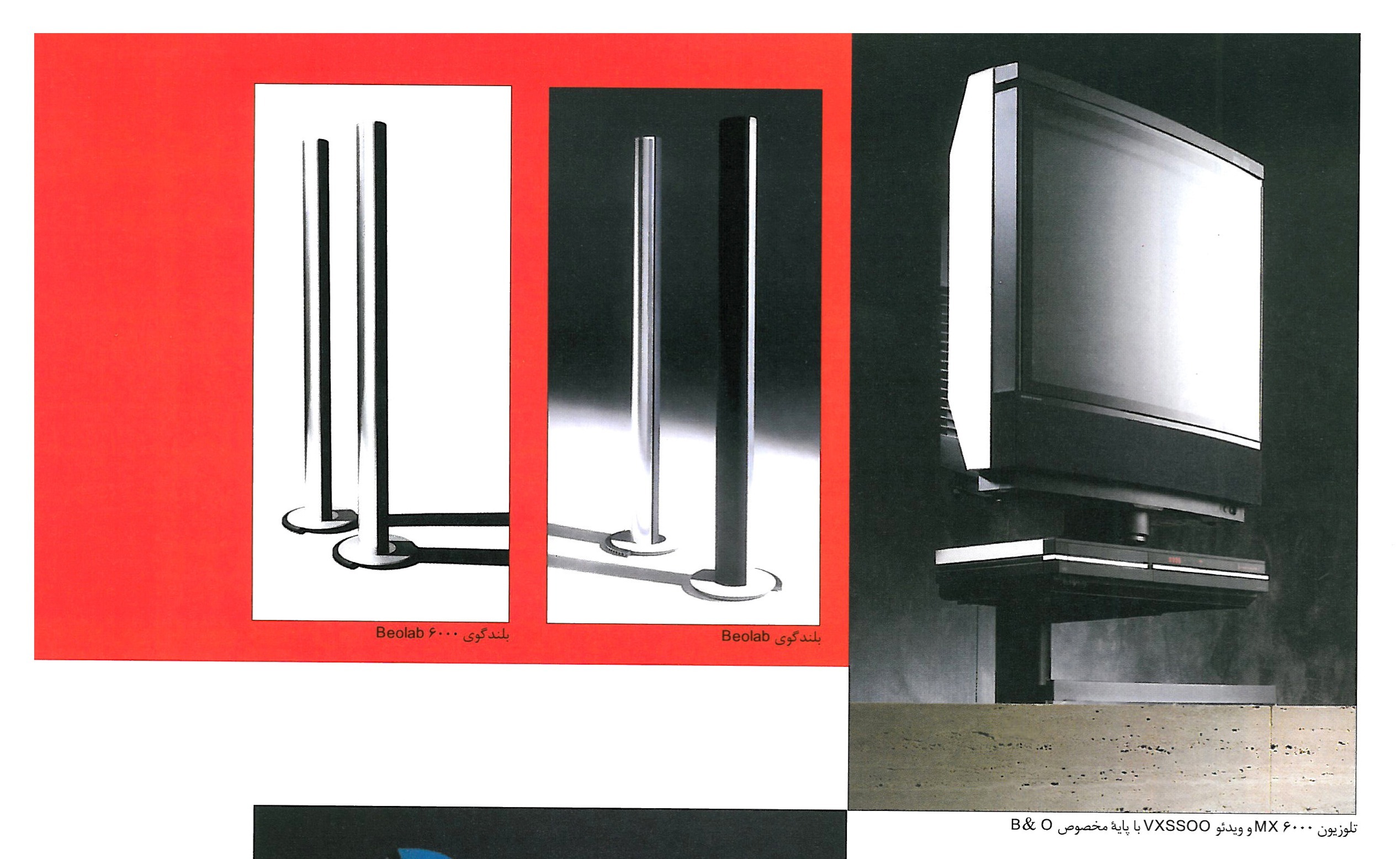
For example, the finishing of the aluminium plates used in the products is a labour-intensive, lengthy process. At first, these plates are laser-polished until completely smooth. Then they are washed first in an alkaline solution, and afterwards three times in water, and immersed in a 15 % citric acid for 6 minutes. After two more rinses in water, they are placed in a 20 % sulphuric acid solution at 13 V and 2,000 A, where they are anodised for 25 minutes. Then water is sprayed on them, and for 25 more minutes they are placed in an 82 % acetate solution in boiling water at 96 °C. The result is a coating 0.5 mm thick on the aluminium plates, whose long durability is plain in such products as the BeoLab speakers.
Technology in the service of design
At B&O there is the firm conviction that design must always set technology to serve. This conviction is expressed in the company's slogan: 'Technology is in the service of B&O design, and where available technology cannot meet the designer's needs, we invent it.'
In the typology of B&O designs, deep attention is given to the relation between man and product. On this basis, simplicity and order resting on logic have been very much emphasised. The company's designers continually try to define a human routine for working with audio-visual electronic devices, so that the user is not faced with multiple buttons and indicators that overwhelm him with their complexity. In B&O products, everything works just as a man expects. You and your feelings, as the user of the products, hold a particular place at B&O.
BeoLink: the home control system
Among the most important achievements of this kind of approach is the BeoLink control system. What led to BeoLink rests on the idea that, to use music, radio, or telephone, you need not be limited to the place and space in which the devices are set. The BeoLink sensors and accessories are placed within the products, and by linking the devices with its cables, you can — from any room in which one of the audio-visual products is set — find your favourite music track and listen to it, programme the video device to record a particular programme, listen to the 8 AM news on the radio, or finally turn the whole system off. When your telephone rings, you can — with the receiver, before answering and speaking — lower or wholly turn off the music; after the call, the volume returns automatically to its previous setting.
BeoCenter AV5: a presence like a living being
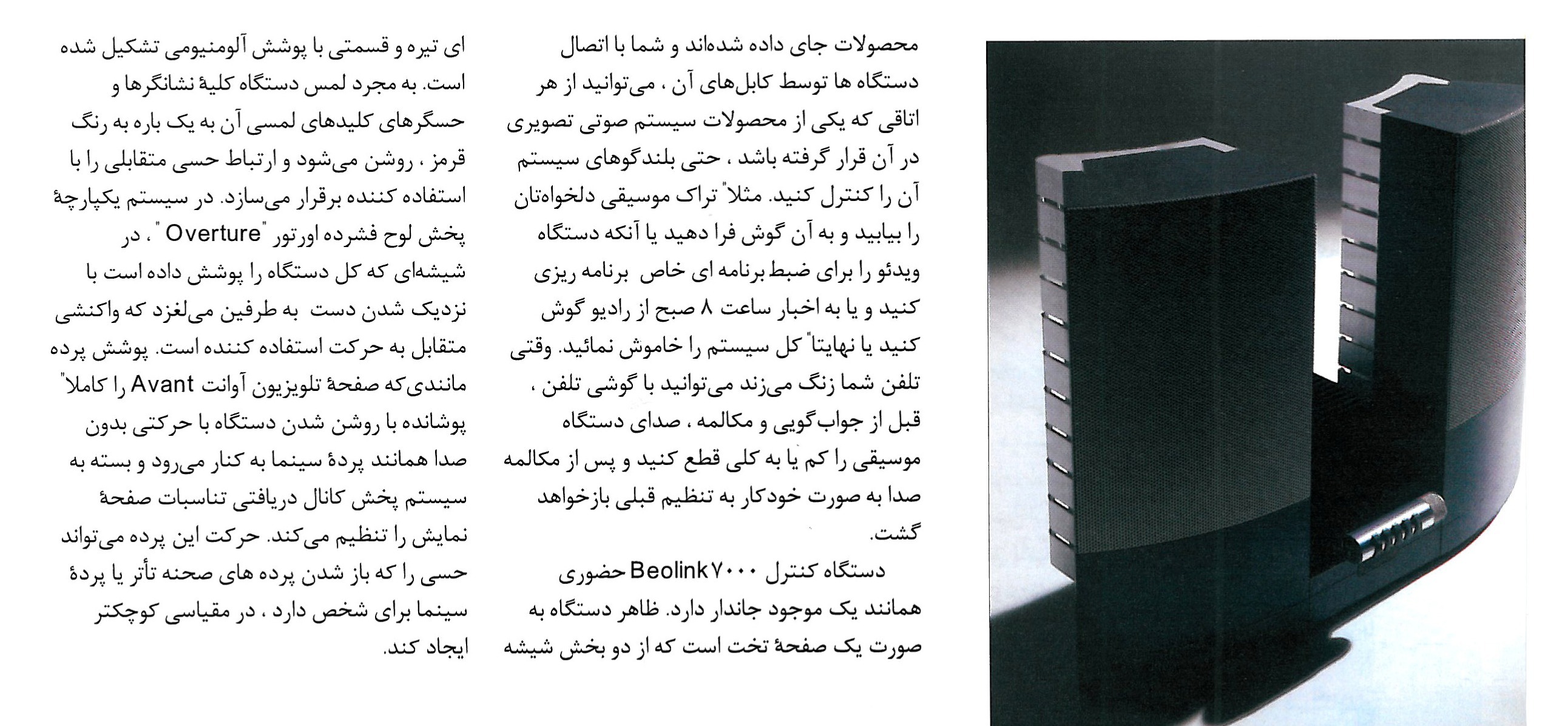
The BeoCenter AV5 has a presence like a living being. Its appearance is a flat surface composed of two dark glass parts and a section with aluminium cladding. The moment the device is touched, all its indicators and the sensors of its touch keys appear at once in a bright colour, setting up an intelligent connection with the user.
In the Overture CD player, in the glass that covers the whole device, with the approach of a hand to its sides, it slides — a reciprocal response to the user's motion. The curtain-like cover that wholly conceals the screen of the Avant television, with the device's switching on, in a soundless motion like a cinema curtain, draws aside, and according to the showing, sets the level of display. The motion of this curtain can recreate, on a smaller scale, the feeling that the opening of theatre or cinema curtains gives a person.