Books
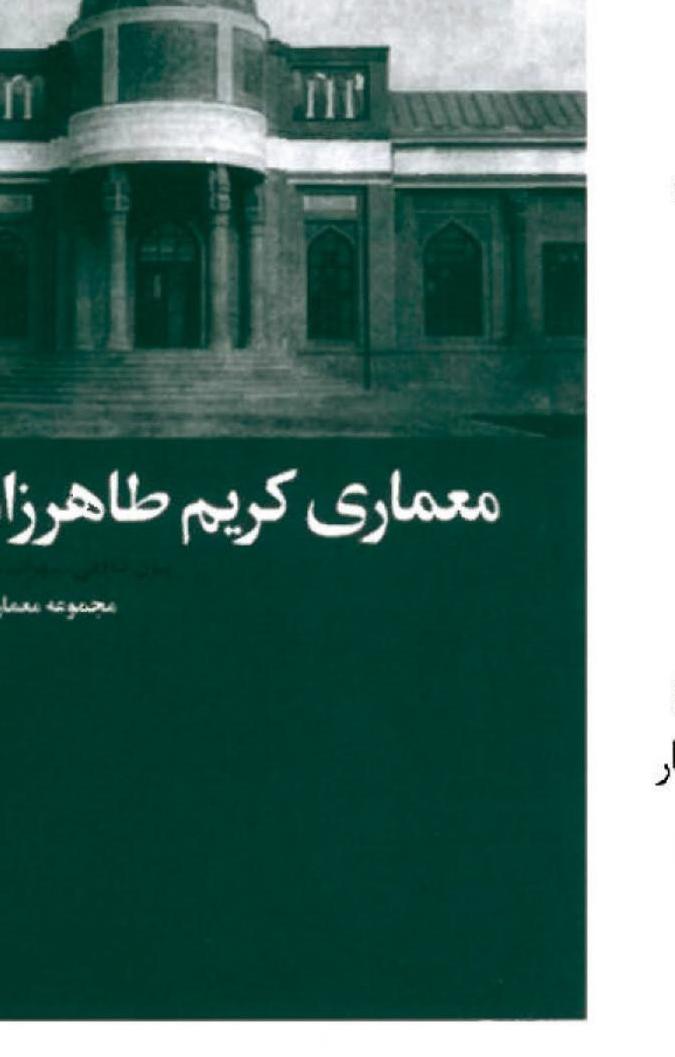
Bijan Shafei, Sohrab Soroushiani, Victor Daniel, The Architecture of Karim Taherzadeh Behzad: The Architecture of the Transformation Era in Iran series, translated by Taraneh Yalda and Neda Ghiassi, Tehran, Did Publishers, 2005 (1384).
In the book's introduction we read: The idea of forming the “Architecture of the Transformation Era” research group took shape in 1982 (1361) and was realized a year later in a student circle with five volunteer members. Understanding the history of contemporary architecture, presenting examples of its works, and introducing the notable architects of this period were the group's initial motivation. Until then, despite an urgent need for analytical and historical literature on this period's architecture, there was no organized, effective means to support and guide those devoted to research. As a result, research activity met many difficulties, leading members to withdraw and, in some cases, to a halt of research. The “Architecture of the Transformation Era” group, too, was deprived of some colleagues' help along the way.
At the outset, the difficulty of access to documents and references became clear. Most of what had been published on this period's architecture did not rest on reliable documents and sometimes lapsed into a personal, undocumented reading. The references and documents needed were highly varied and scattered, and reaching them required extensive library research alongside fieldwork and the wide use of written memoirs and oral history. The 1980s (the 1360s) had not yet ended when the research group arrived at a new understanding of the need. In the early years of the 1990s (the 1370s), free research turned into a professional and national duty and called for broader research aims.
“The Architecture of the Transformation Era” addresses a period of Iranian architecture in which transformation is one of its continuous characteristics. Historically, this period begins in the middle of the reign of Naser al-Din Shah Qajar and continues to the present. In this period, transformation is accompanied by changing features. Numerous buildings were erected by Iranian and foreign architects, influenced by change in various fields, making a division into historical periods necessary. The research results can be presented at three levels: (a) “architects and architects' works,” covering the introduction of architects, their works, and methods; (b) “the historical period,” covering the introduction of the period and its contexts, sample architectural works and architects, styles and tendencies; and (c) “the architecture of the transformation era,” covering an analytical history of the period, the transformation of its contexts, and a classification of styles and tendencies.
The Transformation-Era group came upon the name Karim Taherzadeh Behzad in 1988 (1367), when, continuing its study of contemporary Iranian architecture, it was researching railway-station buildings, and through this became acquainted with Taherzadeh's architectural activity and his earlier collaboration with Kazemzadeh Iranshahr in Berlin. Meeting Kazemzadeh Iranshahr's son — made possible by the kind facilitation of Iraj Afshar — smoothed the path of research. Saramadan-e Honar, written by Karim Taherzadeh Behzad, was a rich source, access to which became possible in library research through Kazem Kazemzadeh Iranshahr. At the outset, efforts to make contact with Karim Taherzadeh Behzad's son in order to obtain documents came to nothing, and after collecting and completing the first-stage information and documents, in 1990 (1369) the group produced a preliminary written summary of Taherzadeh Behzad's body of work.
In later stages these works were pursued more seriously, and through repeated visits the needed information about his body of work in Tehran and the provinces was gathered, and all extant works were more precisely assessed. While preparing documents and information, the group came upon the two-volume book The Artistic Movement of the Reza Shah Pahlavi Era, whose publication had been promised but which had not yet gone to press and could not be accessed. At the end of the research, when the book was in the final stages of layout, contact became possible with Firouz Behzad, Karim Taherzadeh Behzad's son, who lived in Düsseldorf, Germany, and through him the group obtained the manuscript of The Artistic Movement of the Reza Shah Pahlavi Era and other useful documents. After obtaining these materials, the book was reviewed again and the present work was enriched in documents. It is fitting here that the Transformation-Era group express special thanks to Mr Firouz Behzad for his unstinting cooperation.
Kambiz Haji-Ghasemi, Ganjnameh, Volume Fourteen: Houses of Yazd, Tehran, Shahid Beheshti University and Rozaneh Publishers, 2004 (1383).
Volume fourteen of Ganjnameh, by taking up the houses of Yazd, sets before the eye further facets of Iran's Islamic architecture. The surviving traditional houses in Yazd — our jewel-like desert city — are, happily, very numerous, and are introduced in this volume. The houses presented in this book are: the Akhavan-Sigari house; the Ardakanian house; the Tehraniha house; the Rasoulian house; the Rouhanian house; the Rismanian house; the Semsar house; the Shafi'pour house; the Arab house (Bibi Roghayeh); the Arab house (Alireza); the Arab-e Kabir house; the Arabha house; the Oloumiha house; the Fatemha house; the Farhangi and Mozaffari house; the Karavoghli house; the Gerami house; the Golshan house; the Lariha house; the Mortaz house; the Meshkian house; the Mashrout house; and the Malek house.
Parvin Hosseini, Travelogue of Qeshm, edited by Sanaz Ayenehchi, Tehran, Abtin Ghalam Publishers, 2005 (1384). The book's contents are: a description of the tourist attractions of Qeshm Island; and information on the geographical features of Qeshm Island.
Periodicals Received
Publications of the Management and Planning Organization of Iran, Deputy for Technical Affairs, Office of Technical Affairs, Codification of Criteria and Reduction of Earthquake Risk: Guideline for Preparing Forest-Road Projects (Publication no. 148); Guide to the Design, Execution and Operation of Forest Roads (Publication no. 131); Glossary of the Country's Technical and Executive System (with CD, Publication no. 297).
Rah va Sakhteman (Road and Building) monthly, third year, September 2005 (Shahrivar 1384), no. 24: urban crisis management; lightweight and foamed concrete; managing the construction of steel structures; the new-town experience in Iran; a climatic study of Shiraz; seismic study of an asymmetric concrete building on the basis of the capacity spectrum; several thought-provoking open-air pools; and so on.
October 2005 (Mehr 1384), no. 25: a look at the third edition of Standard 2800; the performance of the housing sector over the past eight years; the rehabilitation of Tunis's historic fabric; a study of metro-tunnel stability; technical pathology of the earthquake; precast concrete and how it is joined to sections of a building; the role of renewing worn urban fabric in creating housing capacity; the old fabric — adobe, memory and history; traditional technology or modern technology; and so on.
Iranian Engineering Education quarterly, seventh year, autumn 2005 (Paeez 1384), no. 27: the state of the country's human resources and ways to prevent its waste; architectural-engineering education at Canadian universities; a proposed programme for a doctorate in urban planning; virtual education, new methods, and raising the quality of education; the role of information in technology transfer; an optimal programme for implementing the country's energy-management measures; and so on.
Rayaneh, Memari va Sakhteman (Computer, Architecture and Building), autumn 2005 (1384), no. 7: the world's short sojourn and its guests; climatic architecture with sunlight, light and imagination; hotel design and cosmopolitan separation; Paolo Deda, the Iranian caravanserai, the missing link of Iranian architecture; a memorial of Eastern architecture, the Arman residential and commercial complex; a hotel as tall as the Zagros; the best hotels of 2005; the bodies of the Iranian village; Soltaniyeh, upon the roof of the Mongols' aspiration; contemporary architecture and façades; and so on.
Ehya quarterly, third year, summer 2005 (Tabestan 1384), no. 12: globalization, the opportunities and challenges ahead; a review of the quality-costing system; customer satisfaction as a condition of an organization's survival; factors affecting the market; the integrated management system; the mechanism of social capital at various levels; culture and cultural development; learning organizations and the role of training within them; and so on.
Panjereh, the bulletin of the Building Engineering Organization of Qom Province, summer 2005 (1384): beautification in Qom, a forgotten principle; building well — and yet we do not; engineers' expectations of the central council of the Building Engineering Organization; London's great city hall; the bazaar, the first example of non-rectangular buildings; the bazaar, Qom's most economical urban element; crisis management, the crisis of management; and so on.
Ban, September–October 2005 (Shahrivar–Mehr 1384), no. 46–47: identifying a project's needs versus a formulaic diagnosis of consultancy; a roundtable examining the relocation of the capital, with several experts; the resolution on rehabilitating worn urban fabric; the ins and outs of the 22nd Congress of the International Union of Architects; the Istanbul declaration / Cities, the great bazaar of architecture; a memorial to Iraj Kalantari-Taleghani, architect of the year 2005 (1384); and so on.
Farhangestan-e Honar (Academy of Arts) monthly, fourth year, September 2005 (Shahrivar 1384), no. 33: Seyyed Mohammad Rezvani-Nejad, secretary of the symposium on art and the Sacred Defence; a report on the pre-conference of the “Nature in Eastern Art” conference; a report on the fourteenth Tehran Carpet Exhibition; a look at the state of the handwoven carpet in Iran; a conversation with Professor Heshmati Razavi on Iranian carpets; a report on the exhibition of the foreign works in the treasury of the Museum of Contemporary Art; and so on.
Sakht va Saz (Construction) monthly, sixth year, September 2005 (Shahrivar 1384), no. 49: a bridge for the 21st century; conscience, law, building and resistance; the entry of insurance into construction is forbidden; management, the bewildered commodity of housing; domestic news; industry news; foreign news; architecture competitions; and so on.
Abadi quarterly, winter 2004–05 (Zemestan 1383), no. 10 of the new series: change and continuity in the historic city of Yazd; conservation and urban development — two complementary or contradictory approaches?; the problems and an appropriate approach for revival and renewal; the old fabric and structure of the city of Kerman; restoration and revival in the historic complex of the Miandasht caravanserais; structural masterpieces in contemporary bridges; introducing contemporary projects of Islamic countries; and so on.
Jostar-ha-ye Shahrsazi (Urban-Planning Essays), fourth year, spring 2005 (Bahar 1384), no. 12: where is the city centre?; planning the quality of urban life in city centres, definitions and indicators; the place of the cultural centre in sustainable urban development; the Abbasabad lands, developing the central zone of Tehran; Shiraz and the city centre through time; the central zone of metropolises and globalization; the theory of the city in Iran; and so on.
Haft Shahr (Seven Cities), fifth and sixth years, winter 2004–05 and spring 2005 (Zemestan 1383 and Bahar 1384), nos. 18 and 19: the Bam earthquake — 2,700 years lost in 7 seconds; the role of the Building Engineering Organizations in making cities safe; urban-development plans and the earthquake crisis; crisis management, environmental design; world experiences, lessons and programmes for post-earthquake reconstruction; principles for the protection and restoration of cultural heritage; and so on.



