Which is worth more, a kilo of stone or a kilo of gold? The question may seem ridiculous. Only, of course, from a merchant’s point of view. The answer of a great artist: to me all materials are of equal value.
The Venus de Milo, whether made of gravel – on Paros1 the streets are paved with Parian marble2. – or of gold, would have had the same value. The Sistine Madonna3 would not be worth a penny more if Raphael had mixed a few pounds of gold into the paint. A merchant who in an emergency is forced to think of melting down the gold of the Venus or scraping off the Madonna would probably have to do their sums some other way.
The artist, of course, has only one ambition: to master the material in such a way that the value of their work is independent of the value of the raw material. But architects are not familiar with this ambition. For them, a square metre of façade in granite4 is worth more than a façade built of concrete.
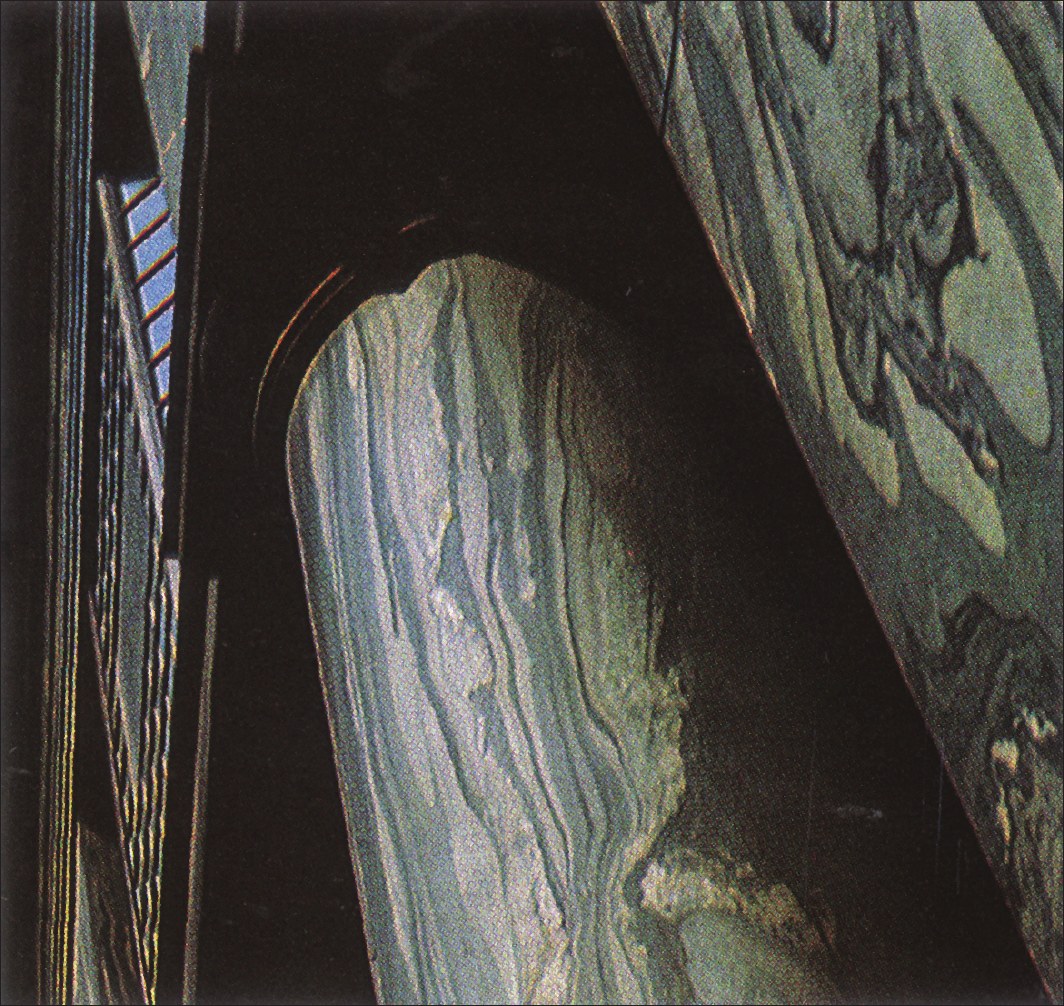
Yet granite is fundamentally worthless. You see that it lies buried out there in the ground. Anyone can get hold of it. Or it forms whole mountains, whole mountain ranges, and only has to be dug out. Streets are paved and cities cobbled with it. It is the most common stone, the most ordinary material we know. Yet there are apparently people who regard it as the most valuable building material.
These people speak of the material, but what they mean is labour, workmanship, human skill and art. Because it takes a great deal of labour to quarry granite from the mountain, a great deal of labour to bring it to its destination, labour to give it a suitable shape, labour to give it a pleasing appearance. And at the sight of a polished granite wall, our being is filled with an awe full of respect. For its material? No, for human labour.
So does all this really mean that granite is more valuable than concrete? Not necessarily. Because a wall with stucco decoration5 by the hand of Michelangelo puts even the most polished granite wall in its shadow. Not only the quantity but also the quality of the work offered plays a part in determining the value of any object.
We live in an age in which preference is given to the quantity of work. Because it is easily recognised, and easily catches the eye of the person in the street, and requires no trained eye or other knowledge. Nor can any mistake occur. Such and such a number of day labourers have worked on it for such and such a number of kreuzer6. The person in the street can make sense of that. And they want the value of the things around us to be made comprehensible to the person in the street. Otherwise those things become meaningless. Hence materials that require a longer working time attract more respect.
It was not always so. In the old days buildings were made of materials that were readily available to all. In some regions walls were built of brick, in some of stone, and in others of cement. Did the people who built in this way feel, compared with architects, that stone was worth less? No one had that feeling. In fact, if they had a stone quarry nearby, they built in stone. Of course, in their eyes, bringing stone from far away to the building site was a matter of money and not of art. And in the old days, art and the quality of work mattered more than they do today.
In such times, of course, proud and powerful personalities arose in architecture. Fischer von Erlach7 did not need granite to make their point. With clay, plaster and sand they created works that had the same power to captivate us as if they had been built of the finest building materials, difficult to work. Their spirit, their artistry mastered the humblest material. They were able to breathe the nobility of art into common8 dust: a kingship in the realm of art.
But in our time it is not the artist who rules, it is the day labourer; not the idea but the working time. And mastery increasingly passes into the hands of the hired worker, because something has turned up that can accomplish the quantitative work better and more cheaply: the machine.
Of course, money is spent on all the working time, whether with a machine or with a worker. But what if someone has no money? That person gradually fakes the working time, so as to imitate the material.
Respect for the quantity of work is the craftsman’s worst enemy in the trade9. Because it leads to imitation. But imitation has undermined the spirit of a large part of craftsmanship. All the pride of craftsmanship has departed from them. ‘Book printer, what can you do?’ ‘I can print in such a way that it looks like lithography.’ ‘And lithographer, what can you do?’ ‘I can make a lithograph look like printing.’ ‘Cabinetmaker, what can you do?’ ‘I can carve ornaments so fashionable that it looks as if the plasterer had made them.’ ‘Plasterer, what can you do?’ ‘I do the moulding and the ornaments with great precision, I make the hairline joints so that everyone thinks they are real, and they look like stonework.’ The tinsmith cries out proudly, ‘I can do that too! If you paint the ornaments and sand them, never in anyone’s view will it appear that they are made of tin.’ A sorry lot they are!
A kind of self-abuse is current in our trade. We should not be astonished that these people are not on a good path. Nor are such people meant to be on a good path in any way. Cabinetmaker, hold your head high. Be proud that you are a cabinetmaker. The plasterer makes ornaments too. You must pass them by without envy or inclination. And you, plasterer, why are you preoccupied with the stonemason? The stonemason makes joints, must make these joints sadly, because small stones are cheaper to obtain than large ones. Be proud that your work does not show those little joints that cut through column, ornament and wall. Take pride in your work, be glad that you are not a stonemason.
But I am wasting my time; the public does not want the proud craftsman, because the better a person can work, the more the public stands behind them. Respect for expensive materials is the surest sign of the parvenu, which is what the public wants; it could not have been otherwise. The parvenu is ashamed not to adorn themselves with diamonds, ashamed not to be able to wear fur, ashamed not to live in stone palaces, because they have concluded that diamonds, fur and a stone façade cost a great deal of money. They do not know that not having diamonds, fur or a stone façade has no effect on elegance. Consequently, having no money, they go after a substitute for them, which is a ridiculous undertaking. Those they want to deceive, the people whose wealth allows them to surround themselves with diamonds, fur and stone façades, cannot be deceived. They find such struggles ridiculous.
In the last few decades imitation has ruled architecture. Wall coverings are made of paper, which of course in no way shows the reality. So there is no option but to add moiré silk, Gobelin10 and carpet patterns to it. Doors and windows are made of softwood. But because hardwood is more expensive, it must be painted to look like it. But faced with precast concrete, the achievement of our century, one is completely at a loss. Concrete is in itself an important material, though when imagining how it is to be used, the same thought comes to mind as with every new material: what is it used to imitate? As a substitute for stone. And because precast concrete is far too cheap, it is wasted on a vast scale. This century has fallen into real trouble with concrete. The smug client may have said to the architect, “Ah, my dear architect, can you spend a few more guilders on the façade?” and the architect, if asked, as far as possible, and perhaps more, would nail more guilders’ worth of art onto the façade.
Today reinforced concrete is used to imitate plasterwork. The prevailing situation in Vienna is that a person who is strongly opposed to the violation of material and to imitation is dismissed as a materialist. These are people who place such value on this material that for its sake they disregard their own character and go looking for a substitute for it.
The English brought us paper. Unfortunately they cannot send us their whole houses. But from the wallpaper we can understand what the English want. They are wallpapers that are not afraid of being made of wallpaper. And why should they be afraid? There are no doubt more expensive wall coverings, but the Englishman is no parvenu; in his house the impression must never arise that there is no more money. Even the fibres of his clothes are of sheep’s wool, and they honestly show the reality. So English fabrics, our fabrics, do not display that Viennese attitude of “I would like to, too, but I can’t afford it”, even though they are woven only of wool.
And so we arrive at the chapter that plays the most important role in architecture, together with the principle that is to form the alphabet of all architecture, the principle of cladding11. The description of this principle is left for the next chapter.
Footnotes:
1- Paros, an island in the Aegean Sea
2- Parian marble, a quality marble from the island of Paros
3- Sistine Madonna
4- granite
5- decoration [Loos uses this word with a different meaning from ornament, although both are rendered in Persian as «تزئین». Tr.]
6- Kreutzer
7- Fischer von Erlach
8- plebeian
9- caste
10- Gobelin
11- cladding