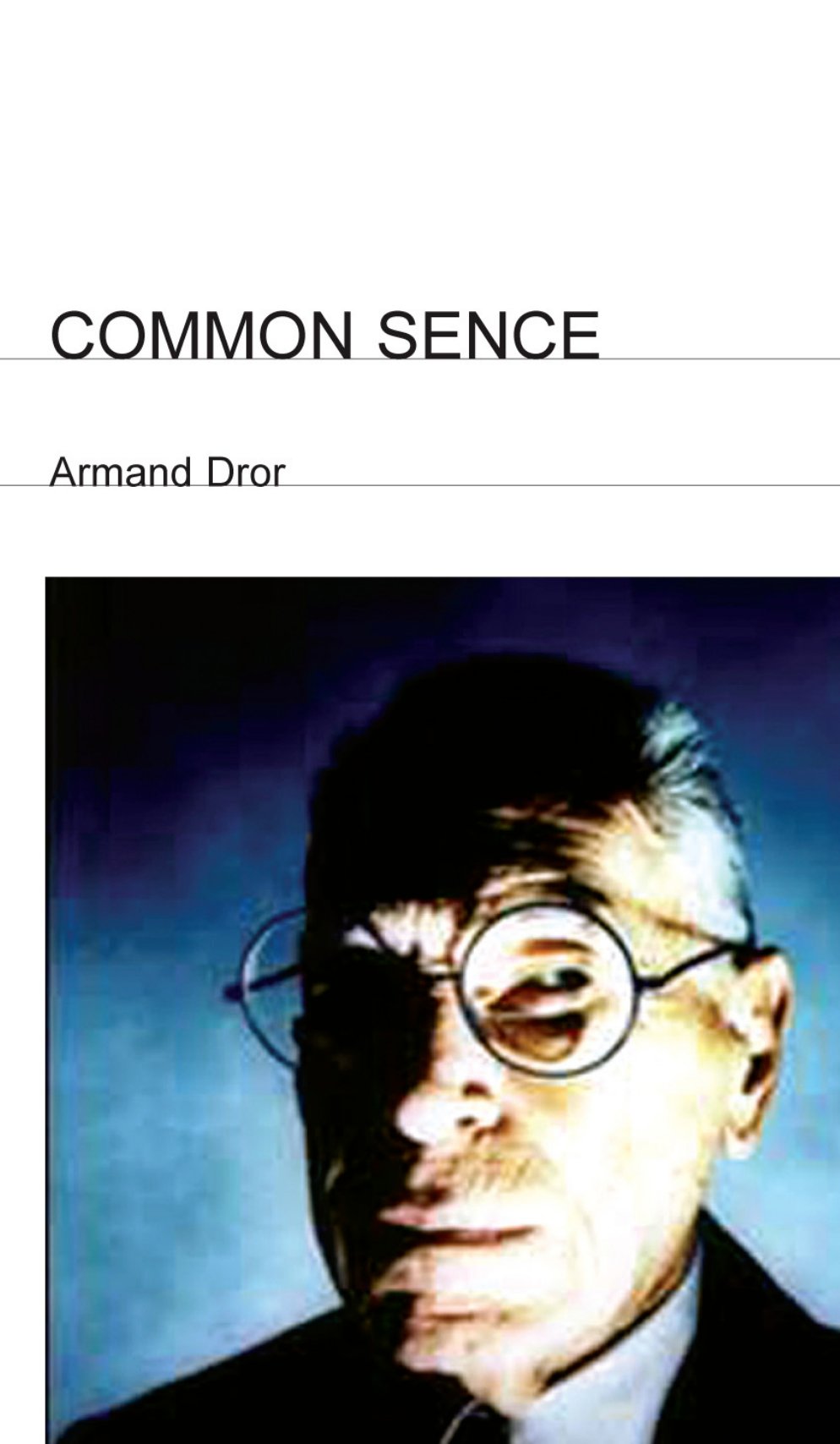
On the occasion of the death of the Italian designer Achille Castiglioni (1918–2002) — a review of Achille Castiglioni: Complete Works 1938-2000 by Sergio Polano (Electa, 2000) and Achille Castiglioni: an Odyssey.
Late last year Achille Castiglioni1 died at the age of 84. His death unfortunately marks the end of an era of the last "dinosaurs" of Italian design. Castiglioni, Magistretti2 and Sottsass3 have had a very important influence on the growth of design in post-war Italy. Magistretti is known for his pioneering, his creativity, and his teaching; and Sottsass for his radical attitude and thought toward the matter of design. Radical reforms in the prevailing methods of design came about through Sottsass, and the linear path that had begun in the nineteenth century with the Arts and Crafts movement, and had moved through Bauhaus4 1920 and Scandinavian design 1950, was transformed at once.
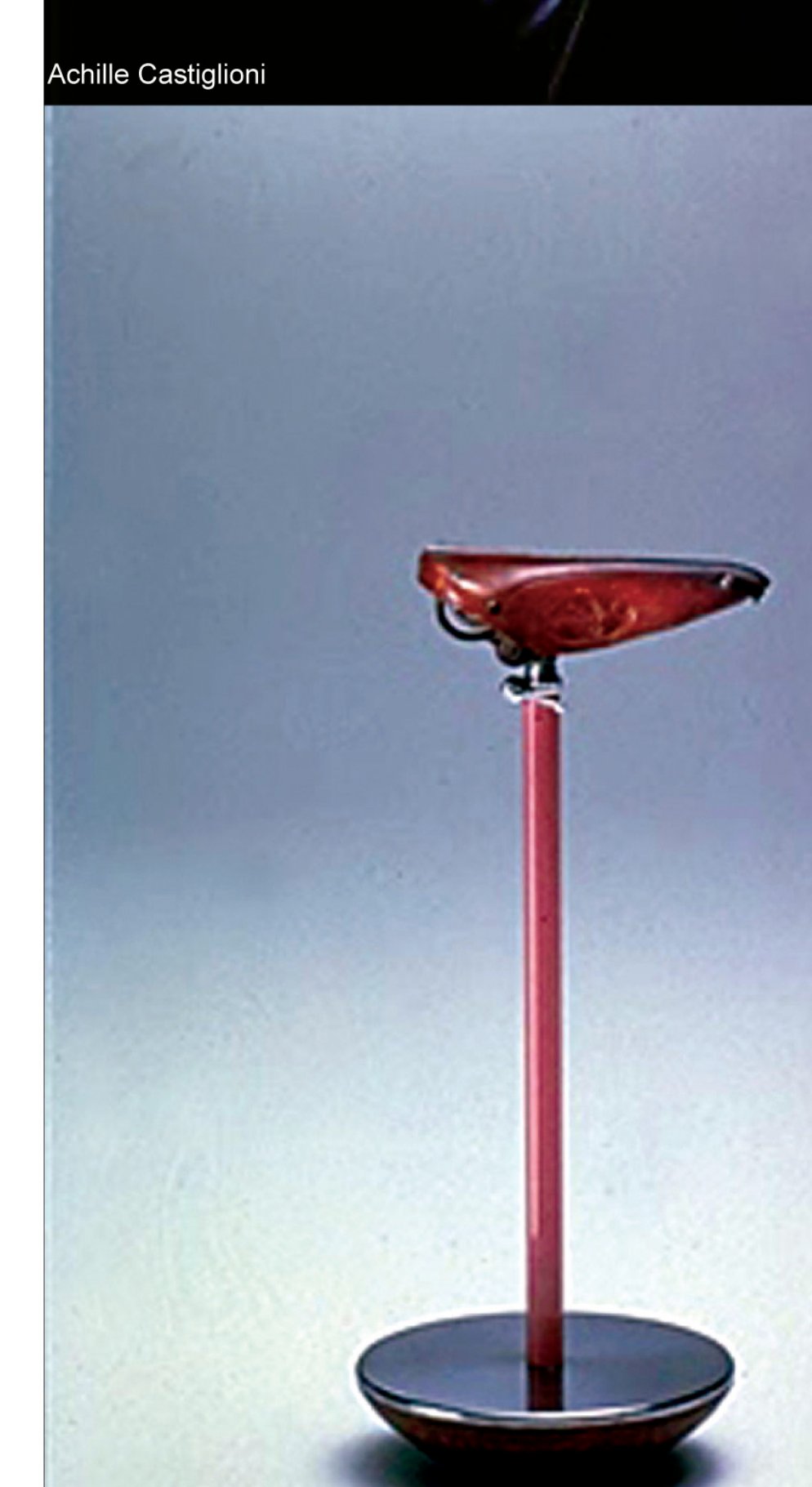
Castiglioni's radicalism, however, is crystallised in his ability to take very ordinary objects and turn them into objects with a new nature within the atmosphere of design. The same thing that Marcel Duchamp5 did by exhibiting the toilet bowl titled Fountain in 1917, and Man Ray7 with his "Indestructible Object" of 1923 — sticking an eye onto a metronome. Castiglioni and his brother Pier Giacomo did this in 1957 by mounting a leather saddle on a tube attached to a convex pedestal of cast iron. In the same year he mounted a car headlamp on a base and designed the Toio8 lamp for Flos. In his own words: "As soon as I sit down I get tired; I like to go this way and that, and at the same time I like to sit and talk. Not fully seated, of course — and the result took the shape of Sella9."
After the end of the Second World War he returned to Italy. Achille, together with his two elder brothers Livio and Pier Giacomo, founded an office on the ground floor of the Sforza Castle10 building. The Castiglioni office, because of the slowdown in construction in the post-war years, concentrated, as did many architects, on smaller-scale projects. They designed interiors, exhibition spaces, furniture, and other objects. The Castiglioni brothers designed many examples of exhibition pavilions, and notably the Société pavilion11 in 1958 and the Milan ones of 1960 — where new uses of plastic were presented — drew much attention. The Luigi-and-Achille office had a wide collaboration with manufacturers of furniture, lighting fixtures, and electrical appliances, and offered designs with exceptional qualities that defined the style of their work: namely, the use of new materials, experimental forms, and new technology, and of course the establishment of an indisputable relationship between function and the essential core of the design, blended together with an unimaginable simplicity.
The Arco13 lamp, which they designed for Flos12 in 1961, expresses Castiglioni's particular view of design. This lamp takes inspiration from a street-lamp pole as its functional and formal source. A base of marble in a cube-like volume, from which a steel tube curves out and arcs gracefully to the lamp's light source. A very simple, spherical reflector surrounds the bulb — and nothing more. This lamp is still in production and you can use it anywhere in the home. The distance from the base to the light source is close to 2.5 metres, and provides the same kind of light as a ceiling fixture. To move its heavy base, all you need is to slip a metal bar into the cavity in the base, lift, and walk — this simplicity of relationships between things through a logical process of thought is the hallmark of Castiglioni.
The early death of Pier Giacomo, although it had a deep effect on Achille, did not produce a change in his style or way of thinking and designing. A cheerful, witty temperament and the ability to attain the essence of simplicity in seeing and in bringing things into being were Castiglioni's distinguishing qualities. Castiglioni's creative method in design is so transparent, abundant, and logical that one might imagine it has been adapted directly from design textbooks — but only his unique abilities can defensibly bring forth a beautiful object with particular functional values. Castiglioni recounts the design process this way: "It begins with scribbling on paper. Rely on your common sense, and know your aims and intentions."
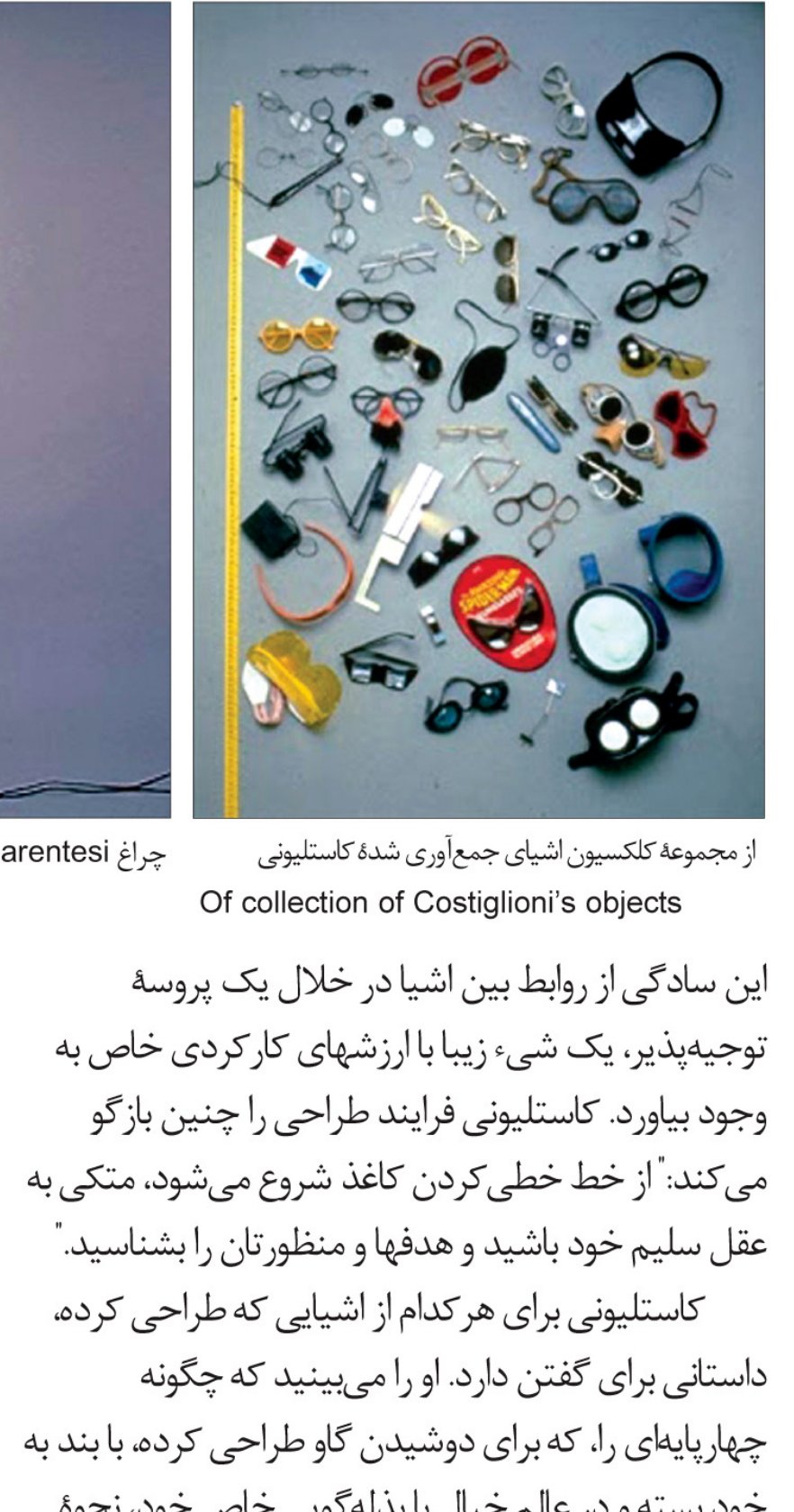
Castiglioni has a story to tell for every object he designed. You see how he ties to himself a stool he designed for milking cows, and in his imagination, with his particular wit, shows the way to use it during milking; or how, for the Slick plastic knife — which he designed for Alessi14 to extract mayonnaise from its bottle — he has a story about his own difficulty with mayonnaise remaining on the bottle's walls. Paola Antonelli15, the curator of the Department of Architecture and Design at the Museum of Modern Art in New York — herself once Castiglioni's student — recalls his collection of "found objects": one day Castiglioni came to class with a large black bag, like Mary Poppins's16 carpetbag, and spread its contents — part of his astonishing collection — on the table. A toy made from an empty soft-drink can he had bought from Tehran; spectacles and eye-shades of strange and bizarre appearance; galoshes he had bought from Russia; a stool from Aspen17; ladles and strainers — in Castiglioni's view these were the most influential things in design education. In class he showed his crowd of students the inventive and vernacular beauty of these objects, and often repeated: "What you need is a stable and steady manner in design, not fashion."
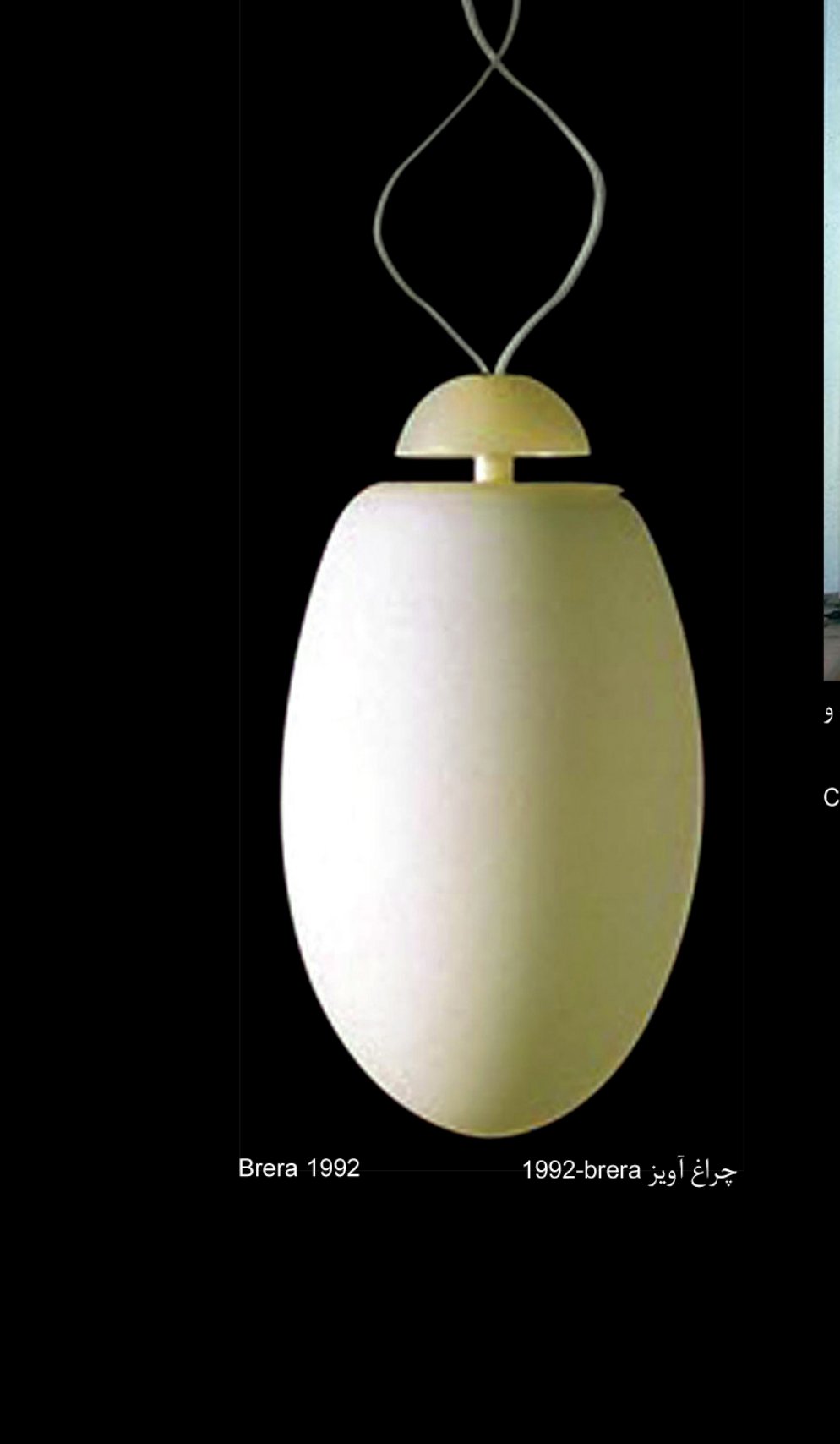
Castiglioni has always been focused on the design process and on finding the solution. His design relies on a narrative mode that runs through the results and the solutions offered in his designs. Castiglioni showed that form and function are inseparable parts of good design, but cannot be the only factors a designer considers. His endless flexibility allowed him, over nearly half a century, to design hundreds of different objects in various fields.
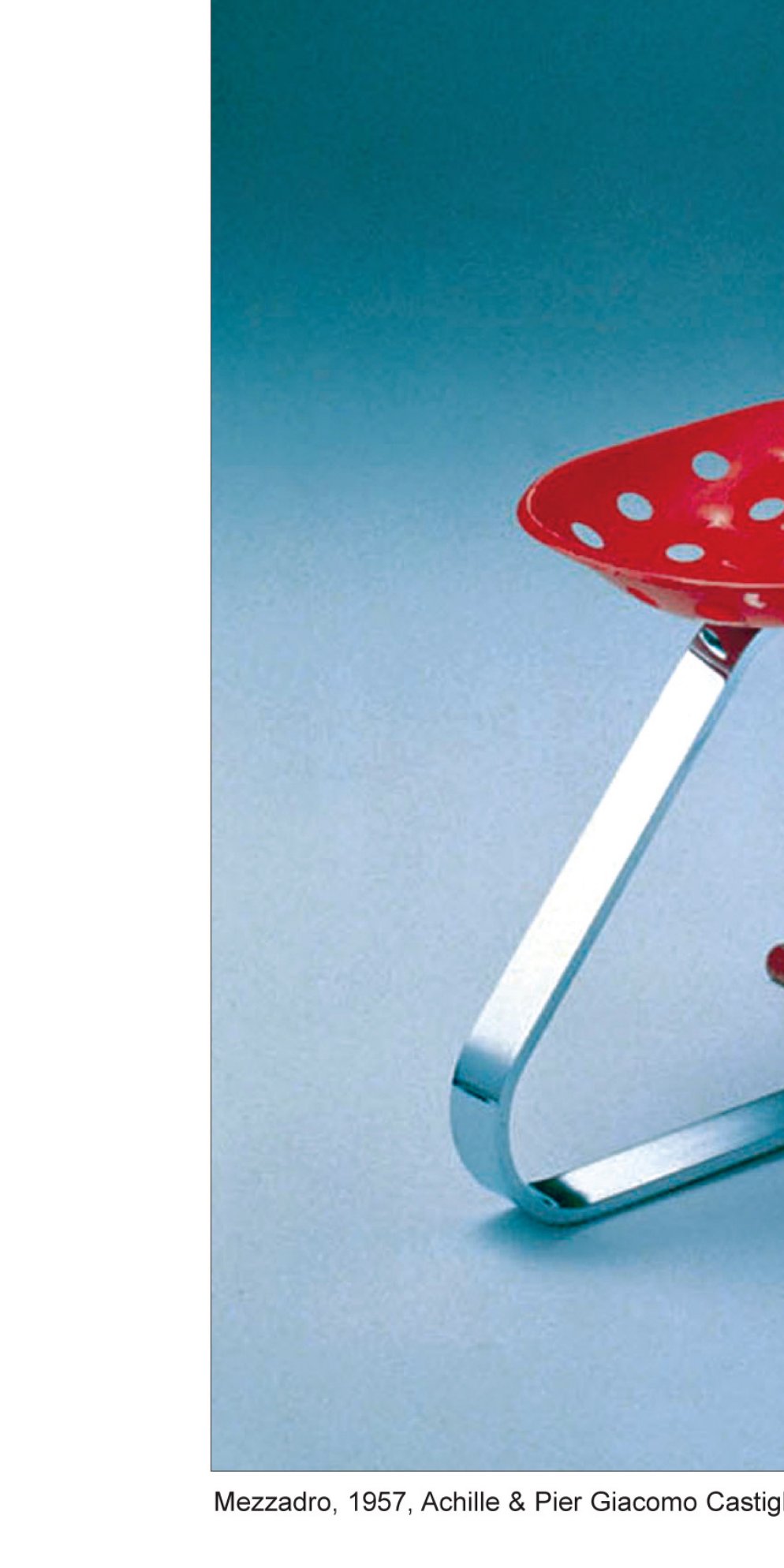
He himself believed that his works in different periods belong to different styles. Sella belongs to the category of objects made from existing objects. Mezzadro18 is a stool made from a tractor seat, a base of metal strapping, a wooden cylinder, and a wing-nut. So too the Toio lamp. He defines a part of his works in a group of refined and improved designs of existing traditional objects, such as the Comacchio19 chair and the Spirale20 ashtray; minimalist designs such as the Luminator21 lamp, consisting of a bulb and socket, a tube, and three small feet. The Snoopy22 table lamp and the RR126 stereo system, with their distinctive anthropomorphic design, can be placed in his expressionist works. And of course his Spalter23 vacuum cleaner of 1956, with its arc-shaped body, and the VLT24 light switch of 1968 are practically among his integral projects.
- Achille Castiglioni
- Vico Magistretti
- Ettore Sottsass
- Bauhaus
- Marcel Duchamp
- Fountain
- Man Ray
- Toio (lamp)
- Sella (stool, 1957)
- Sforza Castle (Milan)
- Società Esercizi Telefonici / exhibition pavilion
- Flos
- Arco (lamp, 1961)
- Alessi
- Paola Antonelli (MoMA)
- Mary Poppins
- Aspen
- Mezzadro (stool, 1957)
- Comacchio (chair)
- Spirale (ashtray)
- Luminator (lamp)
- Snoopy (table lamp, 1967)
- Spalter (vacuum cleaner, 1956)
- VLT (light switch, 1968)



