In the last few years in Iran, a worldwide trend that has permeated architecture has continued to cut culture from today's contemporary architecture. Many of these works look like a stream of colorful forms. Designs that in one way focus on the formation of regionalist design and also tend to reject to at least uphold a certain sense of respect for native heritage against contemporary trends.
These architects, considered as Regionalist critics, offer a different view. They have freed themselves from the common style of nostalgic elements of an architecture museum. These architects consider their designs based on different cultural and social footprints found in literature or other media.
This article reviews the work of one of Iran's well-known architects, Seyed Hadi Mirmiran, who has achieved an interesting combination of Iranian and contemporary architecture which embodies Iranian culture with today's equipment.
What does it actually mean? The most important factor for beginning a design, according to Mirmiran, is the "focal point of the project." This means the demands of the project and the site and the land it is built on, the starting point, the focal point and its context should be at any of these points and can be a form, a concept, a poem, or a myth and sometimes a combination of all the mentioned.
Mirmiran's design proposal for Massoumeh's Holy Shrine (2001) shows his concepts very clearly. In this proposal, we can see three of his concerns: first, his tendency to give a spiritual feeling to the design by its simplicity; and then the regional and national elements suggest that the concept and the form have undoubtedly been inspired by the desert. At the same time, he has achieved contemporary design simultaneously.
The trend of what became known as Critical Regionalism emerged in the early 1980s. After the initial period, a new generation of architects became prevalent who once again offered a different perspective on regionalism in architecture. This new generation, instead of merely replicating traditional forms, sought to establish a deeper connection between the building and its cultural and geographical context.
Mirmiran (born 1945) is one of those architects whose work demonstrates this approach. His design for the Iranian National Water Museum (1988) serves as one of the earliest examples. The building's form grows from the landscape, referencing the desert geography while maintaining a thoroughly modern vocabulary. The museum employs local materials—brick against concrete—creating a dialogue between traditional and contemporary construction methods.
In his design for the Imam Mahdaviyeh Cultural Hall in Qom (1998), the architect draws on the spiritual and cultural significance of the site. By referencing the distinctive features of the Qom region and drawing inspiration from the desert landscape, the salt lake, and the wave forms created by hot desert winds, Mirmiran shaped the dominant forms of the work. Yet simultaneously, we see his effort to deliver work that is "contemporary" and even global in its reach.
The Mako City Cultural Center in the Khuzestan Province (1999) represents a work with similar concerns but in an entirely different corner of the world and in a wholly different cultural context. Yet looking at this cultural center, we see the same approach. Mirmiran, who in another part of the world and in a different cultural setting finds different concerns, materials, and vocabulary, nonetheless manages to create buildings that are at once firmly rooted in their local context and unmistakably modern.
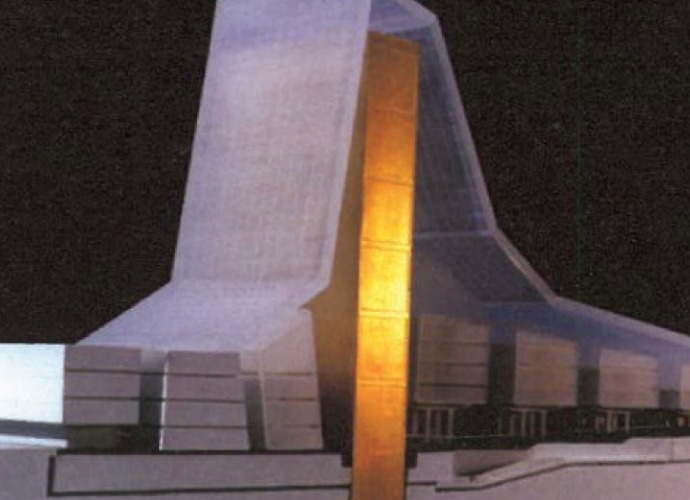
The formation of the National Library of Iran design (1995) is one of the most telling examples of Mirmiran's approach. In this competition entry, the architect sought to create a form that would simultaneously reference Iran's rich cultural heritage and project a vision of modernity. The peaked form of the building, rising dramatically from its base, suggests both the mountain landscape of Iran and the open pages of a book—the fundamental symbol of a library's purpose.
The use of glass and steel in a monumental form creates a building that is undeniably contemporary, yet the proportions and the relationship between solid and void echo traditional Iranian architectural principles. The golden lit entrance slot that bisects the main volume references the concept of light as a spiritual element in Persian architecture, recalling the light wells of traditional Iranian buildings.
What is fascinating is how this question becomes clear when you see the apparent similarities between the Central Library of Riga (Gunnar Birkerts) and the National Library of Iran (Mirmiran). Considering the design of Japan's national library, one should question if neo-national positions can carry out regionalist designs with respect towards the cultural and local culture.
The author concludes that the answer might be found in what is called "polidentities" and considers that today many architects are more flexible in design and do not attach too much importance to frontiers.
By using familiar cultural elements, these approaches and architects try to give cultural responses to their designs, led on by the way they are actually close to today's architecture, and the impression they leave on the viewer is a glance. The author notes this contemporary moment focuses on projects that on their own are actually enough to classify it as regionalism.
All of these works demonstrate that today's architects, at least in Iran, are concerned both with establishing a relationship with the region and creating an architecture that is contemporary. But the appeal of each of these works is also the concern of referencing the cultural and historical context while achieving harmony between the modern and the global.
In a brief explanation published about his Shiraz office, the architect states his guiding principle: the office's treasury (founded in 1998) takes the form of a compass, pointing in all directions simultaneously. In this project, the issue of how to bridge past and present becomes a living question, not merely an academic exercise.
Mirmiran's work in various cultural and climatic contexts across Iran—from the desert cities of Qom and Isfahan to the lush landscapes of the northern provinces, and from sacred sites to secular public buildings—reveals a consistent philosophy: architecture must be rooted in place yet speak a universal language. His buildings neither retreat into nostalgic historicism nor abandon their cultural moorings in pursuit of international fashion.
References:
- Critical Regionalism
- Art and Craft
- Hermann Muthesius
- Das englische Haus
- Bund Saal Heimatschutz
- William Richard Lethaby
- Vicky Richardson, Avantgarde and Tradition, Die Architektur des Kritischen Regionalismus, Kohlhammer 2001, P.110
- Sigfried Giedion, Space, Time and Architecture: The Growth of a New Tradition, 1967
- Kenneth Frampton
- Kenneth Frampton, Towards a Critical Regionalism, in Perspecta 20, 1983
- Irsi Makowecz
- Irene Makovecz, Avantgarde und Tradition, Die Architektur des Kritischen Regionalismus, Kohlhammer 2001, P.126
- Mako
- Gunnar Birkerts
- Vicky Richardson, Avantgarde and Tradition, Die Architektur des Kritischen Regionalismus, Kohlhammer 2001, P.204