



When I was a student in America we had a course called "Ethics in the Profession". This course taught the manners, regulations and morals concerning the profession of architecture. For example, on the matter of financial conflict between contractor and client, we learned that the architect's interests are not the same as the contractor's. The architect, vis-à-vis the contractor, defends the interests of the client. The client alone supplies the architect's fee, and ignoring this principle gives rise to all sorts of problems and conflicts for the client. The matter may seem self-evident and trivial, but knowledge of it has been considered indispensable for any beginning architect. When I was working in Iran, my partners — who looked after the firm's accounts — once told me: "Better to accept the suggestion of certain members of the technical office of the relevant ministry, that we hand over the preparation of the mechanical drawings to them as a 'second-hand' job, so that the executive work is approved more quickly." I replied: "Gentlemen, we have set up a mechanical-services section ourselves precisely to ensure technical coordination. How can we hand the work over to outsiders? This is unacceptable; it is a kind of extortion!" One of my partners said: "But sir, do we not want our work approved as soon as possible, and not to be drowned in the administrative quarrels of the technical office?"
After much back-and-forth I finally suggested that, instead of giving them the second-hand profits, we pay them the equivalent and be done with it — for I would never agree to relinquish the technical responsibilities. Of course I was told that they were greatly offended by this proposal and considered it insulting.
In the architectural and technical culture of those days, then, signing an illegal contract under threat was permitted, but earning the legitimate profits of the work was not. In the "professional ethics" we had been taught, however, such a payment — whether as work or as cash — was held to be both equally illegal and equally corrupt. The question for me was to find a way that would not damage the technical execution of the design. The other party thought that receiving economic returns without effort was forbidden, but with the expense of time and effort the same returns became acceptable. Suppose, then, the practice of giving "second-hand" work to the technical office of the public client (or even of the private client) — at that time considered an ordinary thing by many — were to spread; in the moral code of architecture it would, openly or in secret, become normal and professional. The trouble is that when the profession is silent on questions of this sort, and when there is no codified ethical regulation, right and wrong cannot be told apart, and on the argument that "everyone does it" any illegal or unethical act becomes acceptable and justified.
Architecture and the past — and Jasper Johns
One of the headings of "ethics in architecture" is the architect's relation with other architects and with the works of past architecture, and the determination of our duty in safeguarding the legacies of past architecture. Suppose a project is offered to us in which a piece of architecture worth preserving and worth repair and restoration exists. Are we entitled to demolish it and build our own work on top of it? Is the protection of the outstanding works of past architecture, or even the outstanding works of our colleagues, one of the basic columns of our profession? Or are we, under all circumstances, only there to execute our own works?
In contemporary Western painting we have a few examples of trespass against the work of another. In the 1950s a young painter named Jasper Johns received a pencil drawing from a previous-generation painter named de Kooning (the works of both these well-known painters are in the collection of the Tehran Museum of Contemporary Arts). The said artist erased that drawing and drew on top of it. The matter caused much commotion in the small art world of the day. Likewise, thirty years ago an Iranian-born Armenian artist named Tony Shafrazi did something even stranger — what was, in fact, a kind of art-terrorism. With a spray-paint can he entered the Museum of Modern Art in New York and, on a rare opportunity, wrote on Picasso's great Guernica: "lie, complete lie." Shafrazi — today a friend of mine and one of the important New York gallerists — had meant to do something artistic; the result was, of course, prison. He had not done it to oppose Picasso or modern art, but rather, in Andy Warhol's words, "every man can be famous for fifteen minutes" — perhaps Shafrazi wanted to be famous. Fortunately the great Picasso painting, one of the outstanding masterpieces of modern art, was cleaned immediately.
Poetry and architecture are a rich part of the art and culture of our country. I think we are all roughly in agreement on this. Poetry has a special place in our public and intellectual culture. We know our poets, we memorise their poems, we constantly turn to them. Poetry carries philosophical and social messages and ideas. If anyone tampered with another's poem — old or new — and changed its words and "embellished" it in his own style, we should be astonished. That work is wholly intolerable and unacceptable.
In architecture, however, this is not the case. We do not know the architects of the past, and we set no value on or respect for their works. Architecture in our country is fundamentally taken to be a consumable product that, after a while, can be demolished or rebuilt. Of course the growth and development of the city makes such changes necessary, but if every new generation defines its duty as the demolition of the previous generation's works, no trace of the past will remain.
Recently the journal Memar proposed that I have new photographs taken of my projects in Tehran. I should say that for twenty-five years I had been waiting to see a photographic report on several projects — Shafagh Park, the Niavaran Cultural Center and the Special Office — and I had even directly requested photographs from the Museum of Contemporary Arts. The first sight of these old works — works which, for any architect, are like one's own children — was a shock. I decided to write an essay called "Unnecessary Trespass against Architects' Works". Then I thought it better to write it in another form: as a kind of unburdening of the heart with my fellow architects, that might at the same time serve as a lesson for the apprentice architect. For that reason it is necessary to enter into the design details and explain the manner of trespass.
Shafagh Park and Cultural Center
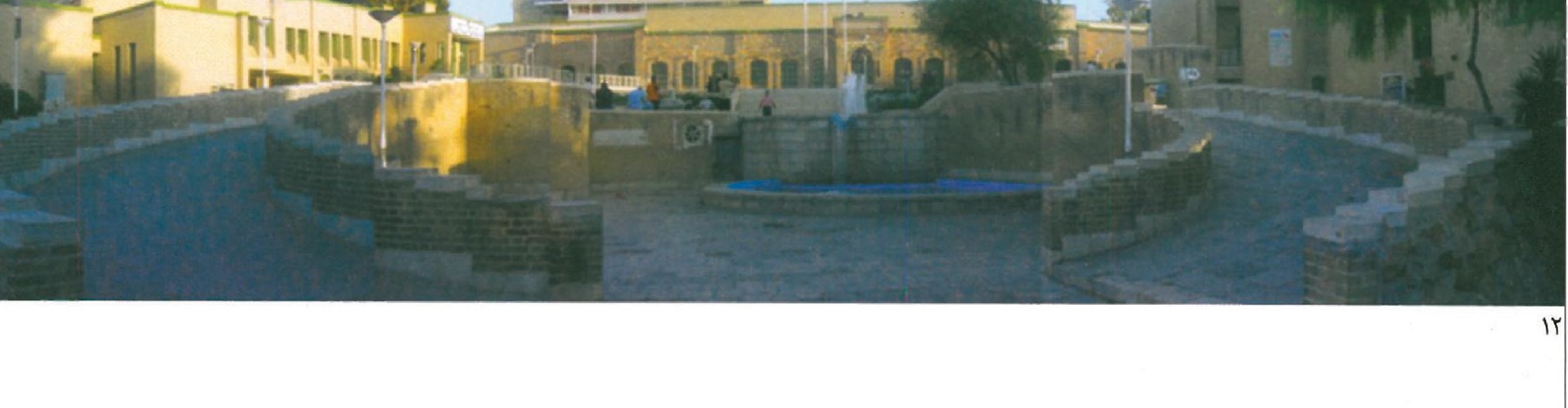
In this design I tried to lay the foundation of the first cultural centre in Iran — a kind that you see in its more developed form in the Niavaran Cultural Center. At that time landscape architecture, garden-making and the design of urban parks were not topics of discussion in Iran. Specialised disciplines of urban architecture, garden design or landscape design did not yet exist. The project was, in effect, a souvenir from abroad and an example of one way of working and thinking in this field. One of the valuable aspects of this work was the preservation of the old building, which at the time was condemned to demolition. I think that, even with a flashlight, you would not find a similar small-scale building of that period in Tehran today. From the Court Minister down to the local mayor, pressure was exerted on me to demolish it: one wanted the view from the Vatican Hospital window to the north opened up, the other refused to acknowledge the value of the architectural tradition. As an architect at that time I felt slightly guilty for depriving the hospital of its view of the park — for it was said that the foreign architect of that hospital, together with his Iranian partner, had selected and designed the hospital site knowing perfectly well that the building would be demolished. Today I am very pleased that, with a small intervention to its façade, I extended this old building and preserved it. To tell the truth, it is more handsome and more dignified than my own buildings, and is free of the youthful artiness that mine carry. (Figure 1)
In the new photographs the lamps for which we had bargained with the blacksmith have entirely disappeared (Figure 2). The waste-baskets I had designed — which were, in fact, a copy of a famous Danish litter-bin — have also disappeared, and the weeping willow that was to throw a romantic shadow at the front of the building has been replaced by a "grape-cluster lamp". Worst of all, an ugly sign — the signage of the city library's façade — has rendered the building unfit to be photographed for architectural journals. We use the best artists for posters that may decorate the city's streets and lanes for one month, but for the first cultural centre built in Iran we set graphic design entirely aside.
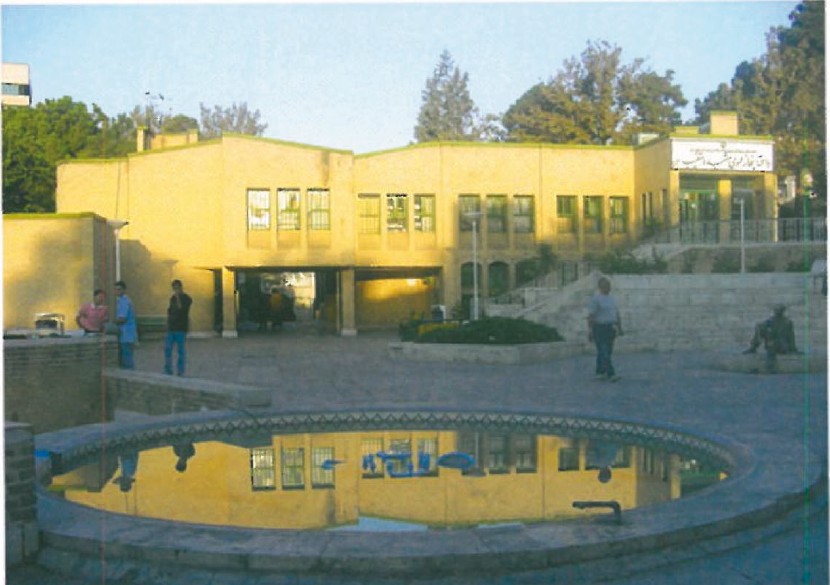
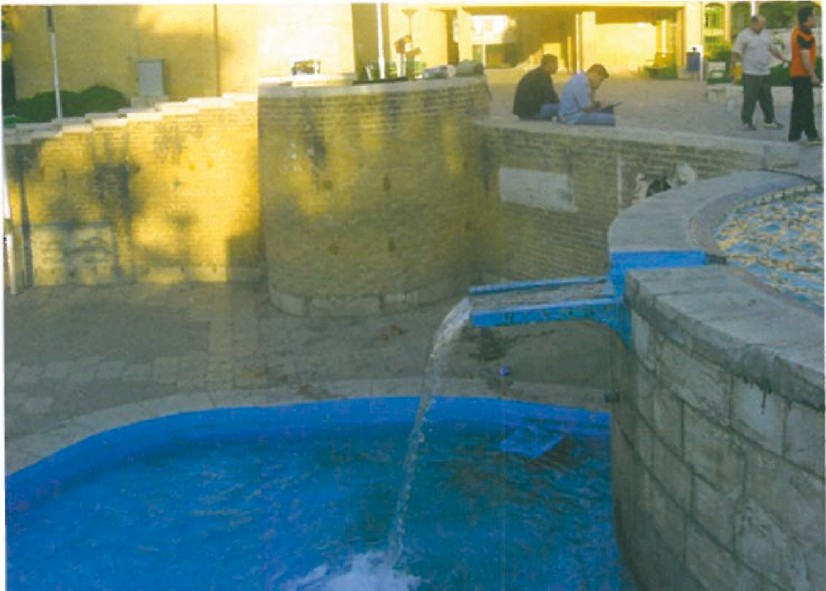
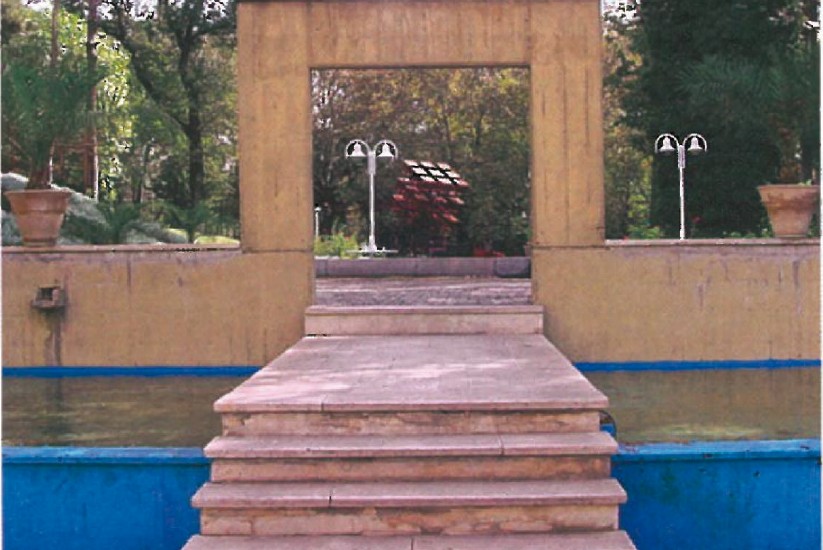
More importantly, I would advise my fellow architects: do not build a stone fountain or a stone water-feature, especially for the municipality, since that organisation purchases several tons of blue paint each month, and certain of its workers (who might better wear blue uniforms) paint anything that has to do with water blue. Perhaps to make sure that the existence of water is well "appreciated" they ought to write the word "water" at the bottom of the basin so everyone notices it. The word for blue (ābi) comes from the word for water (āb). If "water" already means "blue", what is the point of using offensive chemicals to "explain" the existence of water? Even painting and tiling within a fountain is a kind of fight against the integrity of water. In our architectural tradition we do tile façades; but tiles with patterns inside the fountain itself we have nowhere seen. All this preamble was so that I could say: in Shafagh Park there is a small basin made — inspired by old buried earthenware vessels with a long pouring spout — and now they have painted the spout blue, separating it from the rest of the basin and drawing attention away from the cascade to a bad colour that has no place in either traditional or dignified architecture. (Figure 3)
Niavaran Park and Cultural Center
Now let us pay a visit to the Niavaran Cultural Center and the adjacent park. This design includes the area in front of the Special Office building. This park was originally a corner of an old garden of old Shemiran. Such gardens were once plentiful in Shemiran in the early forties (Khorshidi calendar); landlords and certain villagers of Shemiran who worked in Tehran would, in the heat of summer, leave Tehran for several months and move their lives up to the Shemiranat — spending their days under the great plane-trees and beside the running water of the qanats, and their nights under a starry sky or beneath mosquito-nets. The Niavaran garden had no old building, but its relatively large pool and its many small basins and water-channels had been laid out in the style of important historic gardens. One of the aims of the new design was to keep the modern architecture separate from this landscape, to preserve the landscape as a document — and at the same time to return to the past, to a Qajar-era garden. So I tried to keep the calm, the silence and the dignity of the place. (Figure 5 — main entrance to Niavaran Cultural Center and park.)
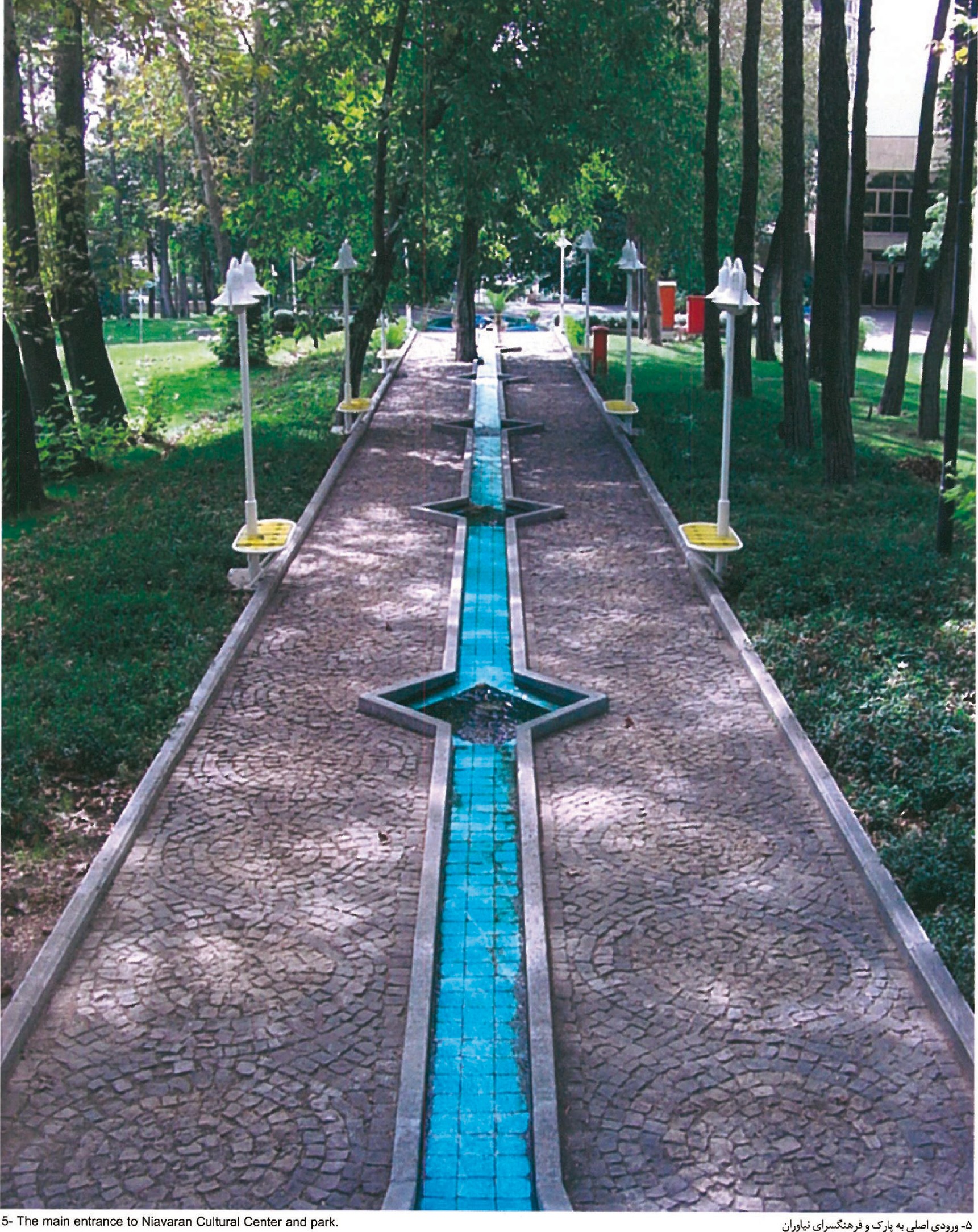
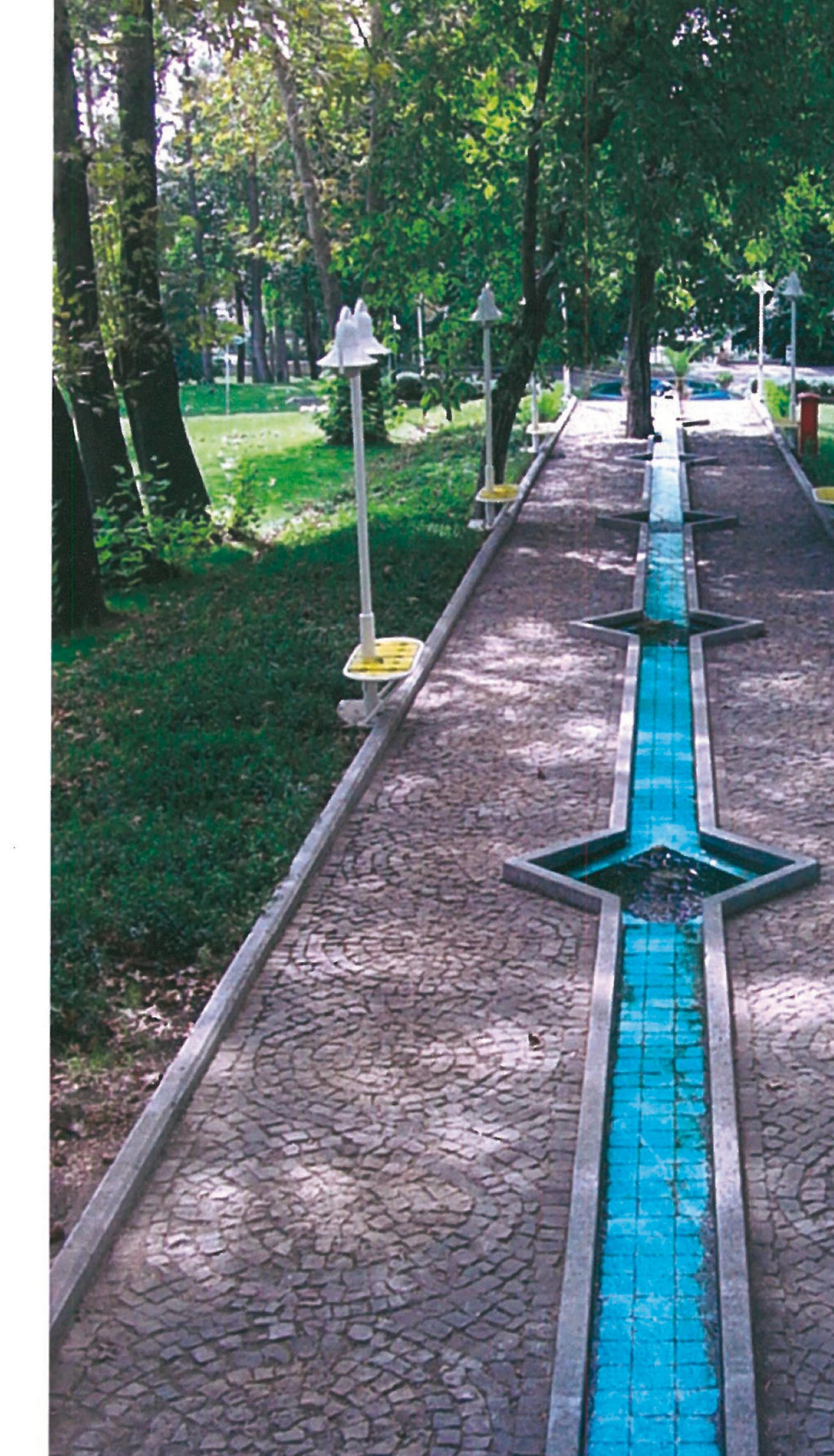
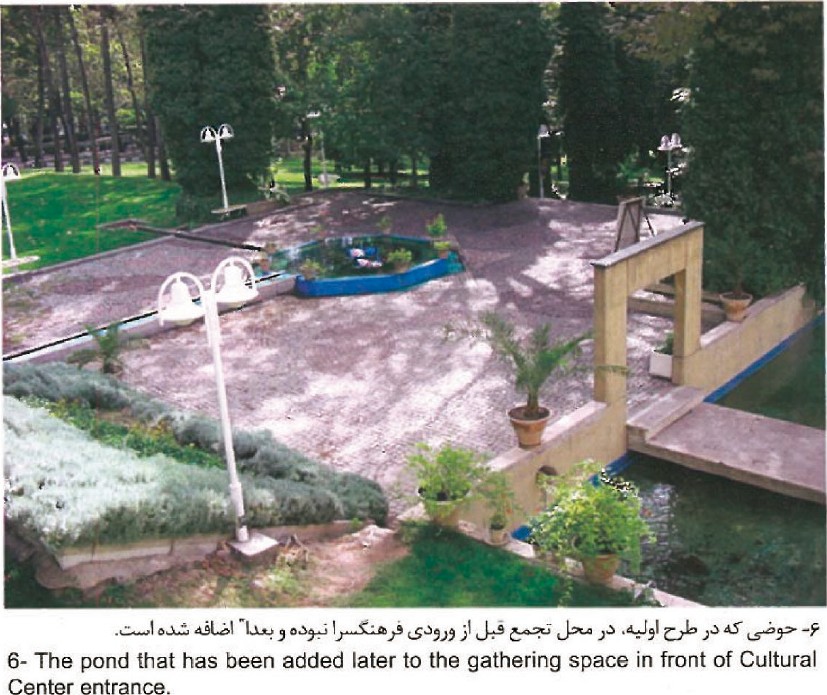
If we now look at the present state of this place, we will undoubtedly see a merciless trespass against the original idea. The image of the present state is more suited to a jazz festival or a "rooḥowzī" street-comedy than to a Qajar garden. An effort has been made so that people can use rubbish-bins without any inconvenience and so that, under the bright lamps, surgical operations can be performed. The "blueists", of course, have done their share. Likewise, one of the eager colleagues has thought it necessary to extend the five fountains. There was a wisdom in the choice of five fountains — like the five holy persons; I had purposely changed four to five. Our colleague has decided to "extend" these fountains, drawing them all the way to the navel of the cultural centre. Imagine what relation a circular pool with surrounding flower-pots has with the adjacent gateway, bridge and water-feature. God knows. One reminds you of the Bauhaus, the other of "Auntie Amerieh's grand courtyard". (Figure 6)
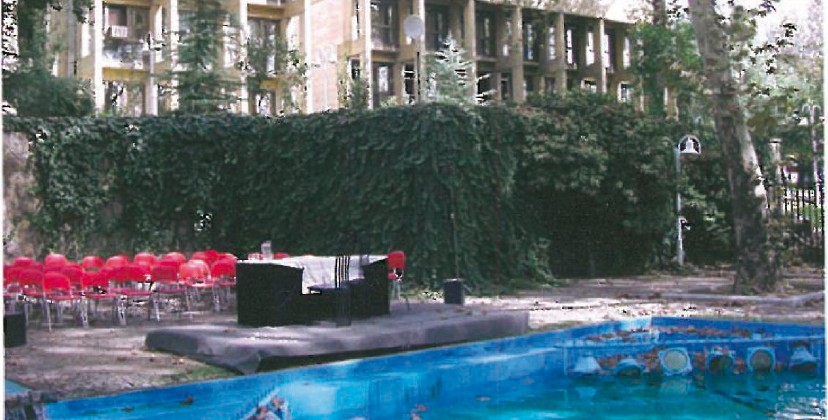
As a result of this trespass the gathering space before the entrance to the cultural centre has been turned into a narrow strip around a pool and has lost its real function. We must also remember the "strike-team" of bridge-builders, since without their presence no public space is complete. A bare concrete bridge had been envisaged for this passage, but the authorities thought it should be covered with stone tiles, like the rest. I hope no one loses his balance and is shamed there. (Figure 8)
For Shafagh Park we spent much time on the lamps. Here, since at that time it was possible to import certain things without customs supervision, I made a journey to Italy in search of suitable lamps. In summer, at the wedding of one of my Iranian friends in Genoa, a lamp caught my eye. After much searching I selected and purchased that lamp — its design was very simple — for this complex and for the Tehran Museum of Contemporary Arts. The municipal engineer has now made these expensive Italian lamps disappear, and you can see the result for yourselves.
A small note on the buildings — and a closing question
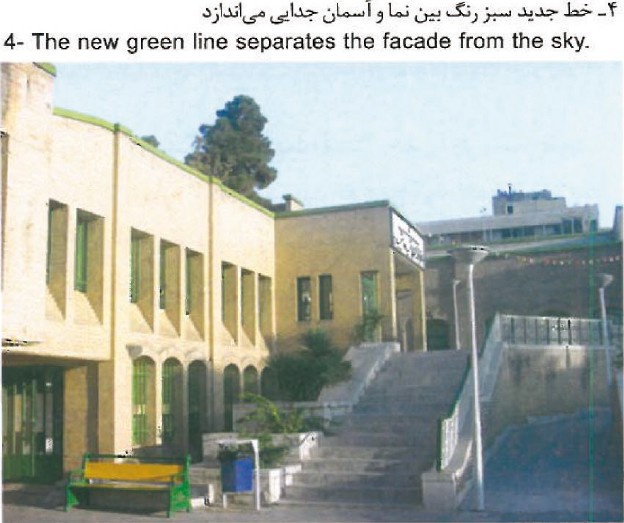
As for the buildings: of course they have been somewhat repaired, and a section has been added to the exhibition hall that is very intelligently designed and does not damage the original scheme — it even completes it. This work was carried out by the engineer Hamid Nour-Keyhani and his colleagues. To avoid harming the volume and personality of the original architecture they have done the renovation and extension in the best possible way. Whether this is a thoughtful and conscious professional act, or because of Mr. Nour-Keyhani's friendship for me — I think the second reading is the truer. There is, however, a single mistake in the restoration: the green line above the building (Figure 4). One of the aims of the design of these buildings was the unity of the wall and the finishing of the elevation in white stone — for brick cannot be exposed to the air without a top course. The aim, in practice, was that no separation should appear between the wall and the colour of the sky! But a continuous green line — even if the colour itself is good — has an effect contrary to that aim. I think that, to protect the brick on top, an invisible galvanised flashing would be far better.
But what is the use of these critical, seemingly trivial stories? Perhaps to give architects greater awareness, and to point out the necessity of codifying an architectural ethics and culture and teaching it to apprentices. Recently in one of the foreign journals I saw a project by a doctor and university professor, an Iranian, with whom I once had an intimate relationship: do you know what the project was? The demolition of a public park designed by myself, and the proposal of a new design without any change in its function or programme. Is this the result of a shortage of work, or a passion to wipe out the works of others? Perhaps, indeed, the only opportunities for work in our country lie in trespass and demolition of the works of architect-colleagues?
But the reality is the absence of a culture of modern architecture. Last week I was on the telephone with a former colleague of mine — fortunately he is in charge of completing one of my important buildings. The design for that building has not been entirely executed, so its central courtyard remains unfinished and needs covering. In conversation, my old colleague said he was busy completing the building, but he still did not know whether to make the central covering as a dome or a pyramid! But why not according to the original design? A design that has been published in the journals and books of architecture? Could one imagine a publisher asking a writer: "I still don't know — should the end of the story be sad, or merry and pleasant?"
Printed English summary panel (PDF 10)
Kamran Diba — mostly celebrated for the design of the Museum of Contemporary Arts, Niavaran Cultural Center, and many other projects built before the revolution — while insisting on the importance of architectural culture and architectural ethics, points out the interventions that has affected the quality of the parks and buildings designed by him. He tries to make the young architects realize the necessity of accepting the modern culture and ethics of architecture. From his point of view, such interventions are similar to altering the words of a story or a poem.