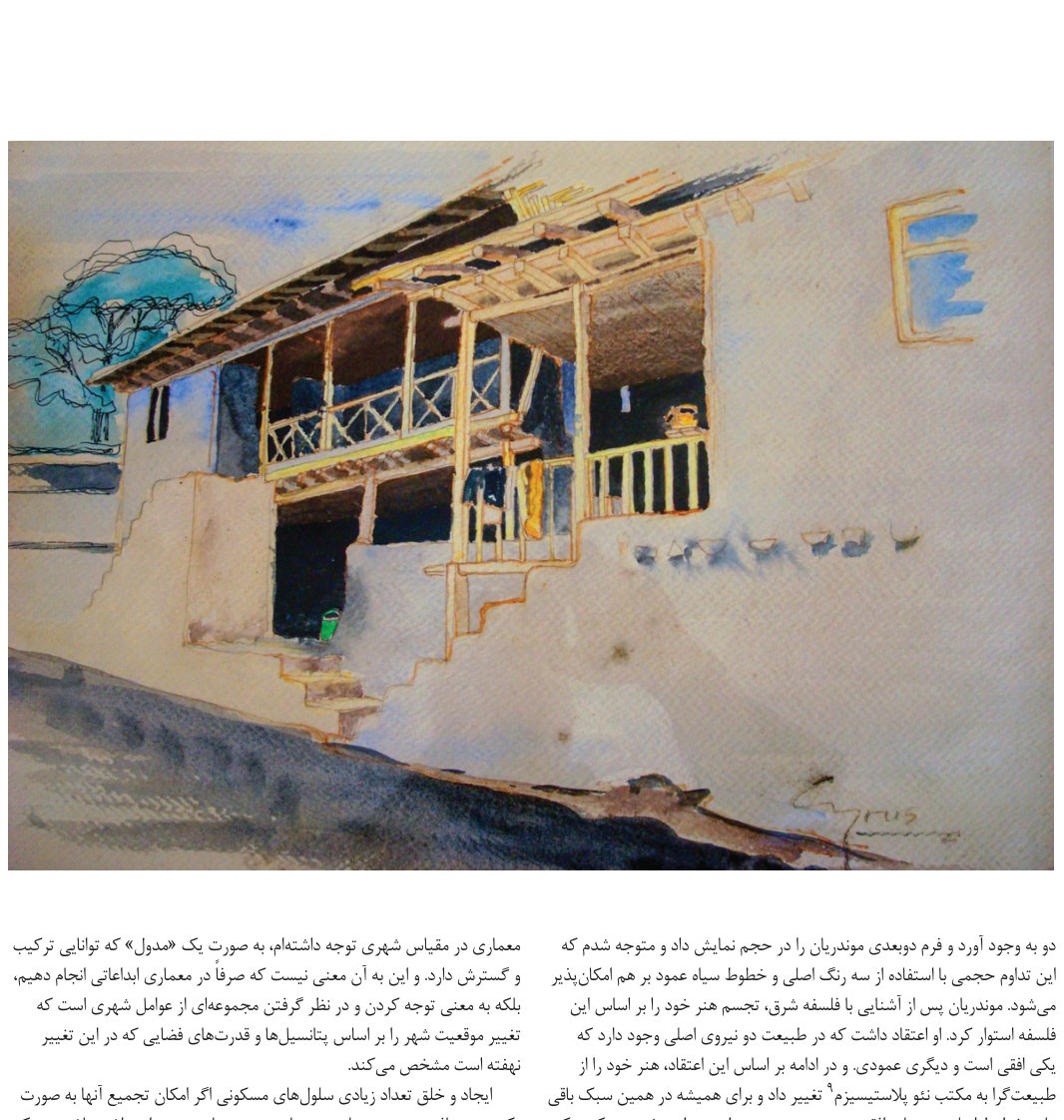
to create a two-dimensional form and display Mondrian's two-dimensional composition in three dimensions, and I realized that this volumetric continuity could be achieved using the three primary colors and black lines perpendicular to each other. After becoming acquainted with Eastern philosophy, Mondrian grounded his artistic vision upon this philosophy. He believed that two fundamental forces exist in nature—one horizontal and the other vertical. Based on this belief, he subsequently shifted his art from naturalism to the Neo-Plasticism movement and remained in this style for the rest of his life. The primary lines of horizontal and vertical forces define the boundaries of surfaces that Mondrian represented with primary colors, and by strengthening the lines of these perpendicular forces—horizontal and vertical—in varying thicknesses, thin and thick, he imparted a new dynamism to his artistic work. From our perspective as architects, behind these thin and thick black lines and the yellow, red, and blue planes, dimensions can be observed that depend on the penetration range of the color spectrum. Mondrian believed that every figurative composition can be reduced to proportions between right angles and segments of pure color, or to plastic volumes on a plane, or to a harmony of coloring in relation to black and the other primary colors of yellow, red, and blue. The influence of Mondrian's art can be seen in the architectural works of Theo van Doesburg and Mies van der Rohe, which later came to be identified as the principal characteristic of European Rationalist architecture. I see these same characteristics in the vernacular architecture of Iran, Yemen, and certain regions of Mexico, where perpendicular surfaces are constituted by vertical and horizontal lines—namely the wooden columns and beams—forming volumes that create the basis of architecture in those regions. Solid and void volumes, white or colored surfaces, vertical and horizontal wooden beams, semi-open balconies carved from the interior of cubic volumes, and many additional expressions arising from the combination of these elements lend a dynamic quality to the building. Like the villages of Ziarat, Abyaneh, and Masuleh, each possessing its own characteristics—yet while similar in terms of materials, color, and technique, they are compositionally distinct. My gaze upon architecture has never been solely for the sake of architecture itself; rather, I have always
paid attention to architecture at the urban scale, as a "module" that possesses the capacity for combination and expansion. This does not mean that we should merely make innovations in architecture per se, but rather that we should attend to and consider a totality of urban factors that determine the transformation of a city's position based on the potentials and spatial powers inherent in that transformation. The creation of a large number of residential cells, if they cannot be aggregated into a unified fabric identity, can have no meaning on its own. "Housing must be created for the human being who lives in it, and for this reason it must be aware of its power of impact on the world and must respond to real needs and social life while taking into account the private lives of individuals." It was therefore necessary to offer solutions from flexible housing models at the architectural-urban planning level, with public and service amenities that possessed qualitative and quantitative dynamism. In the old architecture of Iran, and in all these composite ensembles, one distinguishing factor exists: the attention to human scale. From the room—which is one cell of a house—and the house—which is one cell of a building complex—to larger ensembles, we can discern the dimensions of a house and within it the dimensions of a room. This manifestation of composite architecture is the product of a composite, organized, and systematic society that existed in ancient times, originating from cooperation within the system of "labor." Its influence on the creation of urban architecture manifested as buildings that were fluid, uniform in color, harmonious, and level. This continuous composite fabric, both in plan (visible in aerial photographs) and in elevation—composed of interwoven and merged cubic modules—no matter how expansive, maintains a thoroughly human and harmonious scale. In plan, the houses that represent families justify themselves through solid and void spaces, and in elevation the boundaries of certain rooms and porches, expressing closed and semi-open space, define the limits of one cell within a house. In each
of these solids and voids, or projections and recesses, at angles and corners—in most regions where wood was available—wooden columns have been placed separately from mud-brick or rammed-earth walls in an exposed manner, with the main wooden beam resting upon them and then secondary beams resting upon the main beam, so that the entire skeleton of the building, the movement of forces, and other space-dividing elements—the solid portions representing enclosed space and the void portions representing semi-open space—are all revealed, and in this way the architecture achieves its own distinct expression and school. This architecture possesses a particular geometry based on the element of the "cube," composed of vertical and horizontal lines and the surfaces between them. The visibility of the structural skeleton, separating itself from the spatial envelope, lends a dynamic expression to the overall architectural appearance. All these studies and research gave me the opportunity to reach the conclusion that the elongated, full-width windows that were fashionable at the time were not suitable for Iran's climate and weather, and that interior spaces received more light than necessary, so that other means were always needed to control the excessive penetration of light into living or working spaces. One could, by creating apertures in the facade, control the appropriate light for interior spaces and cover the remaining facade surfaces with walls separating inside from outside—in the same manner we observe in the body and volumes of traditional architecture. Engineer Mehdi Alizadeh was a good encourager and guide for me in this regard, and during our comprehensive discussions he would say that in traditional architecture, a single aperture was sufficient to deliver adequate light to the space of one cell of a house. This appropriate light provides relaxation, comfort, and protection for the house's inhabitants. With the conclusions I drew from all these considerations, the form of a house gradually took shape in my mind, and I saw it outside the usual and customary conventions. Because the architecture of that time consisted of designs built only within the confines of a subdivided plot along city streets, with no harmony whatsoever with neighboring buildings, even if designed by the same architect. I endeavored to arrive at an example of spaces and volumes that, in their totality and at larger scales, would create an order and system possessing relative flexibility and fluidity of forms, while ensuring that, thanks to the harmony of materials and technique, property lines and boundaries would be invisible in the architectural form. My understanding of Iranian architecture was not the use of form-giving elements in an isolated and abstract manner; rather, my attention was directed toward the spirit, sensation, and spatial expression that these volumes created in relation to one another—placed in a harmonious and connected manner with other urban elements, complexes, axes, focal points, and open nature. The influence upon me of what I saw and analyzed and explored in my mind manifested itself as a dynamic, flexible, and fluid architecture. Years ago, in a conversation with Dr. Katouzian on this subject—published in Memar magazine—he offered the following observation: "These works can be divided into two categories: urban works executed within the urban fabric, and villa-type works built on large plots in the urban periphery. The urban works, while being very free and fluid, follow the characteristics of the Rationalist school. They are cubic volumes in motion. These volumes create a kind of spatial module, yet they also have facades, and these facades, while having their own personality, possess a particular duality. In the urban works, rationalism is visible in the exposure of the structural skeleton, which is sometimes steel, sometimes concrete, or a combination of both, depending on the economic conditions of the time. The cubic volumes are strengthened and made more prominent by the building's skeleton. Through the use of brick, this work draws closer to the inherited brick architecture. The urban works display a kind of pluralism in subject matter that, like music, is constantly
changing and often bears no resemblance to one another. The villa works are organic and have been executed just as freely and fluidly, as if the mind has moved with the hand. These works are full of feeling." From the result of all these factors a composition emerges that we may call "dynamic dialectical architecture." The aggregation of such spaces, which creates the urban ground and fabric, is precisely "the organized and systematic Iranian cities." On this subject, I published an article in the newly founded journal Human Environment, which was among the activities of the urban planning teaching group at the Faculty of Fine Arts of the University of Tehran, in the year 1349 (1970). Because of my teaching at architecture faculties (courses in the History of Urban Planning and History of Modern Architecture), I was active in the field of urban planning from 1349 to 1353 (1970–1974). In the History of Urban Planning course, while studying many European cities that had been destroyed during World War II and preparing urban planning projects for their reconstruction, I also began studying and researching the desert-edge cities of Iran. I then took on the supervision of the Shiraz Master Plan (Phase Two), followed by the supervision of the Yazd Master Plan (Phase One), and simultaneously prepared the plan for the industrial city of Saveh, which continued through to the urban design stage. The translation of the book History of Modern Architecture by Professor Leonardo Benevolo was also among the activities of this period, during which I simultaneously held responsibility for the fourth-year architecture studio and also reviewed a large number of student diploma projects. In the early 1350s (1970s), I began very interesting research: "A Study and Survey of the Course of Architecture in Tehran," through which I succeeded in collecting the various periods of architectural changes and transformations in relation to social changes and ways of life from the Constitutional Revolution to 1357 (1978), and with the many photographs I had taken of buildings from different periods, I published the book The Course of Iranian Architecture from the Constitutional Revolution to Today's Social-Political Revolution. These studies took approximately seven years. In my opinion, the most brilliant Iranian architecture of this period belongs to the time when Abkar, Vartan, and Budaghian were active in architectural practice, and unfortunately today only a few of their works remain in scattered corners of the city, whose fate is clear. I recommend that the relevant government organizations preserve and maintain these buildings, which constitute the history of a specific period of architecture. My professional activities also included a fourteen-year period of stagnation, corresponding to the time I lived outside of Iran. After returning to Iran and resuming professional work in the field of practical architecture and urban planning, I was thinking about how to continue architecture and urban planning. To this end, I began continuous collaboration with engineering consulting firms in connection with government organizations and institutions, and after years of work and activity, I hope to be of service in the path of proper advancement and progress of my country's architecture and urban planning.
"Architectural creation encompasses a complex process of defining the concept and essence of an activity or function, identifying the effective factors, synthesizing a collection of thoughts and ideas within the framework of a unified design, and offering a new interpretation of the project's subject." This lengthy sentence was written by Cyrus Bavar in the study report of one of his projects, and upon examining his works closely, we can attest to the sincerity of his words in this statement—which may, at first glance, carry a slight scent of functionalism. I knew Cyrus Bavar primarily through his publications and his long academic career and extensive experience in architectural education. I had not seen his built works, partly because many had fallen victim to the fluctuations of the real estate and housing market. But the first review of images of his works, both built and unbuilt, reveals that we are dealing with an entirely professional architecture that possesses a deep understanding of the nature and concept of space and commands building engineering techniques, seeking to cast its cultural and social ideals in the form of built space. The architectural works of Cyrus Bavar are varied from a formalist standpoint—there is no dominant line or form in them—and this is despite the affinity he has explicitly stated
with the Constructivist movement. Yet despite this formal variety, these visible characteristics can be enumerated in his works, particularly his residential buildings: the use of basic building materials such as steel, concrete, brick, and wood in an exposed manner, without ornamentation and with their authentic color and texture; avoidance of excessive material variety; carving out the volumetric envelope from within to create semi-open spaces; precise and complex detailing, such that no component of the work is left unconsidered or unresolved; the visible presence of stairs as a distinct volume on the exterior facade; and the presence of corner windows in spaces and volumes, where sometimes the steel column at the corner merges with the window lines. These visible characteristics are mostly found in residential works, but in other works with public functions—such as the Minujan Agricultural Complex, the Masjed Soleyman Oil Museum, the Darakeh pathway bridges, or the high-rise residential complexes—one can arrive at a more comprehensive understanding of Cyrus Bavar's architectural design process: Cyrus Bavar is undoubtedly an "author" architect—author not in the conventional sense, but in the sense that
for each architectural project, without any formal or spatial preconceptions, he "authors" a story and scenario whose constituent elements are the specific characteristics and issues of that project, which, passing through the filter of his mind, narrate that project's story. Issues whose very formulation may arise from Cyrus Bavar's cultural and social concerns and his intellectual heritage. He says: "In every line of the architect, philosophy and thought are embedded; that line creates a wall or a volume or a space that is in direct relation to human life." He considers the project as directed toward two goals—change and evolution—the first being more physical and tangible, the second conceptual and intellectual. On this basis, he attributes to the architect a social and human responsibility that extends far beyond employment for wages or visibility in professional and trade circles. Cyrus Bavar belongs to a generation that, compared to the generations before and after, has a better relationship with logic and scientific reasoning and believes in the efficacy of science, technology, and the logic derived from them. For instance, the notion that through thoughtful and deliberate architecture—and of course urban planning—one can bring order to social thought and behavior and reform it. Apart from large-scale projects such as the Minujan Agricultural Complex, the master plan for the Kaveh Industrial City, or the master plan for the surroundings of the Imam Reza Shrine, traces of this thinking can also be seen in the plans of small residential projects: the plans lack a pronounced geometric order but possess a clear spatial order, and the delineation and organization of spatial domains have been carried out with precision and clarity. In several high-rise residential complex projects, such as the Ma'ali Abad Complex in Shiraz, the Keshavarz Boulevard Complex, the Velenjak Complex (and the Zanjan Hotel), Cyrus Bavar's interests and concerns appear in a different form: "I did not want to design one plan and multiply it by n; in these volumes I left empty spaces so that interior movements would be visible and the complex would escape the monotony of a tower. To realize this idea, I tried to show that high-rise construction need not take only the form of a tower."
In these several projects, apart from being able to clearly see Cyrus Bavar's affinity for Constructivism in the volumetric composition, traces of his interests and sensibilities in the social domain are also visible—as if he strives, by carving voids from the volumetric mass, to achieve spaces and amenities that challenge the prevailing assumption that "upper floors are more desirable than lower ones" and, while creating formal and spatial variety, to disrupt the familiar class system of towers. In the study project for the Darakeh bridges, Cyrus Bavar speaks in his project report about citizens' quality of life and social well-being, and about making the mountain environment safe and accessible so that everyone—regardless of financial status or social class—can come to this environment and enjoy the visual and auditory beauty and other natural qualities of the Darakeh valley. With all his emphasis on the natural beauty of the valley and the necessity of preserving its authenticity, he has no qualms about the overt use of engineering techniques—viewing them not as agents of environmental destruction but as tools for protecting the environment from further damage: "The bridges over the Darakeh stream have been built with stone and wood and were necessarily limited by the available lengths of timber. Wherever the stream width exceeded this limitation, they narrowed the opening by stone-lining both sides. This practice, though carried out with natural materials taken from the environment itself, not only created ungainly volumes on both sides of the stream but also disrupted the stream's natural function, which during floods and surges can be catastrophic." The discussion of the Masjed Soleyman Oil Museum project provides an opportunity for Cyrus Bavar not only to speak about his ideas and the scenario he wrote for the project but also to tunnel back to memories of several decades past and speak of the city where he spent his childhood and youth in the 1940s and 1950s. The part that resonates most strongly with me is his emphasis on the high quality of design, engineering, and execution of the oil installations and their welfare and service buildings: "Precise and intelligent planning and the provision of all



