In the middle of the year 1345 (1966), after two years of study at the faculty of architecture and without any work experience, I was introduced — through Alireza Aman — to the "Monaqqeh / Shariatzadeh" office. At that time I had only heard of the name Engineer Yousef Shariatzadeh, who, among the students, was known as one of the prominent architects. His Rivoli Cinema project had attracted the attention of many of us, because its exterior mass had been designed differently from the customary facade-making of cinemas.
The office of "Amir-Nosrat Monaqqeh, Yousef Shariatzadeh and Colleagues" was located in the middle of the very quiet Damascus Street. A street that on one side faced the Radio City Cinema on Pahlavi Street (today's Vali-Asr) and on the other side ended at Kakh Street (today's Palestine).
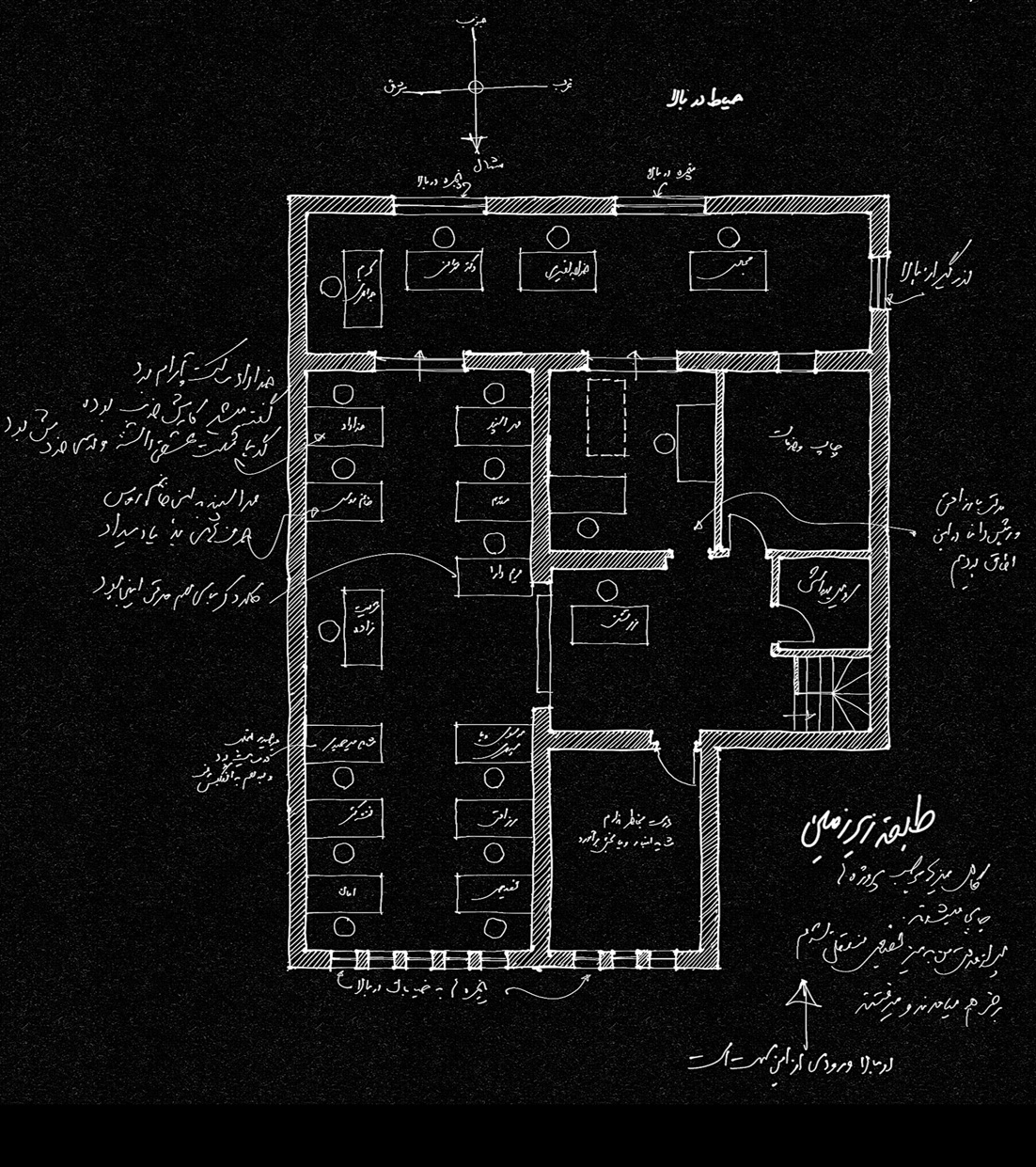
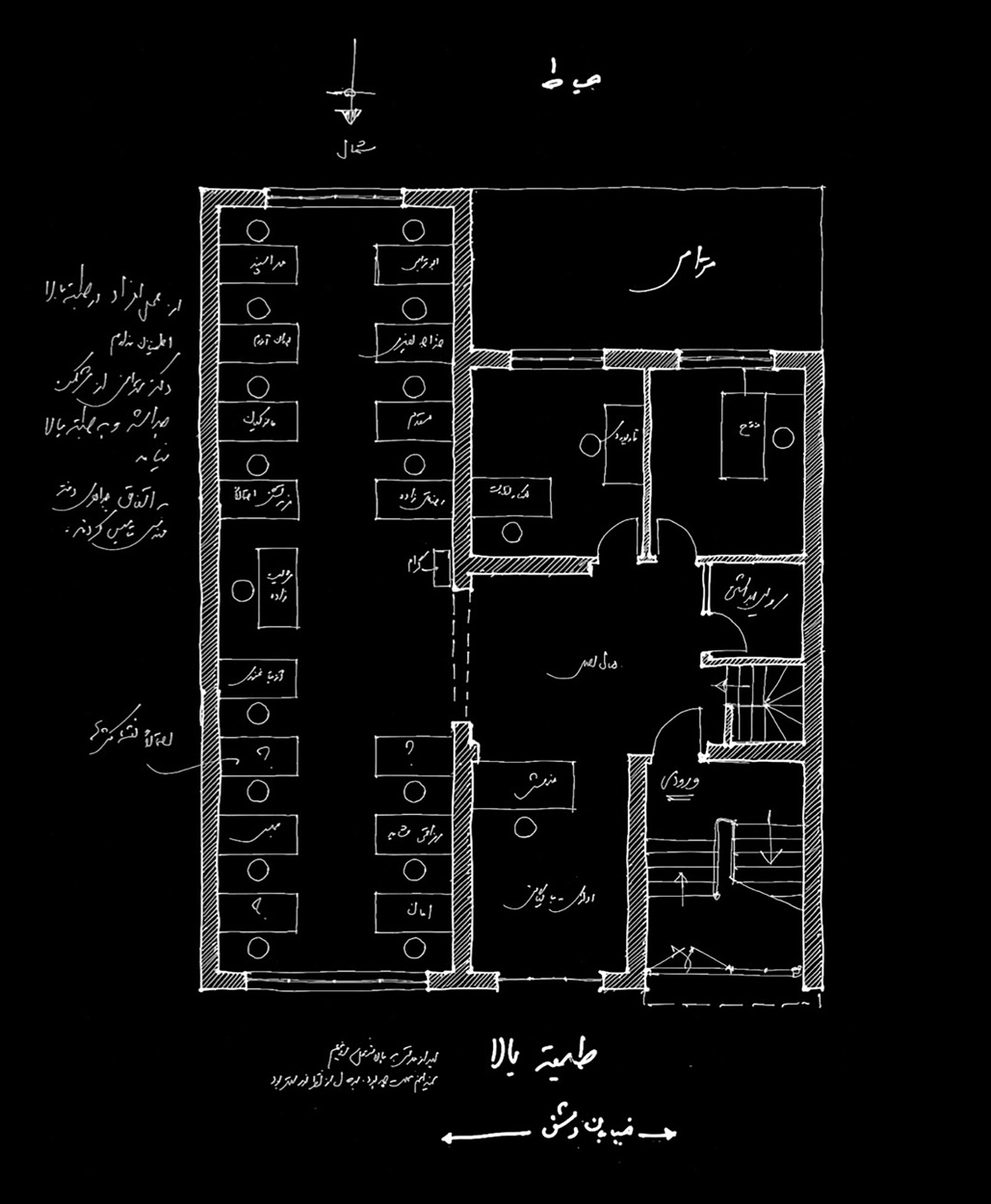
It was a two-storey building. The ground floor was a few steps above the sidewalk level, and on entering one came to a relatively large hall with the secretary's desk. The office of Engineer Monaqqeh, the company's managing director, was on the same floor, along with a few other rooms and a large hall, which was mostly devoted to the services and technical departments.
The architecture section was in the basement, accessible through an inconvenient half-circle staircase from the entrance hall. Without proper light, only a few street-level skylights on the north side and a few small windows on the south side toward the courtyard provided limited light and natural ventilation. At the bottom, the staircase ended in an entry vestibule exactly similar to the floor above, where Manouchehr Zartoshti, the manager of the atelier, also had his desk. Opposite this stair, on the other side, was the hall — the main atelier — with two rows of work-desks on either side. Just at the entry of this hall, Shariatzadeh's desk, unlike the others, faced the vestibule. To the right of the vestibule, one or two more rooms led to a narrow and relatively tall space, perpendicular to the main hall, and at its end three steps connected them to one another. Dr. Mohammad Tehrani — a well-known architect, an artist, and a former teacher at the National (Shahid Beheshti) University — was at this location, and Karim Javaheri was with him as well. Javaheri later, together with others, founded the Iran-Arc firm. In that space there were also two more desks, one of which was assigned to me.
Among the other important figures of that time, Engineer Mohsen Mirheydar was always on the move and very active; later, he became the managing director of the firm. Sirous Fasihi, an old hand at the faculty, was also there. Mir Hossein Mousavi, who was a student at the time, came there for a period, but his work ended after a few months. Sepehri Moghaddam — as the first graduate of the architecture faculty of the National University — was present at the office for two or three months. Together with thanks, I must also remember Alireza Aman, who helped me a great deal. He was a very skilled, thoughtful, and capable architect, who later — along with founding and participating in several architectural offices — mostly engaged in executive work. As I recall, the staff of the architectural atelier numbered about twenty to twenty-five.
At that time, drafting in the faculty was done with a Graphos pen and Trelinger compasses, and in architectural offices a rapidograph — which had a needle-like nib — and Chinese ink or Pelikan ink were used. The first thing that astonished me was that there was no sign of these instruments in this office, and the drawings were done on tracing paper with apparently ordinary pencils. On each desk there was a tabletop pencil-sharpener; a number of graded pencils were sharpened together and put into use simultaneously. This method was much more convenient and even more accurate than the pen — though, of course, it needed some practice and skill. In fact, contrary to what was common, the drawings did not have to be drawn twice, which increased efficiency. Later I learned that in architectural offices in America too, such a method was used.
From the very beginning, I understood that the faculty was simply focused on familiarising us with preliminary design, and that the real world was something else. At that time, the Tabriz machine-making factory was a major project of the office, and I — like many other colleagues — was put to work on it. The administrative and service buildings of the project, which were more attractive in terms of design, were in the hands of Dr. Tehrani and his colleagues; I had neither the chance nor the expectation. The industrial section of this design was being prepared in cooperation with an engineering office from one of the Eastern-Bloc countries (I believe Romania); right there I became aware that I had to improve my English-language skills. Out of necessity, and given the nature of the work, I was compelled to increase my technical information, and I was mainly engaged with the constructional details of the factory building — which was of steel structure — and this in itself had a great instructive aspect for me. Matters such as connections, weatherproofing and rainwater drainage, accesses, and safety considerations, and the like, were a world that we had never become familiar with in the faculty. I had to compensate for the gaps in my knowledge by inquiry, by studying earlier existing examples, and by referring to source materials.
Older colleagues had many examples of Shariatzadeh's ability (apart from the matter of design) in the field of acoustics and lighting, and they praised him; to us, the younger ones, he seemed an exceptional phenomenon. Given that he had a serious belief in the convergence of form and function, the way these results materialised in the design seemed extremely attractive to me. This subject continued in the next project — the Tabriz tractor-manufacturing complex — and for me became, in practice, like a period of serious learning and education. The way light was brought from the ceiling to the great halls of the factory in order to create uniform light and to avoid casting shadows on the equipment; the placement of windows so that the workers would not feel imprisoned and would have a pleasant view; the resolution of the problem of leading rainwater from the sloped roofs of these vast spaces, given the freezing, snow, and severe blizzards of the Azerbaijan climate; and many similar challenges had a serious effect on the design and demanded particular inventive solutions, whose principal idea most often issued from Shariatzadeh's mind.
I was, on one side, engaged with becoming acquainted with — or better said, learning — details such as the calculation of the size of the gutters (London-style guttering) of sloped roofs and the constructional details of connections; and on the other side, with the matters of large-scale design such as the form of the hall covers and the adjacencies of functions related to the production line, and so on. All of this was a university-level course. Becoming acquainted with reference books such as Graphic Standards or Neufert, which were filled with information and design standards, seemed very new and astonishing to me. I would find again the answers to many questions that had never been raised seriously in the architecture faculty. Not that I have any objection to the way teaching was done at that time — at that time, teaching mostly emphasised the cultivation of preliminary, novel, and impressive designs rather than reliance on executive realities. In any case, in the end the product of design must be built on the ground, and one cannot stop at the drawing on paper. These very familiarities with the executive aspects of work themselves could function, in a positive way, as pretexts for innovation in design.
Some time ago, after returning to my homeland after many years, I had the opportunity to become acquainted with many of the new generation of architects. To my complete surprise and regret, I noticed that even after the passing of all this time, reference to standard reference books has not yet become customary, and there is not much familiarity with them. I recall that, in the atelier of the office, colleagues spoke with one another in whispers while at work, and sometimes Shariatzadeh would put on one of his quiet classical-music records, which gave a new energy to the atmosphere of the atelier. More than half a century has passed since that time, and I still believe that the manner of work at the Monaqqeh / Shariatzadeh office was ahead of its time in our country, and I am certain that the presence of Yousef Shariatzadeh played a very effective role in this matter.
After some time, the architecture section of the firm moved to the upper floor — I do not remember what the cause was (perhaps a reduction of some staff) — but it is certain that we had a brighter and more desirable working space at our disposal. With the completion of the industrial sections of the projects, I became engaged with the service buildings, the auxiliary buildings, and other uses as well — which led to my contacts with Shariatzadeh becoming more frequent. Engineer Mirheydar had gone to England to continue his studies, and Dr. Tehrani had also separated from the group of partners. Of course, during his time I had little experience, and I always enjoyed his bold views in architecture. Engineer Razzaghi and I were often present at the office after working hours and enjoyed conversation — and of course, mostly listening — with him, and learned much. His revolutionary personality had great attraction for us students.
During this same period, the office was engaged in the design and construction of the firm's building on Zartosht Street, which still stands at the same place. Parviz Rezagholizadeh supervised it, and the architect Shansi was in charge of the execution. Shansi was a very knowledgeable and skilled architect, and we students often consulted with him on executive matters (especially regarding brick buildings) — which was, in practice, a kind of education. I remember that around that time, a clinic project was assigned to me, which — given the special requirements of such buildings — was a serious challenge. Manouchehr Zartoshti, as someone who had command of healthcare buildings, gave me a book that helped a great deal, and I gained a good command of the details of the spaces; but I was faced with a problem from the side of design and the manner of arranging these spaces. Despite my command of the details of the spaces, I was not satisfied with the overall formation of my design, and I knew that something was off. As a result, one day I went to Shariatzadeh and laid before him everything I had. He mostly listened, and as always his speech was very brief. Speaking very little was one of his maddening characteristics. He took the documents, and the next day, first thing in the morning, I saw on my desk the folder of my documents, on which he had left for me a simple sketch of the overall formation of the design. I was overjoyed and breathed a sigh of relief. It made me release many of the constraints, and the way opened, and my outlook broadened — and this became another lesson.
The new building of the office was almost complete, and we moved there. I believe that around the same time the name of the firm changed to "Banyan." Mirheydar took on the responsibility of supervising the technical section of the firm. Monaqqeh, more than before, would drop in at the atelier. Now and then he would come to our desks — the younger ones — and offer an opinion. Of course, he was mostly engaged in obtaining work, in the firm's public relations, and also in the construction of townships on the Caspian coast. On the whole, the composition and partnership of Monaqqeh and Shariatzadeh — like two different but complementary poles — worked well, and that was the guarantor of the firm's success. In my opinion, Mirheydar too played a fundamental role in the cohesion of this bond, in maintaining it, and in its continuation.
My last project before graduating at that firm was the administrative complex of the Tabriz tractor-manufacturing design — which included a fourteen-storey building (at that time considered very tall), an amphitheatre, the staff self-service complex, and the managers' dining room. A large project, the management of which was, in practice, my responsibility — from coordination with the mechanical and electrical services sections, structure, and estimating, to the preparation of architectural execution drawings. For me, the path from being a draftsman-student to the position of supervising such a project (I was still a student at that time) had extraordinary importance, for all of which I was indebted to that group. This progress was fully confirmed for me in later experiences in other engineering offices.
I can never overlook the educational — scientific — aspect of Banyan. One day a hand-drawn sketch by Engineer Shariatzadeh of the plan of a small mosque in the town of Amol was assigned to me — on a piece of land located behind the main street, with access through a very narrow alley. It had a small minaret whose position created a problem for the plan, and I was on the verge of moving it. When the folder of Shariatzadeh's initial designs came into my hands, I saw a three-dimensional sketch which showed that the minaret, through that narrow alley (perhaps about a metre), conveyed the presence of the mosque behind it to the passers-by. For me this was a great lesson in the necessity of attention to the surroundings, the adjacencies, and their effects on the design.
Sometimes the closeness of two buildings of one project seemed questionable to everyone, and then upon reflection on Shariatzadeh's sketches — which were a reflection of his thoughts — it became clear that the reason was the mental effects of the space on the viewer or passer-by. Lessons of this sort, though they seemed small, were indicative of fundamental and different viewpoints. Sometimes I also imagined that he was experimenting with forms. The design of a residential unit in Daroos, all of whose walls were crooked and skewed and would not be brought into line by any path, together with a completely flat roof which had a uniform slope parallel to the slope of the adjacent street, set me thinking. Sometimes the designs had angles of 30 and 60 degrees — an example is this very Pir-Raz office building. At other times, rounded corners were used in the building, as in the banknote-printing house of the Central Bank or Kerman University. Later I saw a design of his in which Iranian motifs were the key to the planning of its plan. I do not know whether this was deliberate in his work, was accidental, or whether he was experimenting. Later I also collaborated with Banyan for a time, and I enjoyed being there, and learning and acquiring knowledge were still going on.
At one time the name of the Banyan firm changed to Pir-Raz, and I have heard that, although all of its great figures have departed, the same atmosphere still remains as a legacy. Probably the only person I know there is Mohsen Karimpour, who at that time, in his adolescence, was in charge of the office's ozalid printing. What I tested at Banyan, and the experience I acquired there, certainly had a serious and positive effect on my professional life, and I always consider myself indebted to those people and to that whole group; and when I assumed responsibility for the Atec firm, more or less the same model became my standard.