After writing the article “Meaning and Interpretation in Architecture,” which appeared in the last issue of Memar, I came across a piece by Alberto Pérez-Gómez whose subject, in some respects, resembled the subject of my article. In Pérez-Gómez's article, too, the discussion is about meaning in architecture, although he ventures less far. The aim of the present article is not a reply to Pérez-Gómez — though I shall try to restate the essential points of his text — but the start of a discussion with him and with those who think about meaning in architecture as he does. Of course, since in all probability Pérez-Gómez will never read my article and will not become aware of my views, my discussion may turn out to be a “tango for one”; yet I hope it will throw light on positions which Iranian readers interested in such discussions may find useful. I should repeat, again, that this article — written in connection with the previous one and in relation to Pérez-Gómez's positions — is not a rejection of all his views. If I were to liken his positions and mine to two lines — and were not criticised by Pérez-Gómez for being inclined, like him, to a modern non-Euclidean geometry — these two lines would at times run parallel, at times draw entirely apart, and at times cross.
Now, for the sake of clarity, let me restate, in brief, the essential points of Pérez-Gómez's article so that the reader of these lines can become more familiar with the line of argument.
Pérez-Gómez rests his article, as he himself openly says, on the views of Edmund Husserl (1859-1938). Husserl is one of the deepest thinkers of our century, and probably the only thinker who succeeded in disclosing the special character of this century. Most of us know that Husserl was the originator of Phenomenology — that which has been rendered into Persian as padidar-shenasi. In a word: in phenomenology, Husserl shifts the principal and primary emphasis away from Cartesian rationality and onto experiences which, despite scientific knowledge, may yet appear.
While Husserl praises and is hopeful about humanity's progress in the sciences, he holds that scientific advance — or rather scientific laws — cannot be generalised to or applied in every case. In his famous book The Crisis of European Sciences and Transcendental Phenomenology, he discusses precisely this point at length. The same points, in slightly different language and form, are more or less present in Pérez-Gómez's article. It is in the discussion of these points that my line of thought runs almost parallel to Pérez-Gómez's.
But where Pérez-Gómez extends this crisis to architecture and proceeds — by his own reckoning — to deny Cartesian rationality, the two lines part. In this connection he writes, not without significance: “The illness besetting present-day architecture can be seen as the outcome of a collision between architecture and its use of geometry, number and figure that has unfolded since the beginning of modernism…” (p. 464). This illness is especially evident in an excessive faith in mathematics, or in a more or less open functionalism.
Pérez-Gómez goes on to argue that the assumption that “the meaning of architecture springs from functionalism, from a play of compositions and forms — and is to be understood as a decorative language… or that structure is the begetter of architectural design — is the sign of architecture's transformation [from non-scientific to scientific architecture] in the past two centuries; an aim that leads only to the formularisation of architecture and only to a kind of rationalist architecture [which, in his view, has led nowhere!].”
The assumption Pérez-Gómez speaks of, in fact, has no real instance in the works of the modern period. Only Hannes Meyer — the second director of the Bauhaus after Walter Gropius — insisted on the application of mathematics in architecture and demanded that the Bauhaus students arm themselves with slide rules; but he did not last in that school, and after the fascists' assault on the Bauhaus, and the migration of some of its teachers to the United States, he fled to the Soviet Union to test his colleagues' beliefs and, after a short time — as far as my memory aids me — he died, possibly of a broken heart; for, as the poet says, so it was.
And the functionalism that Pérez-Gómez attributes to the architects of the early modern period had no real expression in the work of any of those early moderns — contrary to what Jencks habitually claims. We know that the slogan form follows function belongs to Louis Sullivan, an early modernist. He was wearied by the imitative architecture of the nineteenth century and fought it strenuously. Yet even in his work — Sullivan, who, in some sense, must be counted as the master of Frank Lloyd Wright — no such submissiveness is visible. With his fine and skilled hand he produced designs for architectural ornament that exemplify imagination and feeling.
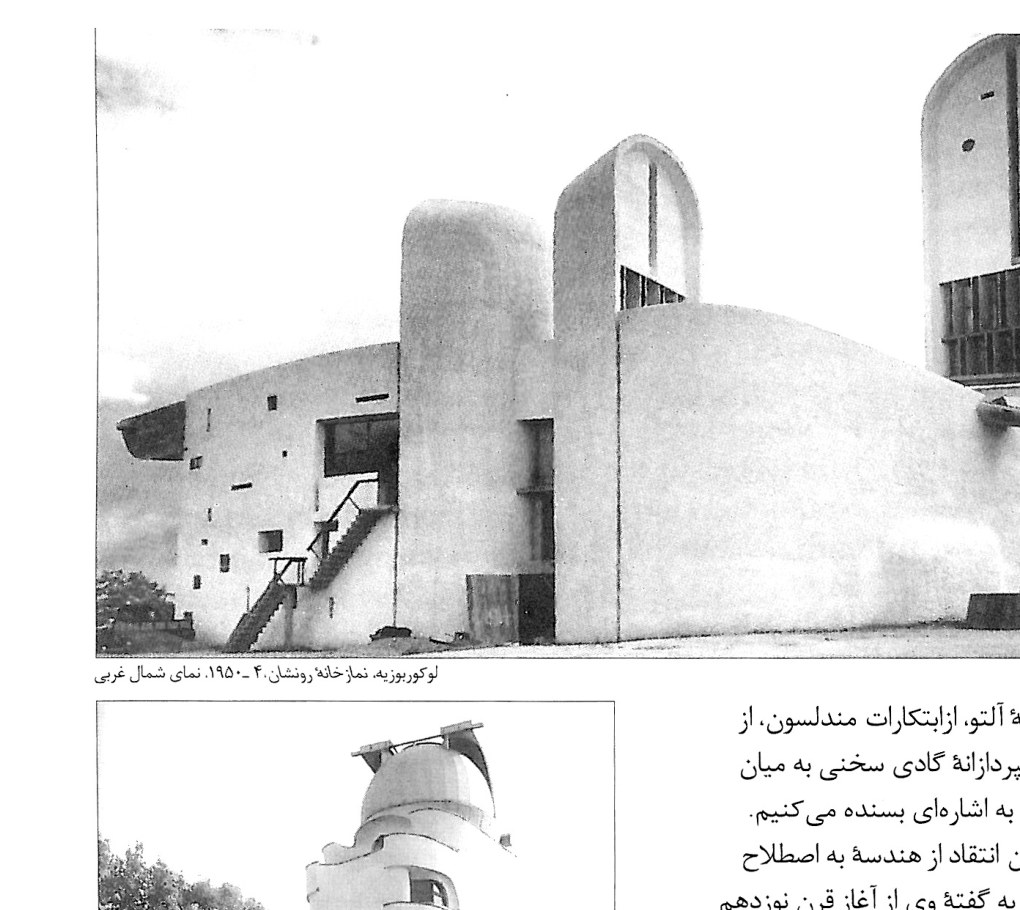
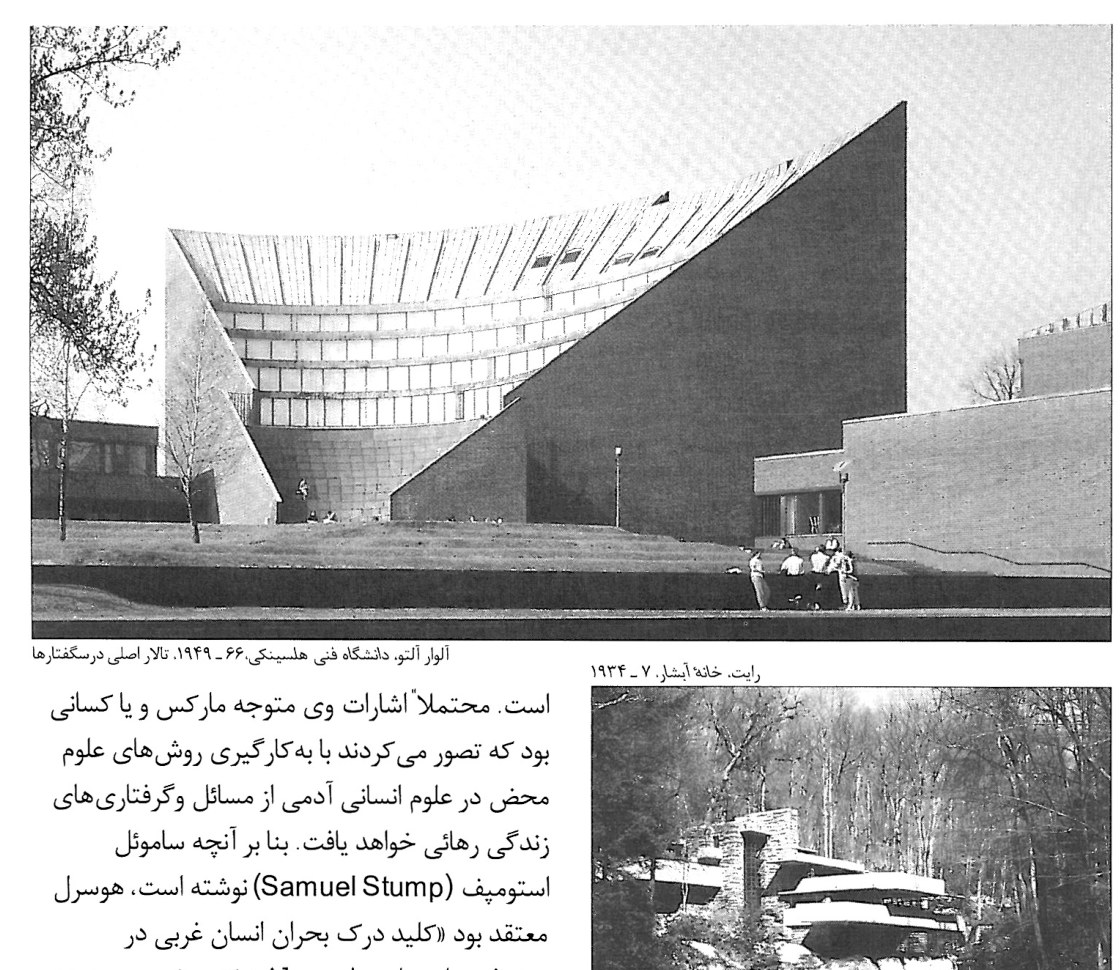
In whose work, indeed, do we see the kind of architecture Pérez-Gómez describes? In Le Corbusier? Mies? Wright? Gropius? Behrens? Hans Scharoun? Aalto? Or Gaudí? And in whose modern-architecture criticism or theory do we find any sign of it: Giedion? Benevolo? Zevi? Hilberseimer? Reimer? In this matter perhaps Christopher Alexander and his teacher Chermayeff are exceptions; but those two were not first-generation architects or critics. Their words drew the attention of architects and theorists for a time, but from the start the modernist architects paid them little heed. Alexander, despite his mathematical theories, could not produce any noteworthy architecture; one must, however, grant that his ideas served as a warning against the unbridled architecture of his time.
Even Mies's Crown Hall, which may have a modern look, is, for various reasons, not properly suited to its function — an architecture school. What made Mies van der Rohe a first-rank, far-sounding architect was his design for a glass skyscraper (1922), which goes far beyond the non-Euclidean geometry Pérez-Gómez has in mind, and is years ahead of the ordinary imagination of his contemporaries. Nor is there, in Le Corbusier's chapel at Ronchamp, any trace of the dry mathematics which, by Pérez-Gómez's account, has caused the present crisis. Of Wright's Fallingwater, of Aalto's creative designs, of Mendelsohn's daring, of Gaudí's solitary fantasy, we shall not even speak — only nod in passing.
While criticising the so-called non-Euclidean geometry — which, he says, has been current since the beginning of the nineteenth century and has caused the crisis that arose in European civilisation and now besets architecture, of which science and its child technology are principal causes — Pérez-Gómez writes, in the voice of the partisans of science: “Truth, which can [only] be displayed by way of scientific laws, builds the essential foundation upon which human decisions, beyond the realities of life, must rest” (p. 467). And then he adds that these realities are obscure and today are accessible only through poetry. I do not know where modern architecture has forgotten poetry — or had forgotten it — that Pérez-Gómez should attribute the present crisis of architecture to that loss!
Giedion, the impassioned and serious spokesman for modern architecture, speaks of the divided man of the nineteenth century. In Space, Time and Architecture, and likewise in his other book The Eternal Presence1, he holds that reason and feeling are necessary for the survival of human civilisation and culture, and probably on his recommendation the teaching of the principles of art, even to engineering students — first at Harvard and later in other American universities — became customary. Likewise at our own Sharif University of Technology, which has had and has a strongly scientific-technical orientation and most of whose teachers were Western-trained and, in a sense, modernists, this tradition was customary in the years before the Revolution: poets and artists were invited to that university to acquaint its engineering students with the principles of art.
Today, more than ever before, scientists have come to realise that scientific discoveries — whose number and reach are by no means small — have illuminated only a part of the realities, and that what is scientifically known is still extraordinarily slight when set beside the complexities and unknowns that lie before man. Let us recall that the science editor of the New York Times, some fifteen or twenty years ago, in a book entitled We Are Not Alone, wrote that science had so far [fifteen or twenty years ago] informed him of the existence of fifteen billion solar systems other than the one in which our globe lies. No scientist worthy of the name can claim — and none has claimed — to be aware of the secrets of eternity. Happy are those who do make such claims!
To the same extent that we should be aware of, sensitive to, and watchful about humanity's unknowns, we should value humanity's findings and knowledge and hold them very precious. Man, who once roamed wood and desert and fed himself on forest fruit and game, must today be grateful to his Lord that he has split the heart of the heavens, that he has, in many cases, prevailed over wild nature, that he has set in order his lonely, wandering life and may set it yet further in order — and all this by the aid of his science and reason and, of course, divine grace. So what is all this clamour against science and against reason?
Should we not see today's advances as the heralds of further knowledge — much of which has been embodied in building and architecture — toward the elevation of humanity's appointed but in no way concluded destiny? How can we today deny the importance of science and technology in architecture, or hold them to be the cause of the crisis in architecture? Reason and technology are not the cause of architecture's crisis; on the contrary, it is unreason — to which mankind, in many cases, is still subject — and the lack of the necessary and sufficient technology that are the cause of the crisis. The cause of crisis is the vast disparity between the scientific and technological knowledge and capacity of East and West, and the great disparity between strong and poor Western societies. Strong Western societies, especially after the Second World War and after the post-war interregnum, have once more found the power to bring even the costliest architectural projects into execution with the advanced technology now at their disposal, while weak societies — Eastern and Western alike — are unable even to build shelter for themselves.
Are Pérez-Gómez's words, and others like them, a denial of science and technology? Do these words mean a return to the most reactionary positions one can express? Do they mean acceptance, once more, of Platonic metaphysics, in whatever new dress? If so, one must indeed regret it, and laugh.
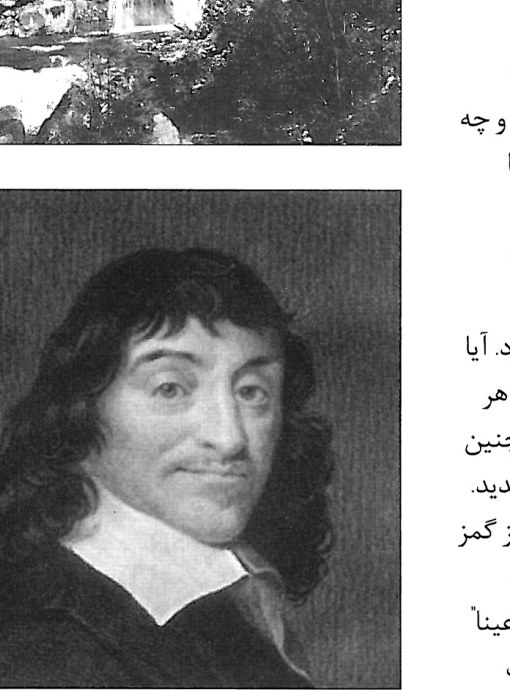
Edmund Husserl, the founder of phenomenology, on whose views Pérez-Gómez says his own thinking rests, used to say that the methods of the pure sciences cannot be applied wholesale in the social sciences. This is a true saying. He probably had Marx in mind, or those who imagined that, by applying the methods of the pure sciences in the human sciences, man would be released from the troubles and sorrows of life. According to what Samuel Stumpf has written, Husserl held that “the understanding of the crisis of Western man is hidden in the advances of the natural sciences [physics, chemistry, astronomy and the like].” But he was sharply aware of the standing of the natural sciences, and even sought to push philosophy toward firm science — not based on guess and conjecture; while warning men against employing the methods of the natural sciences in the social sciences. Husserl even says explicitly somewhere: Phenomenology must honour Descartes as its genuine Patriarch.
His remarks on phenomenology, too, have a scientific footing. So the issue is not the rejection of Cartesian rationality. The discussion turns on a manner of science that admits its own deficiency and is constantly seeking its own completion, correction and elevation. Picasso, the originator of Cubism — or one of its principal founders — has a remark about Paul Cézanne. Proud Picasso's saying about Cézanne was: “He [Cézanne] was the father of us all [the Cubist painters].” For probably Cézanne — a painter not even one of whose works was sold during his lifetime — when he broke down the view of Mont Sainte-Victoire into cubes and turned his eye, in place of customary detail, to overall masses; and when he drew a table with simple objects on it, and tilted the flat table-top more than the reality so as to disturb the objects upon it and to add the factor of time to the customary two dimensions — we see that both Husserl and Picasso, the one in the realm of philosophy and science and reason, and the other in the realm of art and painting and feeling, did not deny the rights of the pioneers who came before them.
It is the same in architecture, and so it must be. In the works of even today's most pioneering architects one can see clearly the influence of those who came before — Wright, Le Corbusier, Mies, Aalto and others; and these too were unquestionably affected by the architects who preceded them, and even by one another. Picasso once said with his usual swagger: “Yes! I steal [borrow] from others — if there is anything to steal!” There exists a photograph of him together with his sketches after the work of painters before him. One great difference between contemporary and earlier architecture is that today, beside a few first-rate architects, we have a larger number of top-flight architects — from Japan, India, Iran, South America and, of course, Europe and America and Canada. Until quite recently (and perhaps still) an Iranian architect was head of the Architects' Association of Canada; in several countries and renowned universities of the West, Iranian architects have been and are teaching — something that, decades ago, was not possible or was unlikely.
It is precisely this number of figures and nationalities that has been and is at work in steering architecture into the present crisis — if we may use that word. The West realised, from the late nineteenth century onward, that it was not having the last word in art, and the principles of classical culture, which had cast their shadow over Europe for centuries on end, fell apart one after another. The emergence of the various schools of painting was itself a sign of this coming-to-itself of Europe, and modernism and freedom were its consequence and its sign. The truth is that the cause of the rise of crisis in the West — indeed throughout the world — is not modernism, which Pérez-Gómez has so harshly criticised. The crisis has economic, social, political and even other scientific causes, in which modernism may indirectly have a share, but in no way the principal share. So one cannot, on this pretext, blame modernism — and worse still, science and technology — and seek the meaning of architecture solely in the unscientific qualities of architecture and art!
1. The Eternal Presence



