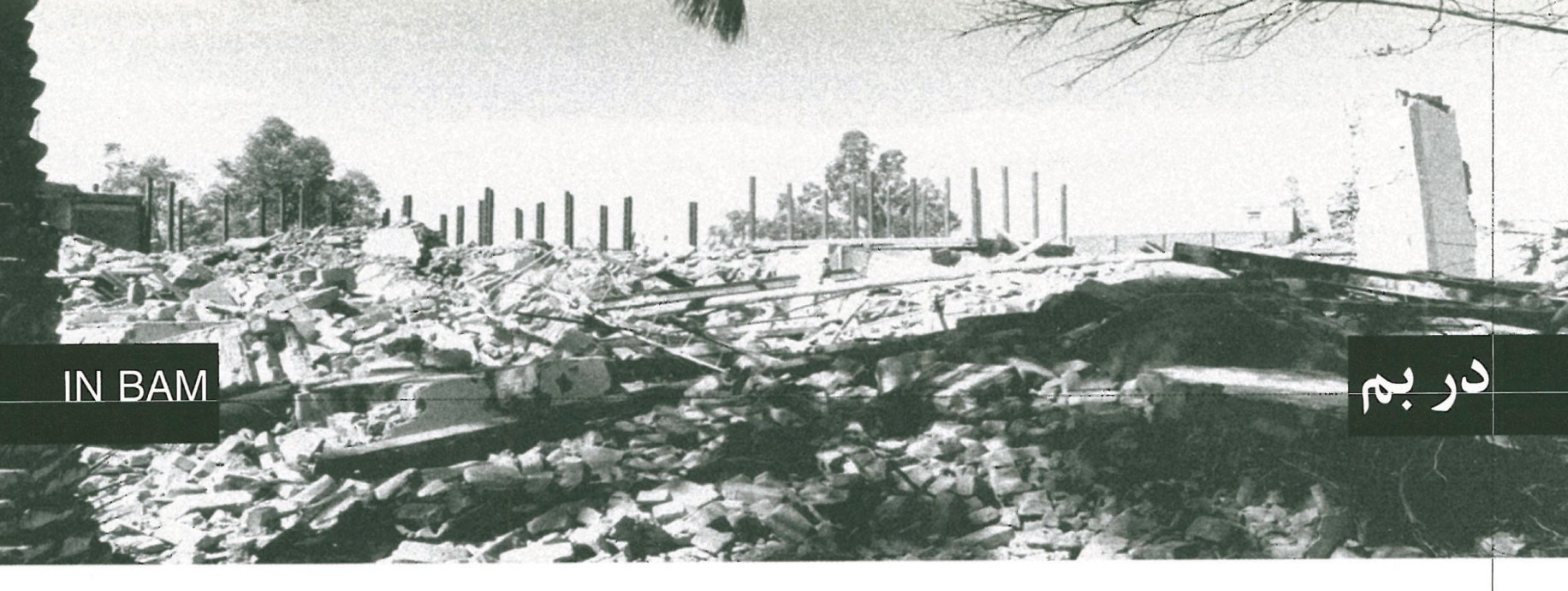
As these lines are being written, it is the tenth of Mordad 1383 (August 1, 2004) and seven months and five days have passed since the earthquake in Bam. Everyone says that what has taken shape in this devastated city is chaos; and what has not taken shape is everything else. All plans are merely on paper, and their realization has not yet begun. Nothing notable has materialized from all the meetings and conferences held. Finally, one of the residents of Bam, in a letter published in one of the newspapers, asked officials to give the people of Bam just one piece of good news to lift the spirits of the earthquake-stricken people.
According to official statistics, sixty to seventy percent of the buildings in the city have been destroyed. Some experts believe that even more than seventy percent of the area has suffered damage. Be that as it may, the earthquake has struck, and doors and windows have been shut on the center and north of the city. The majority of the buildings damaged beyond repair need to be demolished. According to one expert assessment, approximately seven hundred billion tomans is needed to rebuild the city. With the current allocation of four hundred billion tomans as an initial credit line, and considering the historical record, it will likely take seven to eight years before the city returns to its pre-earthquake state.
The housing and public infrastructure situation is serious and urgent. A group of the city's residents have already left Bam for good and settled in Kerman or other cities, and new groups are leaving. The remaining population, nearly eighty percent of the city's inhabitants, have been living in tents or temporary shelters for over seven months.
Reconstruction Plans and Challenges
Several reconstruction plans have been prepared by different organizations. Consulting engineering firms have drawn up plans at the request of the Housing Foundation and other entities, but the coordination and integration of these plans has been problematic. Different agencies are pursuing their own agendas without sufficient coordination.
The scale of destruction is immense: approximately 20,000 residential units, plus commercial, educational, and public buildings need reconstruction. Beyond the physical rebuilding, the social fabric of the city has been torn apart. Families have been scattered, communities displaced, and the historic identity of Bam—a city whose Arg (citadel) was among the world's largest adobe structures—has been gravely wounded.
From an architectural standpoint, the reconstruction of Bam presents both a crisis and an opportunity. The crisis is self-evident: thousands of families without shelter, a historic heritage site in ruins, and an economy in shambles. The opportunity lies in the chance to rebuild thoughtfully, incorporating earthquake-resistant design, preserving the architectural character of the region, and creating a model for disaster reconstruction that other cities can learn from.
The Architecture Council of Bam
An Architecture Council for Bam has been established by order of the Minister of Housing and Urban Development. The council's mission is to oversee the architectural quality and urban design standards of the reconstruction. The members of this council, representing both local and national expertise, face the monumental task of balancing speed of reconstruction with quality of design.
The council must address several critical questions: How should the historic texture of Bam be preserved while building earthquake-resistant structures? What role should traditional building materials and techniques play in the new construction? How can the identity of neighborhoods be maintained when entire blocks must be rebuilt from scratch?
The presence of the Architecture Council, though an important step, has not been without controversy. Some local builders and officials see the council's standards as obstacles to rapid construction, while architects and planners argue that without proper oversight, Bam will be rebuilt as a characterless collection of concrete boxes that bears no resemblance to the city that was lost.
The Need for Coordination
Perhaps the most pressing issue is coordination among the many actors involved in reconstruction. The Housing Foundation, the Ministry of Housing, the governorate of Kerman Province, the municipality of Bam, various consulting firms, international aid organizations, and the people of Bam themselves all have roles to play. Without a unified vision and clear lines of authority, the result is confusion, delay, and wasted resources.
The people of Bam, who have already endured unimaginable loss, deserve better than bureaucratic paralysis. Every month of delay means another month of families living in tents under the scorching desert sun. The door of Bam must be opened—opened to coordinated action, to architectural sensitivity, to the preservation of a proud heritage, and most urgently, to hope.



