In his book "The Dream Factory" (La fabbrica dei sogni), Alberto Alessi speaks of one of the largest institutions — or, better, factories — of industrial design in the field of household goods, and tells the history of its founding, its designers and its famous products. He himself, one of the most renowned industrial designers in Italy and directly responsible at Alessi for gathering the design team's ideas, gives an account and analysis of a project that, in 1979, on the firm's commission, was carried out by eleven well-known international architects. An apparently small affair, lying in the field of architecture, it tells of the freedom of action in the design of a project and of the close link between such freedom and the period of colour and post-modernism; and from the standpoint of attention to artistic reproduction, of the importance of the idea of mass production in the design of a single idea, and of the joining of hand-made industrial design with architecture, it counts as a memorable and singular movement.
The Alessi factory, producer of every kind of household article — from kettles and coffee makers to china services and even clocks and ceramics — is among the most successful industrial-design factories in Italy, with annual sales exceeding 60 million dollars. How, and over what length of time, the first small industrial workshops, from 1920 onwards, came to be transformed into great factories of machined metal, and along the same line into research-and-art workshops, is a history and a story that Alberto Alessi — son of Carlo Alessi and grandson of Giovanni Alessi, the founder of the firm in 1921 — has, in his own book, taken up with particular care and grace.
A museum named Museo Alessi was opened in 1998 in the town of Crusinallo (in the province of Novara). It covers 550 square metres and contains more than 2,000 objects made from 1920 onwards — objects from the hand of skilled designers commissioned by the firm. The Alessi Study Centre, opened in 1990 in Milan, has the task of attracting young artists and designers interested in the field.
Alberto Alessi is an industrialist with a particular outlook: he treats his trade as poetry and art, and his factory as a research laboratory for applied art — a workshop in which he, alongside outstanding designers such as Luigi Massoni, Carlo Mazzeri, Joe Colombo, Ambrogio Pomodoro and, in the 1970s, Franco Sargiani, Eija Helander, Aldo Rossi, Achille Castiglioni, Philippe Starck, Ouri Solorzano and so on, has continued his work and partnership and brought to the world's design community important and singular projects in the history of international design exhibitions. Alberto Alessi is a graduate of law and began his work at Alessi in 1970.
The Tea & Coffee Piazza project
On pages 50-52 of the book Alberto Alessi has written: "One of the fruitful undertakings of the Italian designer and artist Alessandro Mendini, in 1979, which carried in its formation and structure a particular pedagogical aspect and which in later years drew the great attention of designers, was an idea in which the Alessi company, by inviting eleven international architects, set their pure architectural art in a free and artistic confrontation around a single subject."
The subject of the invitation was the making of a classical silver tea-and-coffee tray service, made in 99 copies of each project — accompanied by the signature of the project's author and the mark of the Alessi company (99×11 services in all). The project took the name "Tea & Coffee Piazza" and was shown in 1982 in an exhibition arranged by Hans Hollein (one of the invited designers) at the well-known church of Milan, San Carpoforo.
The content and aim of the work, beyond the special collaboration of industrial designers and architects, pursued two principal subjects: 1. attention to the concept and content of "artistic reproduction"; 2. attention to, and stimulation of, international architects in their research and inquiry into the design and method of making objects.
On this Alessi has written: "Attention to these two was a subject that, for years before, had been pursued with great seriousness and zeal by Mendini, and this zeal carried two distinct messages: he had a strong wish to announce, to the lovers of this art, the height of the development and the ultimate aesthetic of the period of Bel design italiano (a period of creativity and art in Italian design beginning in 1950). And further, with this project he had set himself at a crossroads of awareness and knowledge of the original traditional methods of the past while, at the same time, drawn by the lure of new unknowns, he undertook his own projects. He felt the need of a return to the original essence of a phenomenon in design, and this fell exactly at the time when architects, in the years 1950, had begun the course of making and designing pure architectural objects."
"In truth, the bold and arresting expression in the design of these projects was contemporary with the broad current and the meaningful, powerful expression of the post-modern, and this gave me the golden chance to gather a beautiful collection of creative art with an unimaginable quality of creativity and innovation. A collection that stood in close link with the approach of the new experiences of its time — and a treasure that, years after its discovery, played an important role in the policy of producing Alessi's products. Like works or masterpieces that come into being on the path of research with great toil and effort, we owe the discovery of this phenomenon to the activities of two new designers, Aldo Rossi and Michael Graves."
The eleven projects
No. 1 — Michael Graves: Looking at Michael Graves's project from above, one is involuntarily reminded of biscuit moulds. With the use of plastic materials he has employed certain ornaments in his project that form a finely shaped and patterned composition.
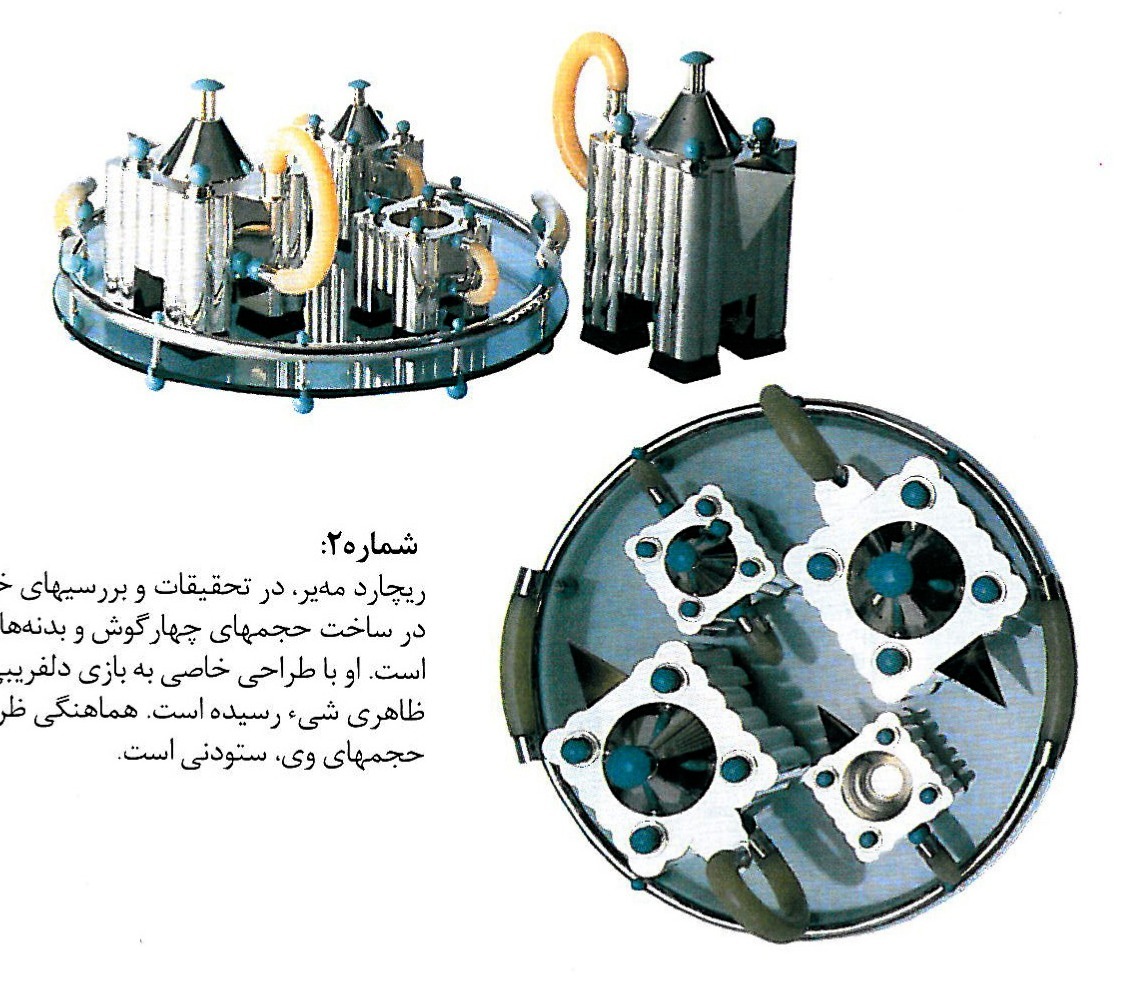
No. 2 — Richard Meier: In his investigation and inquiry, Richard Meier has reached a complex evolution in the making of rectangular volumes and rounded, projecting bodies. With a particular design he has reached a charming play between the inner and outer parts of the object. The agreement between vessel and contents in his volumes is admirable.
No. 3 — Stanley Tigerman: The illusion of small hands holding the tray, in place of the usual handles, and the half-open lips that form the rims of the teapots in Stanley Tigerman's project, are striking and worth seeing. The details with their human aspect, and the complex forms used in the handles, show a high technical daring in the making of this project.
No. 4 — Robert Venturi: In this project the objects, with curved design and a particular delicacy and grace, are arranged on a tray that calls to mind the Campidoglio square.
No. 5 — Kazumasa Yamashita: The logic, precision and grace of Japanese art is to be seen in Kazumasa Yamashita's project. The handles and grips are the first sign of respect for this artistic content.
No. 6 — Charles Jencks: The satire borrowed from post-modernism in Charles Jencks's project, and the excess and exaggeration in the use of stout columns and capitals, calls to mind something between mockery and astonishment in architecture.
No. 7 — Aldo Rossi: Aldo Rossi proves in this project all his intelligence and acuity. The tray here is turned into a small domestic altar, and the attention to medieval architecture in its making is of importance.
No. 8 — Paolo Portoghesi: Paolo Portoghesi has used hexagonal and pyramid forms — a small castle in the heart of the family and the home, for short, joyful moments. He has also provided in his tray for an ashtray, which among all the projects is to be seen only in his.
No. 9 — Alessandro Mendini: All the objects in Alessandro Mendini's project are circular. He seems to have given a fresh life and breath to the "Bombé" tea-and-coffee-tray project by Carlo Alessi, which in 1945 was one of the most renowned industrial-design objects of the Alessi house. In Mendini's tray it is as if all the objects, at every moment, wish to free themselves from the captivity of their bases and prepare for flight.
No. 10 — Oscar Tusquets: Oscar Tusquets's project is composed of two polished metal sheets joined to one another from the inside. One of the sheets, on an oblique axis along the length of the body, is bent outwards and forms the handle of the object. The convexity of the bodies and their agreement carry a particular beauty.
No. 11 — Hans Hollein: Hans Hollein has set his objects loose on a flat, even tray-surface — a surface that calls to mind the position of a propeller in a sea-going ship. He has also designed a particular vitrine (wall) for the display and presentation of these eleven projects for the Alessi house.



