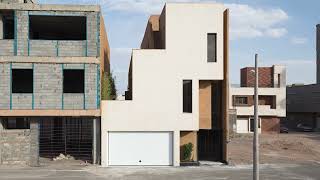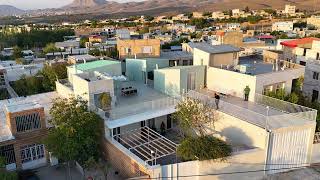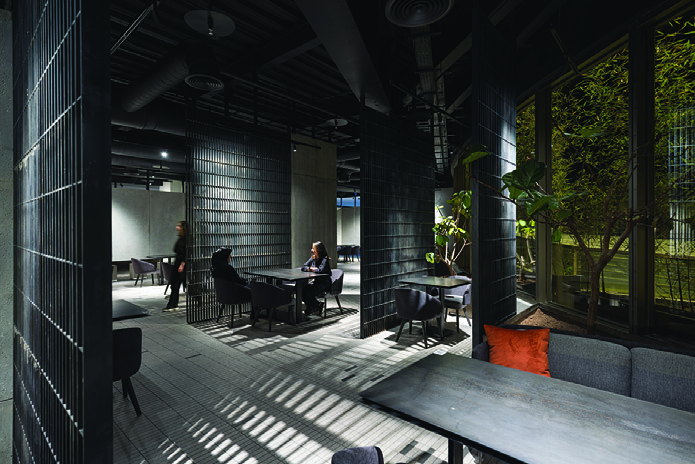
Until that day I had known Keyvan Khosravani through his caravanserai in Nain, and had heard that half a century ago he had also designed garments for Farah Pahlavi. In Memar magazine, Khosravani had appeared several times in earlier issues: first with an introduction to himself and his architectural works, and later with the presentation of two major projects — the Nain Caravanserai and the design for the prayer hall of the Grand Mosque of Paris — as well as an interview. We had also received several letters from him that spoke to his sensitivity and his close attention to Memar, the magazine.1 For months before issue 113 of Memar magazine, Keyvan Khosravani became a pretext — and a path — for me and for us to grow more familiar with him, to seek out and write about the various dimensions of an architect and an artist. For a man who has lived eight decades, the quantity of his architectural works is not imposing — but the impact of that same number of works on what came after is quite imposing. It was around those same months earlier that I saw an image on a friend's Instagram page bearing the mark of Keyvan Khosravani: a photograph of a young Keyvan in short trousers, set beside an image of a building, with a caption quoting Khosravani on the subject of his uncle's house. The building visible in the photograph was the "Khosravani Villa" — a house that Gabriel Guevrekian built around 1314 SH for the Khosravani family near Ferdowsi Square — and one of the few valuable works Guevrekian left in Iran alongside several other houses. A building which, like so many of our precious heritage, no longer exists. Before leaving Iran, Khosravani had built three buildings, of which his caravanserai in Nain is genuinely an influential work. It has been written that this building is the finest example of vernacular architecture in this land. More remarkable still is that, after fifty years, it remains the most fitting example through which to visualize vernacular architecture. To have earned the superlative "first" — with a position fixed firmly in time — is sufficient in itself. Time does not stand still but always moves forward, and so "the first" never changes. But to have carried the attributes "most fitting," "most appropriate," "most outstanding" for half a century — that is no small thing. On acquainting myself with everything Khosravani has done — not so numerous, after all — the title chosen for this issue gradually lost its color for me. "Keyvan Khosravani, vernacular architect"? He was vernacular and still is — there is no doubt about his vision of architecture as one that finds meaning through knowledge of and fidelity to indigenous Iranian tradition and authenticity. But architect? Merely because he studied architecture — and studied it well, in abundance? Because he was among Seyhoun's finest students? No, I do not believe that a mere architect could also produce the music program for Golha television.9 Could invent and create such beauty in the indigenous arts of weaving, printing, and decorating traditional textiles. Could redesign and restore, with such remarkable quality, the Paris apartment of that celebrated French writer Georges Sand — companion of Frédéric Chopin — where she wrote her novels and lived. Could also hold in his heart the children of the Gun-e Zanbourkhaneh and Oudlajan quarters? And then again — an architect who spent part of his childhood growing up in the "Khosravani Villa"?
Perhaps it is better to look upon Keyvan Khosravani in this issue as an artist: an intellectual artist with roots connected to social commitment. At some point along the road of life he no longer pursued the building of buildings — by his own account, in confrontation with the system of work distribution that he saw as corrupt. He turns toward pattern: patterns arising from the depths of tradition, patterns that have been repeated and refined over hundreds of years, each shaped and matured in some corner of this land. For hundreds of years flowers, suns, earth, and mountains were abstracted into motifs on cloth. From Osko to Isfahan to Baluchestan. Indeed — what path led Khosravani, standing beside the building of the "Khosravani Villa," to Baluchestan? Khosravani, who had already tested himself at dressmaking in Paris, took technique and art from every corner of the land to make something new upon his accumulated experience — and it was no accident that he was asked to make garments for Farah Pahlavi that would also carry a mark of this land. The young artist accomplished the work and fashioned the clothes. Garments that today reside in museums not because of their association with the queen of that era, but because of the authenticity of their pattern, their appearance, and their spellbinding beauty. A time came when Khosravani made dressmaking his livelihood — a livelihood that would put bread on the table. He rented a basement, made clothes, sold them, and his business flourished. In those days, wearing Khosravani's handmade garments in this city carried a distinction of its own — for people who were a little different from the ordinary. Remarkable as it is — we who have always made our fondness for foreigners plain and welcomed what the stranger brings — we climbed over one another to possess "Number One" Khosravani's garments. In those days when no one knew anything of branding, "Number One" Khosravani was a name and a mark unto itself. Time does not stay still — it moves forward and makes the age. Khosravani went his way, and "Number One" did not reach the next numbers. In a later era no one any longer thought of the distinction of wearing "Number One." He emigrated and went to Paris — a city where he was, in appearance, no stranger. He did not have the familiar tradition and authenticity of his homeland, but he had tradition and authenticity — only speaking a different language. He knew this city and had sketched it extensively years before. He had many familiar corners there, but no place to make clothes. He no longer played games with patterns. Time passed until a day came when some remembered an architect who had built the most vernacular building in Iran — who thought well and knew well, and was versed in tradition and authenticity. Who better than he to give an Iranian character to the prayer hall of the largest mosque in the city? With authentic Iranian design and pattern. They entrusted to Khosravani the design of the prayer hall of the Grand Mosque of Paris. He drew up the design, imprinting the indigenous tradition of his homeland in the great basement of the largest mosque in Paris — and what a beautiful thing he envisioned. But as ill fortune would have it, what we know so well today — those damned sanctions, I mean — caught the story of the prayer hall by the collar, and what should have been, was not. The largest mosque in the capital of France was deprived of an Iranian prayer hall designed by Khosravani.
It was during that same life in exile that he heard of the earthquake and the destruction. An earthquake in Bam. That left the heart aching at the sight and sound of rubble, death, devastation, and the ruin of the Arg. He put forward a design for a model school that an earthquake could not destroy — in the heart of the desert. For the tomb of that Sufi beloved of Rumi — Shams, I mean — he also drew up a design that was to be erected in Khoy, and perhaps remain as a legacy of Khosravani upon the soil where Shams is buried — but again, it was not to be. In Khosravani's words there is a perennial lament: why did no one continue what he had begun? Perhaps he himself knows better than anyone what it was he started, and how great that beginning could have been as a continuation. He speaks of the garments and the authentic traditional arts, and of how much road there was still to travel — and no one took that road. He speaks of how the garments he sewed are preserved in museums, and no one today has the power to sew them again. Of how he brought indigenous and authentic Iranian art from the corners of Osko and Hormoz to the gaze of the world — and no one grasped the magnitude of what had happened. Of how he built a structure of kah-gel (mud and straw) and it still stands sound today, doing its work properly — yet no one else built anything similar. He grieves at why we lost what we had and did not know its worth. Khosravani deserves to be known: the same Khosravani who cast light upon the walls and columns of Persepolis, and illuminated the Hafeziyeh — the tomb of Hafez — at the Shiraz Arts Festival. The same black sheep of the Khosravani family who, headstrong, brought the children of Oudlajan's back alleys to the inauguration of Niavaran Cultural Center — into the midst of the elite of the time — to preserve Oudlajan, and did preserve it.
1 Issues 29, 36, 42, 50, 55, 60, 65, 85, and 98.