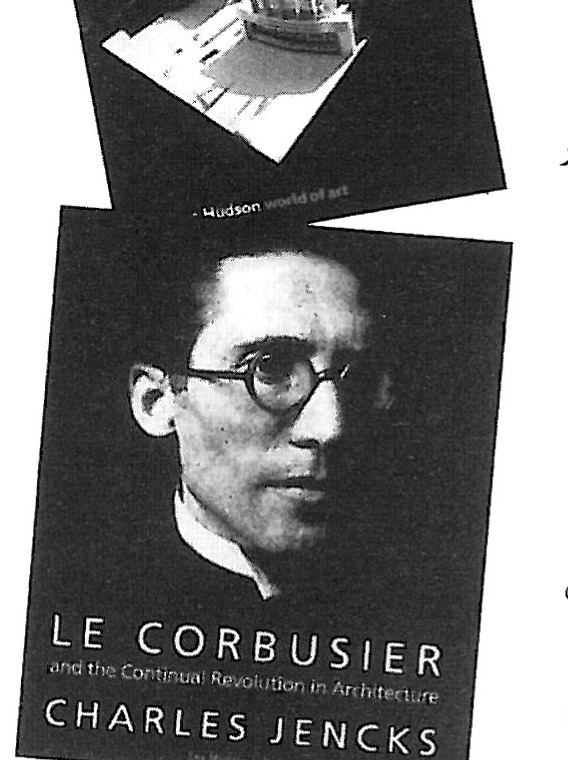
Books reviewed: Le Corbusier, by Kenneth Frampton, New York: Thames and Hudson, 2001, 240 pages, $15 (paperback). And Le Corbusier and the Continual Revolution in Architecture, by Charles Jencks, New York: The Monacelli Press, 2000, 384 pages, $50. From Architectural Record, February 2002, pages 57-58.
It is now thirty-six years since Le Corbusier's death at Roquebrune-Cap-Martin on the Mediterranean, and one is hard pressed to find a major architect who has remained outside his influence. A vast volume of writing has been done on the various aspects of his work, and the volume continues to grow; yet — quite apart from the great quantity of specialised treatises and introductions — books that approach this architect with a comprehensive grasp have been few. Le Corbusier is a subject that slips from the hand and must be wrestled with. In dealing with anything of the depth and complexity of his work, there is no place for easy or off-the-cuff description.
The author must combine wide learning, deep grasp, and fluent expression. Old findings and new readings must be brought together in a single composition and held within the cast of the author's own mental concerns. It is also of the utmost importance that the share of his predecessors in this field be properly weighed, so that the artist's place in a long span of the history of ideas and forms may be re-assessed.
Frampton: postmodernism as critical reference
For a long time, Le Corbusier has counted, for Frampton, as a critical reference. Some of his deepest writings have been on the doctrinal and political contradictions of this architect's social project. The reader is therefore not surprised by the slant of his book Le Corbusier — apparent in the foreword: 'The connection between the architect's beliefs and his conceptual intentions has been emphasised to the same extent as the realisation of the actual buildings.'
There is no harm in this approach, on condition that the buildings are also addressed in the entire poetic richness of their singularity. Le Corbusier's buildings have a singular manner in which social and private realities are equally attended to. Their singularity cannot be expressed simply in terms of the customary themes, of building types, or of 'conceptual intentions', for they oscillate between the objective and the conceptual.
Frampton's writing is so compressed that the reader feels he has been forced to keep within the strictures of the Thames and Hudson 'World of Art' series. Material from the formative years up to the Villa Schwob (1916) is dispatched in a brief chapter, and following it the 'heroic period' (the 1920s) is examined across the various scales of architecture, furniture, and urbanism. The houses and villas of Le Corbusier in this period are, too, given only a glancing reference, with hasty borrowings from other authors' analyses, with a tendency to classify the buildings according to their ideas and their building types. The reader does not gather what effect the buildings themselves have had on Frampton's feeling.
The more important sections of the book — those that take up the themes of Le Corbusier's Cité Radieuse (Radiant City) or his 'politics of the unpolitical' — read more freely. Frampton's handling of the later works — like the Unité d'Habitation in Marseille, the Ronchamp chapel, or the Capitol of Chandigarh in India — is clearer and lets the reader reflect more deeply on the interaction between ideas and the final form of the works. In the sections on the religious works and on the Poème de l'Angle Droit, the reader, beyond, attends to the spiritual and cosmic dimensions of Le Corbusier's architecture and worldview. By the end of the book, the reader has the sense that Frampton still regards Le Corbusier as a fundamental touchstone for the culture of critical modernism.
Jencks: postmodernism, hollow
Charles Jencks, in his Le Corbusier and the Continual Revolution in Architecture, tries to bring him under the banner of his own unfinished 'postmodernism'. In truth, this is no new book at all — it is a fleshed-out version of Le Corbusier and the Tragic View of Architecture (1st ed. 1937; 2nd ed. 1987). In spite of much evidence of the variety of philosophical views that bore upon Le Corbusier, Jencks insists that Nietzsche must be the key to understanding the so-called 'tragic' personality and architecture of Le Corbusier; and he extends the picture to take in 'spirituality, women, postmodern symbolism, genius, and the importance of cosmic architecture.' He tells us that these are, in the body of the book and equally in the analysis of Corbu (a profession only just born today), fresh things.
But these claims come out hollow. Take the matter of 'cosmic architecture': Jencks has many things to say about the solar symbolism of the parliament building at Chandigarh, but the sources he cites — and on which he ostensibly relies — are second-hand. The reader vainly searches for the earlier scholarship and analysis, since the footnotes are very scattered, and in any case there is no bibliography. (I cannot imagine how the Monacelli Press allowed such a thing.) In the absence of a complete first-hand study, with bricolage journalism that cobbles fragments of interpretation and fancy, this time the line has become 'cherchez la femme'.
Jencks brings many women into his imaginative narrative, giving each a particular role: Josephine Baker (the woman Le Corbusier met aboard the steamer Lutétia in 1929) suddenly becomes a 'minor goddess'; Margrit Tjader-Harris (whom Le Corbusier saw repeatedly in his 1935 trip to the United States) is turned into 'the spiritual guide, his Beatrice in directing this campaign'; Miss De Silva — 'the petite, refined Sri Lankan beauty', who, when they met in the last years of the 1940s, was in her twenties — at any rate undergoes a metamorphosis into a mythical figure who helps Le Corbusier to prepare himself for the discovery of the spiritual mysteries of 'Mother India'.
Yet there is no mention of P.L. Varma, the Punjab chief engineer who was Le Corbusier's support at every stage of his Indian work. He became Le Corbusier's close friend and shared with him his readings of India's spiritual heritage. Varma is today called 'the spirit of Chandigarh's structure'.
One of the strangest moments in the book is when Jencks dresses up the 1978 renovation project of the Chandigarh Capitol as a picture of the neo-rationalist style, claiming that, had Le Corbusier lived, he would have done exactly this. In an age when developers seek to lay hands on Chandigarh and to violate its zoning laws, such a move cannot be called wholesome amusement.
Poor Madame Le Corbusier
But all the while — even as the errant husband sketches women aboard cruise liners or, in his fancy, caresses mysterious beauties — where is poor Madame Le Corbusier? Plainly: at home, busy keeping the warm hearth of the family, and, when the grand bon homme returns home, cooking first-class food for him and his distinguished guests. Poor Yvonne Gallis — Gallis is her maiden name — on account of her death in 1957, Jencks puts forward the strange claim: 'Many French acquaintances have said that she was not a well-behaved woman.' When I read that sentence, I thought there must be a misprint, read it again, and then went to the footnotes to see who these 'French acquaintances' were. Anyway: who has said that Yvonne 'was not a well-behaved woman'? And what does all this have to do with her relation with Le Corbusier, with Le Corbusier himself, or with his architecture?
An invitation to a careful biography
The relation between an artist's life and the unfolding of forms is never straightforward, and it is naive to suppose that we can directly relate them to 'personality'. Yet Jencks takes a shortcut and somehow claims that La Tourette (= the little tower) is a picture of the architect himself. Here the reader wishes for any antidote to such a text — a text that mixes intellectual claims with marketplace prejudices. It is time that a full-fledged historian-biographer, equipped with the tools and insight peculiar to that profession, write a careful, balanced biography of Le Corbusier. Yet even then, such a book will not fully express his art — just as his art is not fully expressive of him.



